Department of International Health, Johns Hopkins University Bloomberg School of Public Health, 615 N Wolfe St, Baltimore, MD, 21205-2103, USA.
Departments of Biostatistics and International Health, Johns Hopkins University Bloomberg School of Public Health, 615 N Wolfe St, Baltimore, MD, 21205-2103, USA.
BMC Health Serv Res. 2023 Oct 17;23(1):1109. doi: 10.1186/s12913-023-10106-5.
Despite growing interest in monitoring improvements in quality of care, data on service quality in low-income and middle-income countries (LMICs) is limited. While health systems researchers have hypothesized the relationship between facility readiness and provision of care, there have been few attempts to quantify this relationship in LMICs. This study assesses the association between facility readiness and provision of care for antenatal care at the client level and facility level.
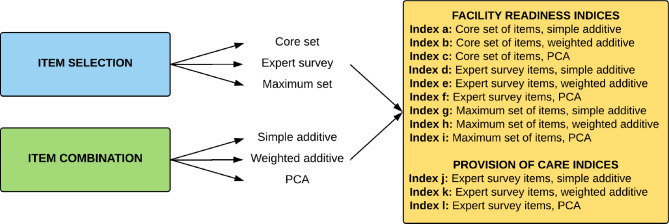
To assess the association between provision of care and various facility readiness indices for antenatal care, we used multilevel, multivariable random-effects linear regression models. We tested an inflection point on readiness scores by fitting linear spline models. To compare the coefficients between models, we used a bootstrapping approach and calculated the mean difference between all pairwise comparisons. Analyses were conducted at client and facility levels.
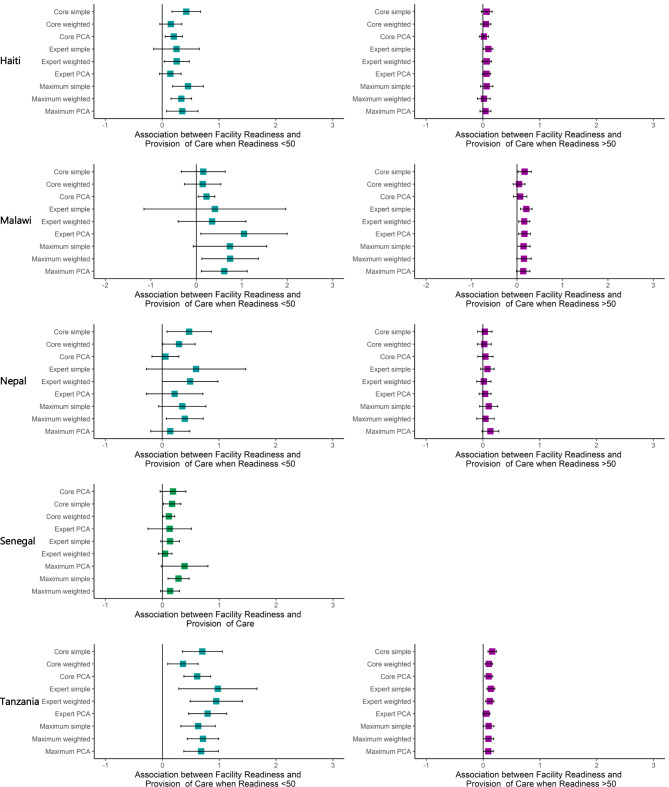
Our results showed a small, but significant association between facility readiness and provision of care across countries and most index constructions. The association was most evident in the client-level analyses that had a larger sample size and were adjusted for factors at the facility, health worker, and individual levels. In addition, spline models at a facility readiness score of 50 better fit the data, indicating a plausible threshold effect.
The results of this study suggest that facility readiness is not a proxy for provision of care, but that there is an important association between facility readiness and provision of care. Data on facility readiness is necessary for understanding the foundations of health systems particularly in countries with the lowest levels of service quality. However, a comprehensive view of quality of care should include both facility readiness and provision of care measures.
尽管人们对监测医疗质量改进越来越感兴趣,但有关中低收入国家(LMICs)服务质量的数据有限。虽然卫生系统研究人员假设了医疗机构准备情况与医疗服务提供之间的关系,但在 LMICs 中,很少有尝试来量化这种关系。本研究评估了在客户端和医疗机构层面,医疗机构准备情况与产前护理服务提供之间的关联。
为了评估服务提供与各种产前护理医疗机构准备指数之间的关联,我们使用了多层次、多变量随机效应线性回归模型。我们通过拟合线性样条模型来测试准备分数的拐点。为了比较模型之间的系数,我们使用了自举方法,并计算了所有成对比较之间的平均差异。分析在客户端和医疗机构层面进行。
我们的结果表明,在国家和大多数指数构建层面,医疗机构准备情况与服务提供之间存在着微小但显著的关联。在客户端层面的分析中,关联最为明显,这些分析的样本量更大,并且调整了医疗机构、卫生工作者和个人层面的因素。此外,在医疗机构准备分数为 50 的样条模型更好地拟合数据,表明存在合理的阈值效应。
本研究结果表明,医疗机构准备情况不能替代服务提供,但医疗机构准备情况与服务提供之间存在着重要的关联。了解卫生系统的基础,特别是在服务质量最低的国家,需要有关医疗机构准备情况的数据。然而,全面的医疗质量评估应包括医疗机构准备情况和服务提供措施。