Institute and Department of Endocrinology and Metabolism, Shanghai Ninth People's Hospital, Shanghai Jiao Tong University School of Medicine, Shanghai, China.
School of Public Health, Zhejiang University, Hangzhou, China.
Cardiovasc Diabetol. 2023 Oct 17;22(1):278. doi: 10.1186/s12933-023-02019-8.
Sodium-glucose cotransporter 2 (SGLT2) inhibitors have shown promise in reducing the risk of atrial fibrillation (AF). However, the results are controversial and the underlying metabolic mechanism remains unclear. Emerging evidence implied that SGLT2 inhibitors have extra beneficial metabolic effects on circulating metabolites beyond glucose control, which might play a role in reducing the risk of AF. Hence, our study aimed to investigate the effect of circulating metabolites mediating SGLT2 inhibition in AF by Mendelian randomization (MR).
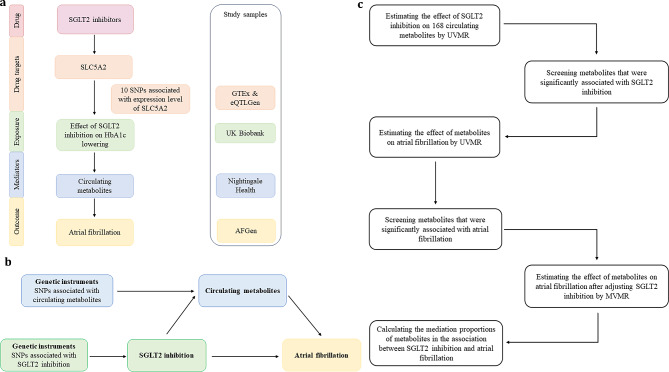
A two-sample and two-step MR study was conducted to evaluate the association of SGLT2 inhibition with AF and the mediation effects of circulating metabolites linking SGLT2 inhibition with AF. Genetic instruments for SGLT2 inhibition were identified as genetic variants, which were both associated with the expression of SLC5A2 gene and glycated hemoglobin level (HbA1c). Positive control analysis on type 2 diabetes mellitus (T2DM) was conducted to validate the selection of genetic instruments.
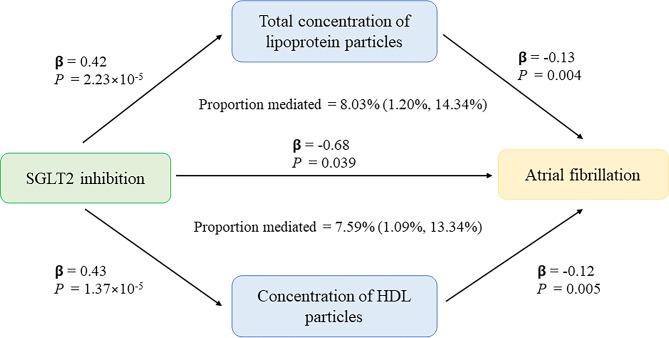
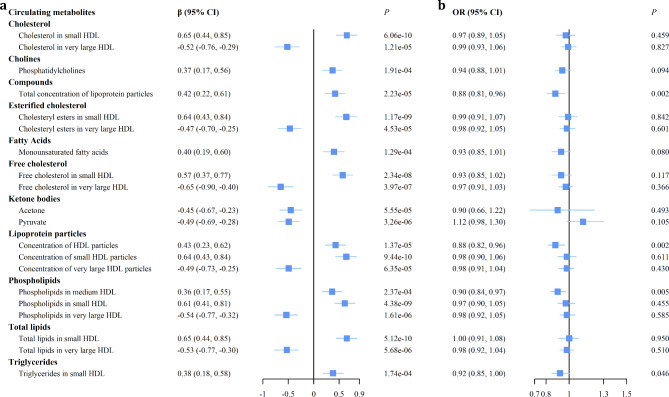
Genetically predicted SGLT2 inhibition (per 1 SD decrement in HbA1c) was associated with reduced risk of T2DM (odds ratio [OR] = 0.63 [95% CI 0.45, 0.88], P = 0.006) and AF (0.51 [0.27, 0.97], P = 0.039). Among 168 circulating metabolites, two metabolites were both associated with SGLT2 inhibition and AF. The effect of SGLT2 inhibition on AF through the total concentration of lipoprotein particles (0.88 [0.81, 0.96], P = 0.004) and the concentration of HDL particles (0.89 [0.82, 0.97], P = 0.005), with a mediated proportion of 8.03% (95% CI [1.20%, 14.34%], P = 0.010) and 7.59% ([1.09%, 13.34%], P = 0.011) of the total effect, respectively.
This study supported the association of SGLT2 inhibition with a reduced risk of AF. The total concentration of lipoprotein particles and particularly the concentration of HDL particles might mediate this association. Further mechanistic and clinical studies research are needed to understand the mediation effects of circulating metabolites especially blood lipids in the association between SGLT2 inhibition and AF.
钠-葡萄糖共转运蛋白 2(SGLT2)抑制剂已被证明可降低心房颤动(AF)的风险。然而,结果存在争议,其潜在的代谢机制仍不清楚。新出现的证据表明,SGLT2 抑制剂除了控制血糖之外,对循环代谢物还有额外的有益代谢作用,这可能在降低 AF 风险方面发挥作用。因此,我们的研究旨在通过孟德尔随机化(MR)研究 SGLT2 抑制对 AF 中循环代谢物的影响。
进行了两样本两阶段 MR 研究,以评估 SGLT2 抑制与 AF 的相关性,以及连接 SGLT2 抑制与 AF 的循环代谢物的中介作用。SGLT2 抑制的遗传工具被确定为与 SLC5A2 基因表达和糖化血红蛋白水平(HbA1c)均相关的遗传变异。对 2 型糖尿病(T2DM)进行阳性对照分析,以验证遗传工具的选择。
遗传预测的 SGLT2 抑制(HbA1c 每降低 1 SD)与 T2DM 风险降低相关(比值比 [OR] = 0.63 [95% CI 0.45, 0.88],P = 0.006)和 AF(0.51 [0.27, 0.97],P = 0.039)。在 168 种循环代谢物中,有两种代谢物均与 SGLT2 抑制和 AF 相关。SGLT2 抑制通过脂蛋白颗粒总浓度(0.88 [0.81, 0.96],P = 0.004)和 HDL 颗粒浓度(0.89 [0.82, 0.97],P = 0.005)对 AF 的影响,中介比例分别为 8.03%(95% CI [1.20%, 14.34%],P = 0.010)和 7.59%([1.09%, 13.34%],P = 0.011)。
本研究支持 SGLT2 抑制与 AF 风险降低相关。脂蛋白颗粒的总浓度,特别是 HDL 颗粒的浓度,可能介导了这种关联。需要进一步的机制和临床研究来了解循环代谢物(尤其是血脂)在 SGLT2 抑制与 AF 之间的关联中的中介作用。