IIIrd Department of Medicine - Hematology, Oncology, University Medical Center of the Johannes Gutenberg-University, Mainz, Germany.
Institute of Immunology, University Medical Center of the Johannes Gutenberg-University, Mainz, Germany.
Front Immunol. 2023 Oct 2;14:1267866. doi: 10.3389/fimmu.2023.1267866. eCollection 2023.
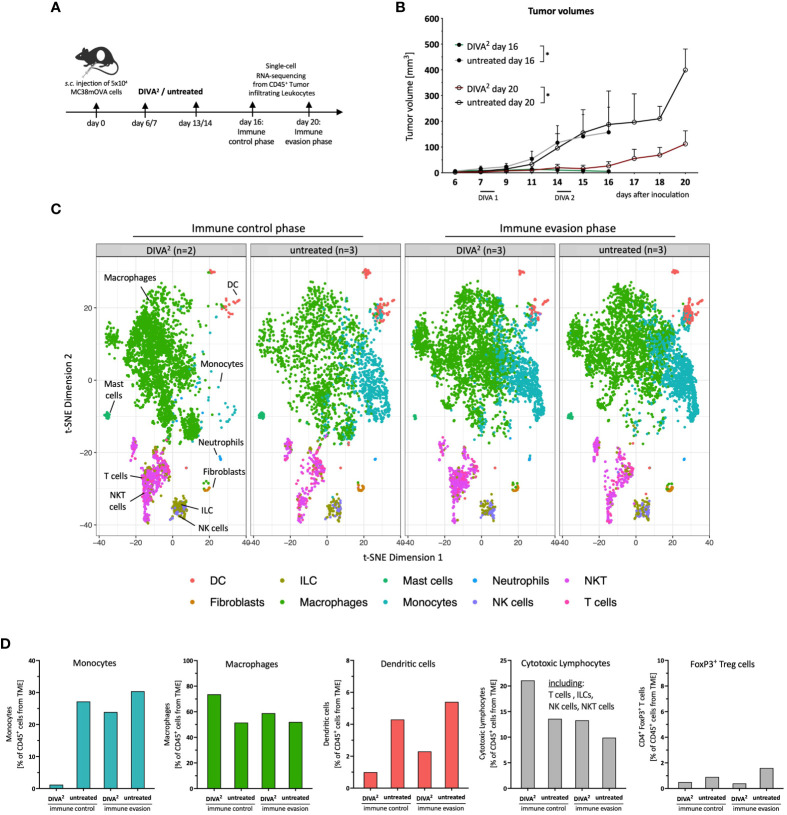
Tumor development and progression is shaped by the tumor microenvironment (TME), a heterogeneous assembly of infiltrating and resident host cells, their secreted mediators and intercellular matrix. In this context, tumors are infiltrated by various immune cells with either pro-tumoral or anti-tumoral functions. Recently, we published our non-invasive immunization platform DIVA suitable as a therapeutic vaccination method, further optimized by repeated application (DIVA). In our present work, we revealed the therapeutic effect of DIVA in an MC38 tumor model and specifically focused on the mechanisms induced in the TME after immunization. DIVA resulted in transient tumor control followed by an immune evasion phase within three weeks after the initial tumor inoculation. High-dimensional flow cytometry analysis and single-cell mRNA-sequencing of tumor-infiltrating leukocytes revealed cytotoxic CD8 T cells as key players in the immune control phase. In the immune evasion phase, inflammatory CCR2 PDL-1 monocytes with immunosuppressive properties were recruited into the tumor leading to suppression of DIVA-induced tumor-reactive T cells. Depletion of CCR2 cells with specific antibodies resulted in prolonged survival revealing CCR2 monocytes as important for tumor immune escape in the TME. In summary, the present work provides a platform for generating a strong antigen-specific primary and memory T cell immune response using the optimized transcutaneous immunization method DIVA. This enables protection against tumors by therapeutic immune control of solid tumors and highlights the immunosuppressive influence of tumor infiltrating CCR2 monocytes that need to be inactivated in addition for successful cancer immunotherapy.
肿瘤的发生和发展受肿瘤微环境(TME)的影响,TME 是由浸润和驻留的宿主细胞、它们分泌的介质和细胞外基质组成的异质性集合体。在这种情况下,各种具有促肿瘤或抗肿瘤功能的免疫细胞浸润肿瘤。最近,我们发表了我们的非侵入性免疫接种平台 DIVA,它适合作为一种治疗性疫苗接种方法,并通过重复应用(DIVA)进一步优化。在我们目前的工作中,我们揭示了 DIVA 在 MC38 肿瘤模型中的治疗效果,并特别关注免疫接种后 TME 中诱导的机制。DIVA 导致肿瘤短暂控制,然后在初始肿瘤接种后三周内进入免疫逃逸阶段。肿瘤浸润白细胞的高维流式细胞术分析和单细胞 mRNA 测序显示,细胞毒性 CD8 T 细胞是免疫控制阶段的关键参与者。在免疫逃逸阶段,具有免疫抑制特性的炎症性 CCR2 PDL-1 单核细胞被招募到肿瘤中,导致 DIVA 诱导的肿瘤反应性 T 细胞受到抑制。用特异性抗体耗尽 CCR2 细胞可延长存活时间,表明 CCR2 单核细胞在 TME 中的肿瘤免疫逃逸中很重要。总之,本研究为使用优化的经皮免疫接种方法 DIVA 产生针对抗原的强大原发性和记忆性 T 细胞免疫反应提供了一个平台。这可以通过对实体瘤的治疗性免疫控制来保护免受肿瘤的侵害,并强调了肿瘤浸润性 CCR2 单核细胞的免疫抑制影响,除了成功的癌症免疫治疗外,还需要对其进行失活。