
维甲酸诱导F9细胞分化过程中c-myc的调控是转录后水平的,且与生长停滞相关。
c-myc regulation during retinoic acid-induced differentiation of F9 cells is posttranscriptional and associated with growth arrest.
作者信息
Dean M, Levine R A, Campisi J
出版信息
Mol Cell Biol. 1986 Feb;6(2):518-24. doi: 10.1128/mcb.6.2.518-524.1986.
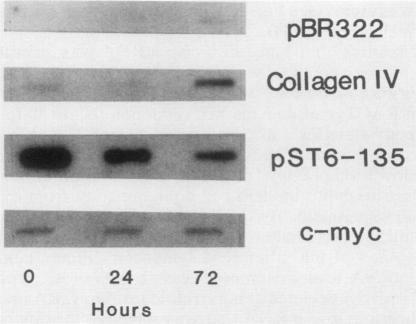
We have shown that c-myc mRNA levels decrease more than 20-fold when F9 teratocarcinoma stem cells are induced to arrest growth and terminally differentiate to parietal endoderm after exposure to retinoic acid and cyclic AMP (Campisi et al., Cell 36:241-247, 1984). Here, we demonstrate that although growth arrest and full expression of the differentiated phenotype required about 3 days, c-myc mRNA declined abruptly between 8 and 16 h after the addition of retinoic acid and cyclic AMP. The decline was independent of cyclic AMP. We found little or no change in the level of c-myc transcription during differentiation, although two other genes showed marked transcriptional regulation. Thus, decreased c-myc mRNA is a consequence of very early posttranscriptional regulation directed by retinoic acid. Differentiation was not fundamental to this regulation. We have shown that sodium butyrate blocks expression of the differentiated phenotype if added within 8 h of retinoic acid and cyclic AMP (Levine et al., Dev. Biol. 105:443-450, 1984). However, butyrate did not inhibit the decrease in c-myc mRNA. Furthermore, F9 cells partially arrested growth without differentiating when grown in isoleucine-deficient medium. Under these conditions, c-myc mRNA levels also declined. Our results suggest that induction of differentiation-specific genes may be under retinoic acid-mediated control dissimilar from that responsible for the decay of c-myc mRNA. In addition, they raise the possibility that growth arrest may be initiated by reduced c-myc expression.
我们已经表明,当F9畸胎瘤干细胞在暴露于视黄酸和环磷酸腺苷(Campisi等人,《细胞》36:241 - 247,1984)后被诱导停止生长并终末分化为壁内胚层时,c - myc mRNA水平下降超过20倍。在此,我们证明,尽管生长停滞和分化表型的完全表达需要约3天,但在添加视黄酸和环磷酸腺苷后8至16小时之间,c - myc mRNA急剧下降。这种下降与环磷酸腺苷无关。我们发现在分化过程中c - myc转录水平几乎没有变化,尽管另外两个基因显示出明显的转录调控。因此,c - myc mRNA的减少是视黄酸介导的非常早期转录后调控的结果。分化并非这种调控的根本原因。我们已经表明,如果在视黄酸和环磷酸腺苷添加后8小时内添加丁酸钠,它会阻断分化表型的表达(Levine等人,《发育生物学》105:443 - 450,1984)。然而,丁酸钠并未抑制c - myc mRNA的减少。此外,F9细胞在异亮氨酸缺乏的培养基中生长时会部分停止生长而不发生分化。在这些条件下,c - myc mRNA水平也会下降。我们的结果表明,分化特异性基因的诱导可能受视黄酸介导的控制,这与导致c - myc mRNA降解的控制不同。此外,它们还提出了生长停滞可能由c - myc表达降低引发的可能性。



 Zotero 插件