Gonzalez F J, Song B J, Hardwick J P
Mol Cell Biol. 1986 Aug;6(8):2969-76. doi: 10.1128/mcb.6.8.2969-2976.1986.
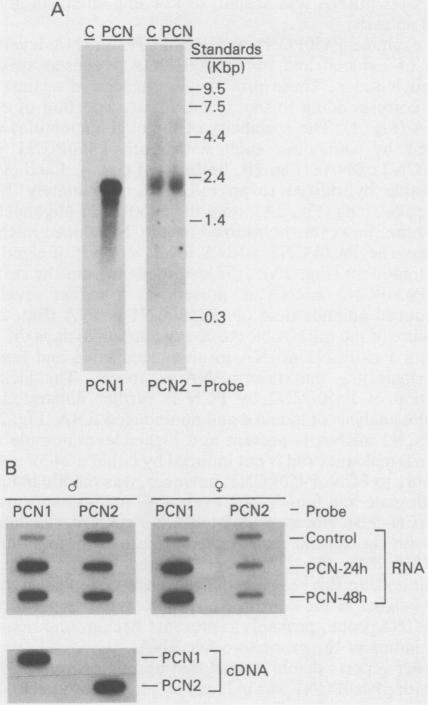
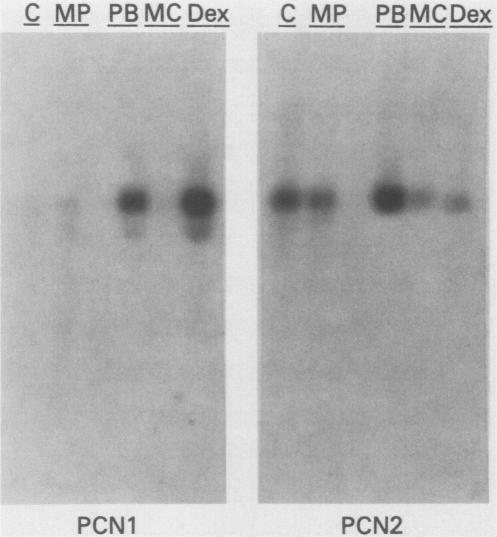
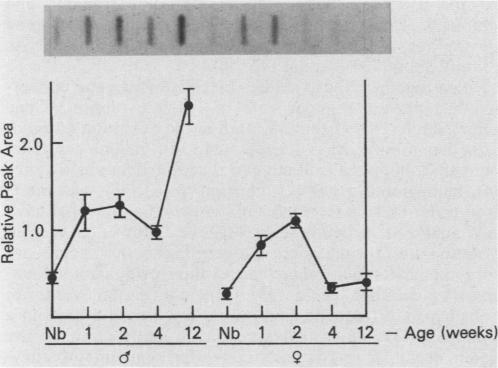
A cytochrome P-450 cDNA clone, designated pP450PCN2, homologous to the previously characterized pregnenolone 16 alpha-carbonitrile (PCN)-induced P-450 cDNA (pP450PCN1; F. J. Gonzalez, D. W. Nebert, J. P. Hardwick, and C. B. Kasper, J. Biol. Chem. 260:7435-7441), was isolated from a rat liver cDNA expression library by use of a polyclonal anti-P450PCN1 antibody. This P-450 cDNA contains 2,014 base pairs and yields an open reading frame of a protein consisting of 504 amino acids (Mr = 57,760). P450PCN2 cDNA and protein shared 90% nucleotide and 89% amino acid similarity with P450PCN1 cDNA and protein, respectively. The 5' untranslated, coding, and 3' untranslated regions between the two cDNAs share 94, 93, and 79% similarities, respectively. Nucleotide differences in the coding regions, however, are not evenly distributed. Complete homology exists between the two mRNAs for 425 nucleotides (positions 346 through 771). Other regions of 93 nucleotides containing only one difference and 147 nucleotides containing two differences exist toward the 3' end of the coding regions. These data suggest the possibility that a gene conversion event(s) have occurred subsequent to duplication of the ancestral P450PCN gene. Oligonucleotide probes unique for P450PCN1 and P450PCN2 cDNAs were used to examine the levels of their respective mRNAs in noninduced and PCN-induced liver cells and in male and female rats of various ages. P450PCN1 mRNA was not detectable in either male or female rats at any ages. In contrast, P450PCN2 mRNA was present at a low level in newborn rats and became elevated in both males and females at 1 week of age. Levels of p450PCN2 mRNA continued to increase in males until 12 weeks, whereas the mRNA in females reached peak levels at 2 weeks of age but declined continuously at the onset of puberty (between 4 and 12 weeks). These levels of P45PCN2 mRNA closely parallel the increases in testosterone 6 beta-hydroxylase activity and P450PCN2 protein level, as analyzed by Western blots. P450PCN1 mRNA was induced by PCN, dexamethasone, and phenobarbital in both male and female rats. P450PCN2 mRNA was not significantly induced by PCN or dexamethasone but was readily induced by phenobarbital. Testosterone 6 beta-hydroxylase activity was also induced severalfold by PCN, dexamethasone, and phenobarbital. These data demonstrate that P450PCN1 and P450PCN2 genes are differentially regulated during development and after administration of inducing compounds and furthermore suggest that both enzymes possess testosterone 6 beta-hydroxylase activity.
一个细胞色素P-450 cDNA克隆,命名为pP450PCN2,与先前鉴定的孕烯醇酮16α-腈(PCN)诱导的P-450 cDNA(pP450PCN1;F. J. 冈萨雷斯、D. W. 内伯特、J. P. 哈德威克和C. B. 卡斯珀,《生物化学杂志》260:7435 - 7441)同源,通过使用多克隆抗P450PCN1抗体从大鼠肝脏cDNA表达文库中分离得到。这个P-450 cDNA包含2014个碱基对,产生一个由504个氨基酸组成的蛋白质的开放阅读框(Mr = 57,760)。P450PCN2 cDNA和蛋白质分别与P450PCN1 cDNA和蛋白质具有90%的核苷酸相似性和89%的氨基酸相似性。两个cDNA之间的5'非翻译区、编码区和3'非翻译区分别具有94%、93%和79%的相似性。然而,编码区的核苷酸差异分布并不均匀。两个mRNA在425个核苷酸(位置346至771)处完全同源。编码区3'端还有93个仅含一个差异的核苷酸区域和147个含两个差异的核苷酸区域。这些数据表明,在祖先P450PCN基因复制后可能发生了基因转换事件。用于P450PCN1和P450PCN2 cDNA的独特寡核苷酸探针被用于检测它们各自的mRNA在未诱导和PCN诱导的肝细胞以及不同年龄的雄性和雌性大鼠中的水平。在任何年龄的雄性或雌性大鼠中都检测不到P450PCN1 mRNA。相比之下,P450PCN2 mRNA在新生大鼠中以低水平存在,在1周龄时在雄性和雌性中均升高。雄性中P450PCN2 mRNA水平持续增加直至12周,而雌性中的mRNA在2周龄时达到峰值水平,但在青春期开始时(4至12周之间)持续下降。如通过蛋白质免疫印迹分析,这些P45PCN2 mRNA水平与睾酮6β-羟化酶活性和P450PCN2蛋白质水平的增加密切平行。P450PCN1 mRNA在雄性和雌性大鼠中均被PCN、地塞米松和苯巴比妥诱导。P450PCN2 mRNA未被PCN或地塞米松显著诱导,但很容易被苯巴比妥诱导。睾酮6β-羟化酶活性也被PCN、地塞米松和苯巴比妥诱导了几倍。这些数据表明,P450PCN1和P450PCN2基因在发育过程中和给予诱导化合物后受到不同的调节,并且进一步表明这两种酶都具有睾酮6β-羟化酶活性。