Child Neuropsychology Section, Department of Child and Adolescent Psychiatry, Psychosomatics and Psychotherapy, Medical Faculty, RWTH Aachen University, Aachen, Germany.
JARA-Brain Institute II, Molecular Neuroscience and Neuroimaging, RWTH Aachen & Research Centre Juelich, Juelich, Germany.
Sci Rep. 2023 Oct 18;13(1):17744. doi: 10.1038/s41598-023-43847-8.
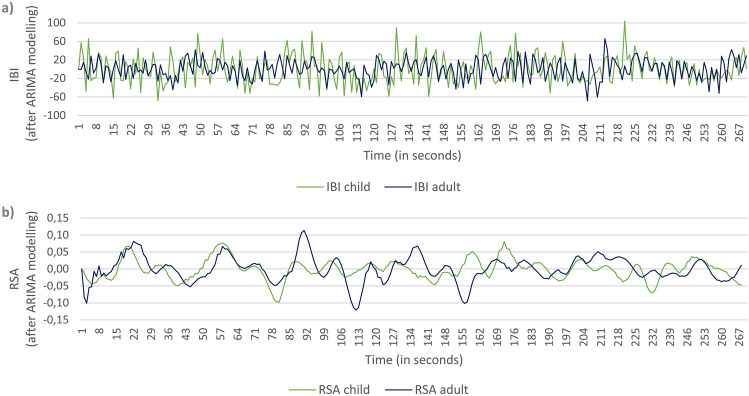
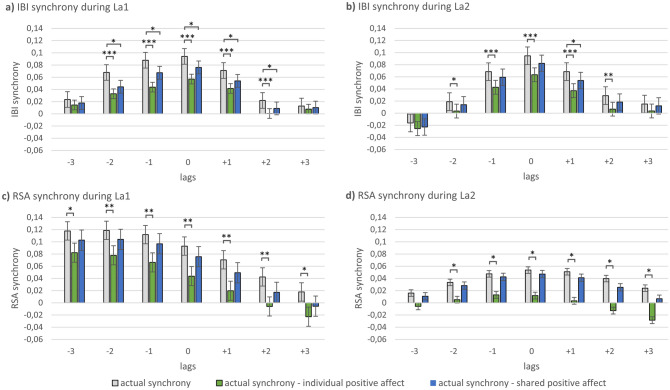
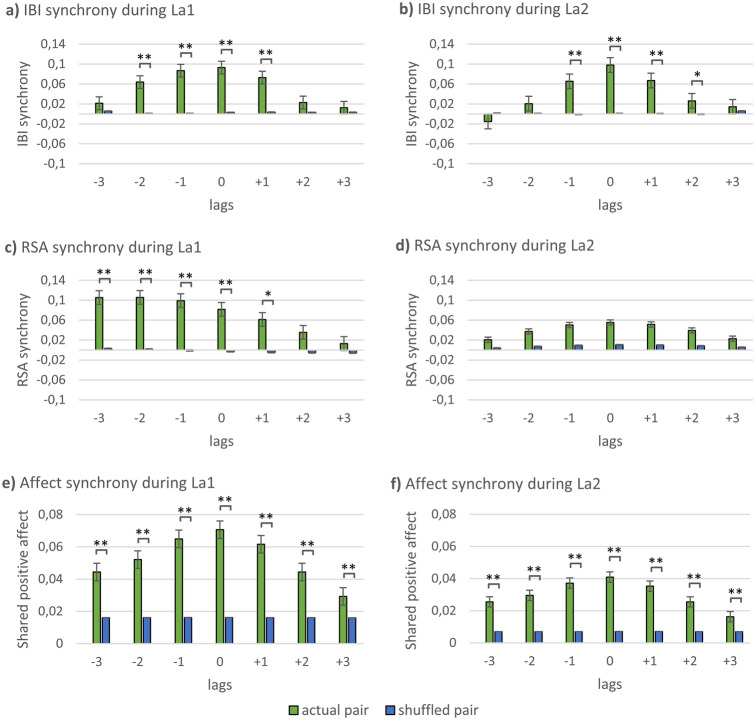
Mother-child interaction has been characterized by a fine-tuning of behavior and physiological activity. Yet, little is known about the dynamics of mother-child physiological synchrony during early school age and their associations to positive affect. To investigate these processes, 42 mother-child dyads, with children aged 8 to 10 years, played an interactive game while their interbeat intervals (IBI) and respiratory sinus arrhythmia (RSA) were measured simultaneously. IBI/RSA synchrony was calculated using cross-correlations of the IBI/RSA second-by-second time series for lags - 3 to + 3 seconds. Mother's and child's individual and shared positive affect were microcoded. During the interactive tasks, IBI and RSA synchrony significantly increased compared to control conditions. RSA and affect synchrony were significantly stronger for negative compared to positive lags indicating a stronger child leads/mother follows covariation. Further, dyad's IBI and RSA synchrony were significantly associated to mother's and child's individual positive affect. Our data suggest that in low-risk community samples, mothers may respond to their children's positive affect by matching their own affect and physiology. Investigating these temporally precise, concurrent and lagged synchrony processes may open up new avenues for understanding the ways in which parent-child interactions contribute to child developmental outcomes.
母婴互动的特点是行为和生理活动的精细调节。然而,对于儿童早期的母婴生理同步性及其与积极情绪的关联,我们知之甚少。为了研究这些过程,我们招募了 42 对母婴,孩子年龄在 8 到 10 岁之间,在玩互动游戏的同时测量他们的心率间期(IBI)和呼吸窦性心律失常(RSA)。使用 IBI/RSA 逐秒时间序列的互相关计算 IBI/RSA 同步性,滞后-3 到+3 秒。母亲和孩子的个体和共享积极情绪被微编码。在互动任务中,与对照条件相比,IBI 和 RSA 同步性显著增加。与积极滞后相比,RSA 和情绪同步性在负滞后时更强,这表明孩子的主导作用/母亲的跟随作用更强。此外,母婴的 IBI 和 RSA 同步性与母亲和孩子的个体积极情绪显著相关。我们的数据表明,在低风险的社区样本中,母亲可能通过匹配自己的情绪和生理来回应孩子的积极情绪。研究这些时间精确、同步和滞后的同步过程可能为理解亲子互动如何促进儿童发展结果的方式开辟新的途径。