Department of Nephrology, Children's Hospital of Chongqing Medical University, Zhongshan 2nd Rd.136, Chongqing, 400014, China.
Ministry of Education Key Laboratory of Child Development and Disorders, National Clinical Research Center for Child Health and Disorders, China International Science and Technology Cooperation Base of Child Development and Critical Disorders, Children's Hospital of Chongqing Medical University, Chongqing, China.
World J Pediatr. 2024 May;20(5):506-516. doi: 10.1007/s12519-023-00753-3. Epub 2023 Oct 19.
Pediatric antineutrophil cytoplasmic antibody-associated vasculitis (AAV) is a life-threatening systemic vasculitis featured by liability to renal involvement. However, there are few studies on the risk factors and predictive models for renal outcomes of AAV in children.
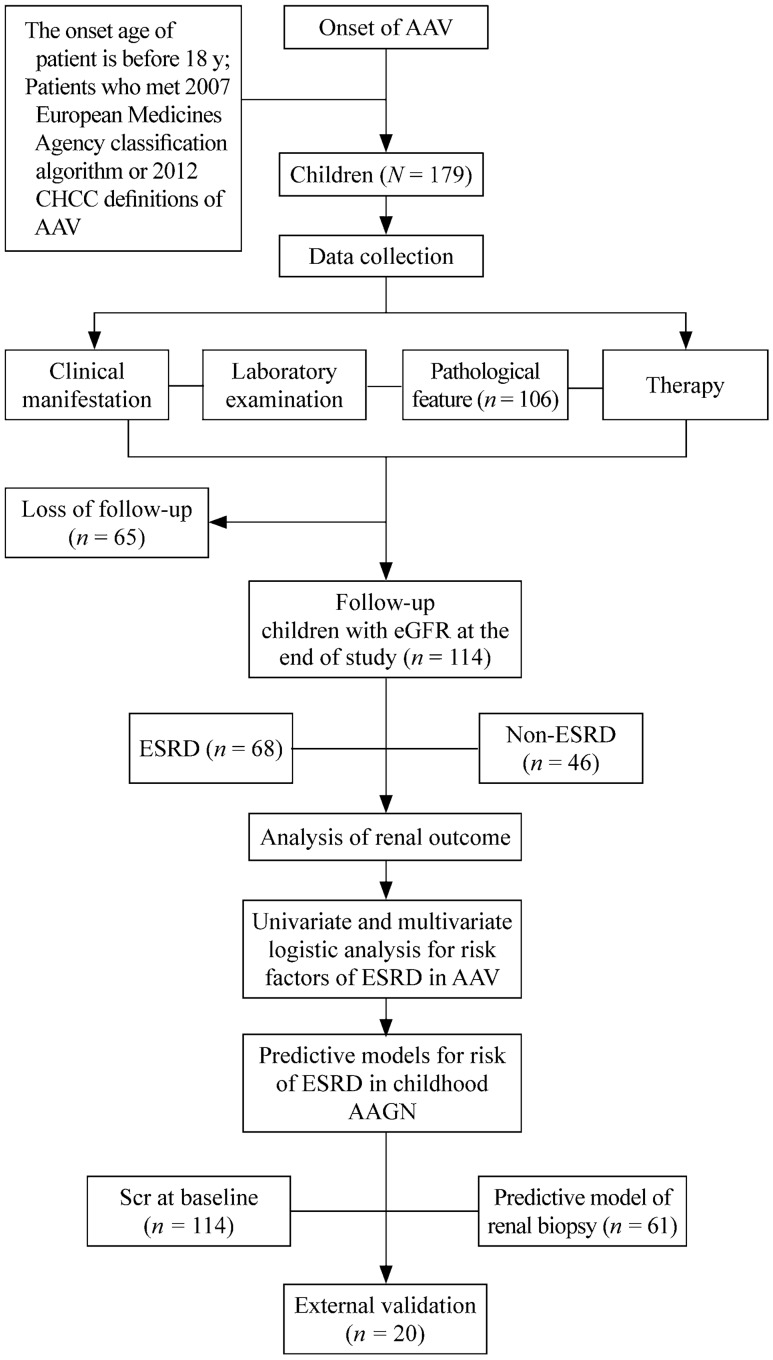
Data from 179 AAV children in multiple centers between January 2012 and March 2020 were collected retrospectively. The risk factors and predictive model of end-stage renal disease (ESRD) in AAV were explored.
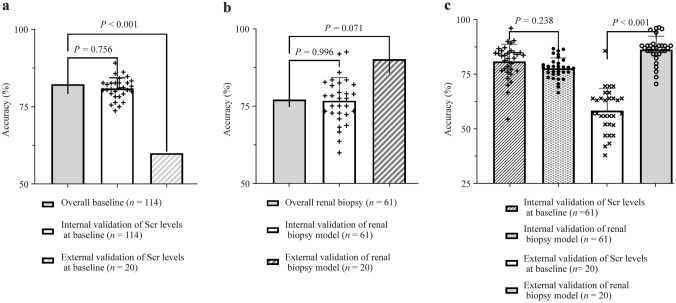
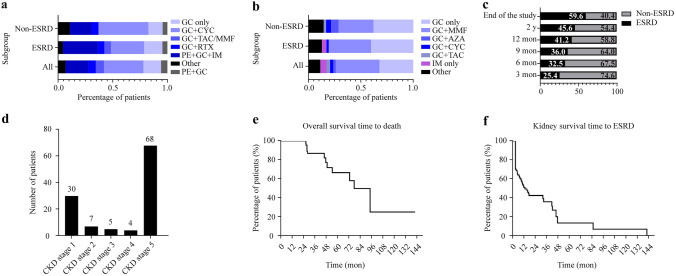
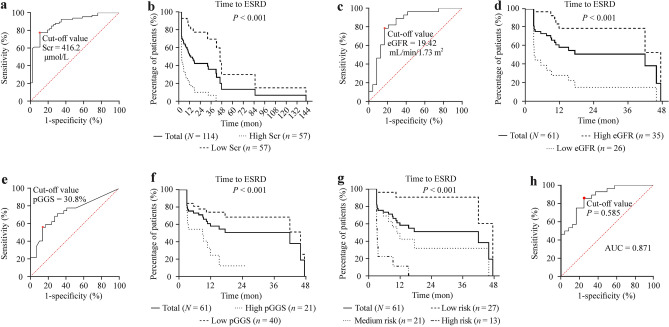
Renal involvement was the most typical manifestation (95.5%), and the crescent was the predominant pathological lesion (84.9%). The estimated glomerular filtration rate (eGFR) was evaluated in 114 patients, of whom 59.6% developed ESRD, and the median time to ESRD was 3.20 months. The eGFR [P = 0.006, odds ratio (OR) = 0.955, 95% confidence interval (CI) = 0.924-0.987] and the percentages of global glomerulosclerosis (pGGS; P = 0.018, OR = 1.060, 95% CI = 1.010-1.112) were independent risk factors for ESRD of renal biopsy. Based on the pGGS and eGFR at renal biopsy, we developed three risk grades of ESRD and one predictive model. The Kaplan‒Meier curve indicated that renal outcomes were significantly different in different risk grades (P < 0.001). Compared with serum creatinine at baseline, the predictive model had higher accuracy (0.86 versus 0.58, P < 0.001) and a lower coefficient of variation (0.07 versus 0.92) in external validation.
Renal involvement is the most common manifestation of pediatric AAV in China, of which more than half deteriorates into ESRD. The predictive model based on eGFR at renal biopsy and the pGGS may be stable and accurate in speculating the risk of ESRD in AAV children. Supplementary file 2 (MP4 18937 KB).
小儿抗中性粒细胞胞浆抗体相关性血管炎(AAV)是一种危及生命的系统性血管炎,易发生肾脏受累。然而,目前关于儿童 AAV 肾脏结局的危险因素和预测模型的研究较少。
回顾性收集了 2012 年 1 月至 2020 年 3 月期间多个中心的 179 例 AAV 患儿的数据。探讨了 AAV 发生终末期肾病(ESRD)的危险因素和预测模型。
肾脏受累是最典型的表现(95.5%),新月体肾炎是主要的病理损伤(84.9%)。114 例患者评估了估算肾小球滤过率(eGFR),其中 59.6%发生了 ESRD,中位发生 ESRD 的时间为 3.20 个月。eGFR [P=0.006,优势比(OR)=0.955,95%置信区间(CI)=0.924-0.987]和全球肾小球硬化率(pGGS;P=0.018,OR=1.060,95%CI=1.010-1.112)是肾活检发生 ESRD 的独立危险因素。基于肾活检时的 pGGS 和 eGFR,我们制定了 ESRD 的三个风险等级和一个预测模型。Kaplan-Meier 曲线表明,不同风险等级的肾脏结局有显著差异(P<0.001)。与基线时的血清肌酐相比,预测模型在外部验证中的准确性更高(0.86 比 0.58,P<0.001),变异性系数更小(0.07 比 0.92)。
中国小儿 AAV 最常见的表现为肾脏受累,其中超过一半的患儿病情恶化至 ESRD。基于肾活检时 eGFR 和 pGGS 的预测模型可能稳定且准确地推测 AAV 患儿发生 ESRD 的风险。补充文件 2(MP4 18937 KB)。