Amsterdam UMC, University of Amsterdam, Neurology, Meibergdreef 9, Amsterdam, Netherlands.
Amsterdam Neuroscience, Neurodegeneration, Amsterdam, Netherlands.
BMC Neurol. 2023 Oct 18;23(1):372. doi: 10.1186/s12883-023-03387-0.
The effectiveness of Deep Brain Stimulation (DBS) therapy for Parkinson's disease can be limited by side-effects caused by electrical current spillover into structures adjacent to the target area. The objective of the STEEred versus RING-mode DBS for Parkinson's disease (STEERING) study is to investigate if directional DBS for Parkinson's disease results in a better clinical outcome when compared to ring-mode DBS.
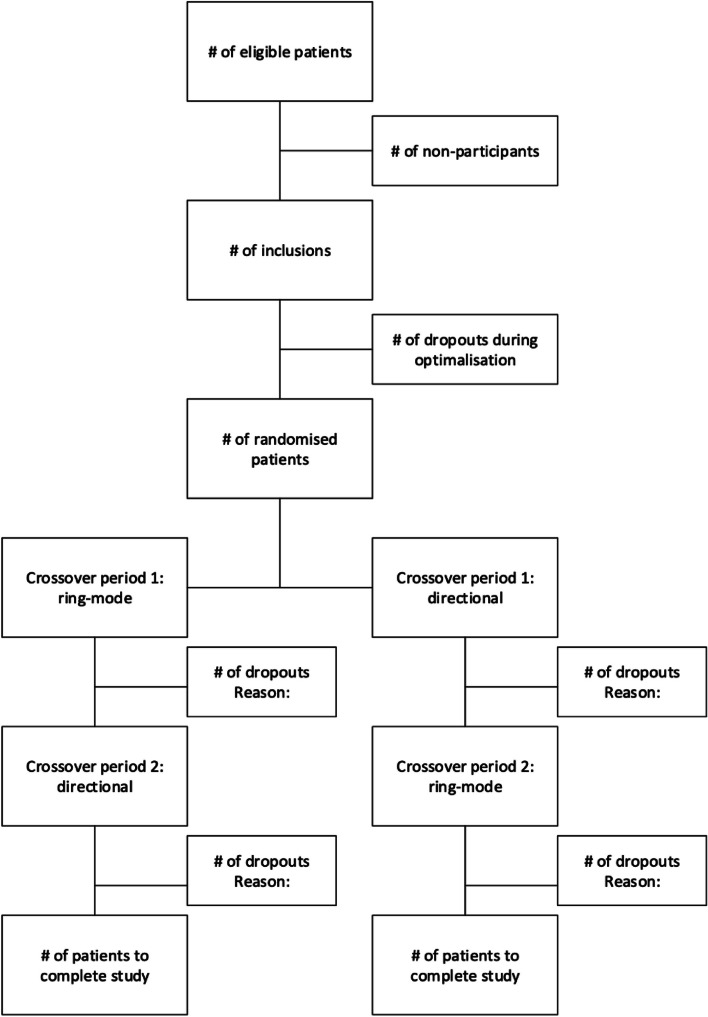
The STEERING study is a prospective multi-centre double-blind randomised crossover trial. Inclusion criteria are Parkinson's disease, subthalamic nucleus DBS in a 'classic' ring-mode setting for a minimum of six months, and optimal ring-mode settings have been established. Participants are categorised into one of two subgroups according to their clinical response to the ring-mode settings as 'responders' (i.e., patient with a satisfactory effect of ring-mode DBS) or 'non-responder' (i.e., patient with a non-satisfactory effect of ring-mode DBS). A total of 64 responders and 38 non-responders will be included (total 102 patients). After an optimisation period in which an optimal directional setting is found, participants are randomised to first receive ring-mode DBS for 56 days (range 28-66) followed by directional DBS for 56 days (28-66) or vice-versa. The primary outcome is the difference between ring-mode DBS and directional DBS settings on the Movement Disorders Society Unified Parkinson's Disease Rating Scale - Motor Evaluation (MDS-UPDRS-ME) in the off-medication state. Secondary outcome measures consist of MDS-UPDRS-ME in the on-medication state, MDS-UPDRS Activities of Daily Living, MDS-UPDRS Motor Complications-Dyskinesia, disease related quality of life measured with the Parkinson's Disease Questionnaire 39, stimulation-induced side-effects, antiparkinsonian medication use, and DBS-parameters. Participants' therapy preference is measured at the end of the study. Outcomes will be analysed for both responder and non-responder groups, as well as for both groups pooled together.
The STEERING trial will provide insights into whether or not directional DBS should be standardly used in all Parkinson's disease DBS patients or if directional DBS should only be used in a case-based approach.
This trial was registered on the Netherlands Trial Register, as trial NL6508 ( NTR6696 ) on June 23, 2017.
深部脑刺激(DBS)疗法对帕金森病的疗效可能会受到电流溢出到目标区域相邻结构的副作用的限制。STEERed 与 RING 模式 DBS 治疗帕金森病(STEERING)研究的目的是研究与 RING 模式 DBS 相比,定向 DBS 是否会导致更好的临床结果。
STEERING 研究是一项前瞻性多中心双盲随机交叉试验。纳入标准为帕金森病,丘脑底核 DBS 在“经典”环模式设置至少 6 个月,且已建立最佳环模式设置。根据患者对环模式设置的临床反应,将参与者分为两组之一:“应答者”(即,DBS 环模式治疗效果满意的患者)或“非应答者”(即,DBS 环模式治疗效果不满意的患者)。共纳入 64 名应答者和 38 名非应答者(共 102 名患者)。在优化期内找到最佳的定向设置后,参与者被随机分为首先接受 56 天(范围 28-66)的环模式 DBS 治疗,然后接受 56 天(28-66)的定向 DBS 治疗,或反之。主要结局是在停药状态下,运动障碍协会统一帕金森病评定量表 - 运动评估(MDS-UPDRS-ME)中,环模式 DBS 和定向 DBS 设置之间的差异。次要结局包括在服药状态下的 MDS-UPDRS-ME、MDS-UPDRS 日常生活活动、MDS-UPDRS 运动并发症-运动障碍、帕金森病问卷 39 测量的疾病相关生活质量、刺激诱导的副作用、抗帕金森病药物使用和 DBS 参数。研究结束时,将测量参与者的治疗偏好。将对应答者和非应答者组以及两组合并组进行分析。
STEERING 试验将提供关于定向 DBS 是否应该在所有帕金森病 DBS 患者中常规使用,还是应该仅在基于病例的方法中使用的信息。
该试验于 2017 年 6 月 23 日在荷兰试验登记处(NL6508(NTR6696))注册。