Mo Yin, Ding Ying, Cao Yang, Hopkins Jill, Ashley Elizabeth A, Waithira Naomi, Wannapinij Prapass, Lee Sue J, Ling Claire L, Hamers Raph L, Roberts Tamalee, Lubell Yoel, Karkey Abhilasha, Akech Samuel, Lissauer Samantha, Opintan Japheth, Okeke Iruka, Eremin Sergey, Tornimbene Barbara, Hsu Li Yang, Thwaites Louise, Lam Minh Yen, Pham Ngoc Thach, Pham Tieu Kieu, Teo Jeanette, Kwa Andrea Lay-Hoon, Marimuthu Kalisvar, Ng Oon Tek, Vasoo Shawn, Kitsaran Suwatthiya, Anunnatsiri Siriluck, Kosalaraksa Pope, Chotiprasitsakul Darunee, Santanirand Pitak, Plongla Rongpong, Chua Hock Hin, Tiong Xun Ting, Wong Ke Juin, Ponnampalavanar Sasheela Sri La Sri, Sulaiman Helmi Bin, Mazlan Mohd Zulfakar, Salmuna Zeti Norfidiyati, Rajahram Giri Shan, Zaili Mohd Zaki Bin Mohd, Francis Joshua R, Sarmento Nevio, Guterres Helio, Oakley Tessa, Yan Jennifer, Tilman Ari, Khalid Muhammad Osama Rehman, Hashmi Madiha, Mahmood Syed Faisal, Dhiloo Azizullah Khan, Fatima Ambreen, Lubis Inke Nadia D, Wijaya Hendri, Abad Cybele L, Roman Arthur Dessi, Lazarte Cecilia C Maramba, Mamun Gazi Md Salahuddin, Asli Rosmonaliza, Momin Muhd Haziq Fikry Bin Haji Abdul, Nyamdavaa Khurelbaatar, Gurjav Ulziijargal, Bory Sotharith, Varghese George M, Gupta Lalit, Tantia Pratik, Sinto Robert, Doi Yohei, Khanal Basudha, Malijan Greco, Lazaro Jezreel, Gunasekara Samanmalee, Withanage Sumudu, Liu Po Yu, Xiao Yonghong, Wang Minggui, Paterson David L, van Doorn H Rogier, Turner Paul
ADVANCE-ID, Saw Swee Hock School Of Public Health, National University of Singapore, Singapore, 117549, Singapore.
Division of Infectious Diseases, National University Hospital, Singapore, Singapore, 119074, Singapore.
Wellcome Open Res. 2023 Aug 16;8:179. doi: 10.12688/wellcomeopenres.19210.2. eCollection 2023.
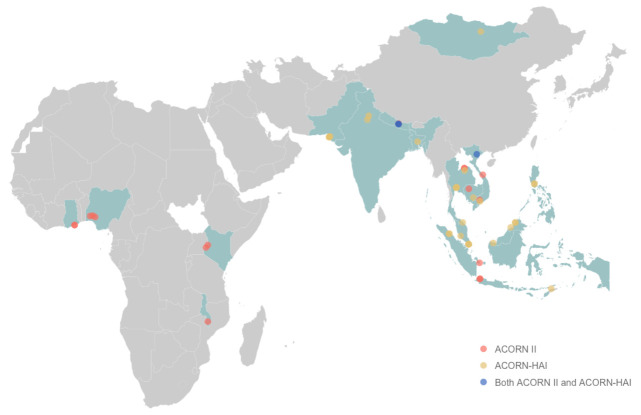
: Antimicrobial resistance surveillance is essential for empiric antibiotic prescribing, infection prevention and control policies and to drive novel antibiotic discovery. However, most existing surveillance systems are isolate-based without supporting patient-based clinical data, and not widely implemented especially in low- and middle-income countries (LMICs). : A Clinically-Oriented Antimicrobial Resistance Surveillance Network (ACORN) II is a large-scale multicentre protocol which builds on the WHO Global Antimicrobial Resistance and Use Surveillance System to estimate syndromic and pathogen outcomes along with associated health economic costs. ACORN-healthcare associated infection (ACORN-HAI) is an extension study which focuses on healthcare-associated bloodstream infections and ventilator-associated pneumonia. Our main aim is to implement an efficient clinically-oriented antimicrobial resistance surveillance system, which can be incorporated as part of routine workflow in hospitals in LMICs. These surveillance systems include hospitalised patients of any age with clinically compatible acute community-acquired or healthcare-associated bacterial infection syndromes, and who were prescribed parenteral antibiotics. Diagnostic stewardship activities will be implemented to optimise microbiology culture specimen collection practices. Basic patient characteristics, clinician diagnosis, empiric treatment, infection severity and risk factors for HAI are recorded on enrolment and during 28-day follow-up. An R Shiny application can be used offline and online for merging clinical and microbiology data, and generating collated reports to inform local antibiotic stewardship and infection control policies. : ACORN II is a comprehensive antimicrobial resistance surveillance activity which advocates pragmatic implementation and prioritises improving local diagnostic and antibiotic prescribing practices through patient-centred data collection. These data can be rapidly communicated to local physicians and infection prevention and control teams. Relative ease of data collection promotes sustainability and maximises participation and scalability. With ACORN-HAI as an example, ACORN II has the capacity to accommodate extensions to investigate further specific questions of interest.
抗菌药物耐药性监测对于经验性抗生素处方、感染预防与控制政策以及推动新型抗生素研发至关重要。然而,大多数现有的监测系统基于分离株,缺乏基于患者的临床数据支持,并且没有得到广泛实施,尤其是在低收入和中等收入国家(LMICs)。
以临床为导向的抗菌药物耐药性监测网络(ACORN)II是一项大规模多中心方案,它基于世界卫生组织全球抗菌药物耐药性与使用监测系统,以估计症状和病原体结果以及相关的卫生经济成本。ACORN医疗保健相关感染(ACORN-HAI)是一项扩展研究,专注于医疗保健相关的血流感染和呼吸机相关性肺炎。我们的主要目标是实施一个高效的以临床为导向的抗菌药物耐药性监测系统,该系统可纳入LMICs医院的常规工作流程。这些监测系统包括任何年龄的住院患者,他们患有临床相符的急性社区获得性或医疗保健相关细菌感染综合征,并接受了肠外抗生素治疗。将开展诊断管理活动,以优化微生物培养标本采集做法。在入组时和28天随访期间记录基本患者特征、临床医生诊断、经验性治疗、感染严重程度和HAI的危险因素。一个R Shiny应用程序可离线和在线使用,用于合并临床和微生物学数据,并生成整理报告,为当地抗生素管理和感染控制政策提供信息。
ACORN II是一项全面的抗菌药物耐药性监测活动,倡导务实实施,并通过以患者为中心的数据收集优先改善当地诊断和抗生素处方做法。这些数据可迅速传达给当地医生和感染预防与控制团队。相对容易的数据收集促进了可持续性,并最大限度地提高了参与度和可扩展性。以ACORN-HAI为例,ACORN II有能力进行扩展,以进一步研究感兴趣的特定问题。