Nochioka Kotaro, Shiroto Takashi, Hayashi Hideka, Inoue Takumi, Oyama Kazuma, Susukita Kai, Takahama Hiroyuki, Takahashi Jun, Shimokawa Hiroaki, Yasuda Satoshi
Department of Cardiovascular Medicine, Tohoku University Graduate School of Medicine, Japan.
Clinical Research, Innovation and Education Center, Tohoku University Hospital, Japan.
Int J Cardiol Heart Vasc. 2023 Oct 11;49:101277. doi: 10.1016/j.ijcha.2023.101277. eCollection 2023 Dec.
Limited data exist on the prognostic significance of a history of cancer and atrial fibrillation (AF) in patients with coronary artery disease (CAD). This study aimed to evaluate the associations among a history of cancer, AF, and long-term prognosis in patients with CAD.
We studied 3,233 patients with CAD (69 ± 11 years; women, 23%) in a multicenter hospital-based cohort study, the CHART-2 and related a history of cancer and AF to cardiovascular outcomes with a median follow-up of 10.8 years.
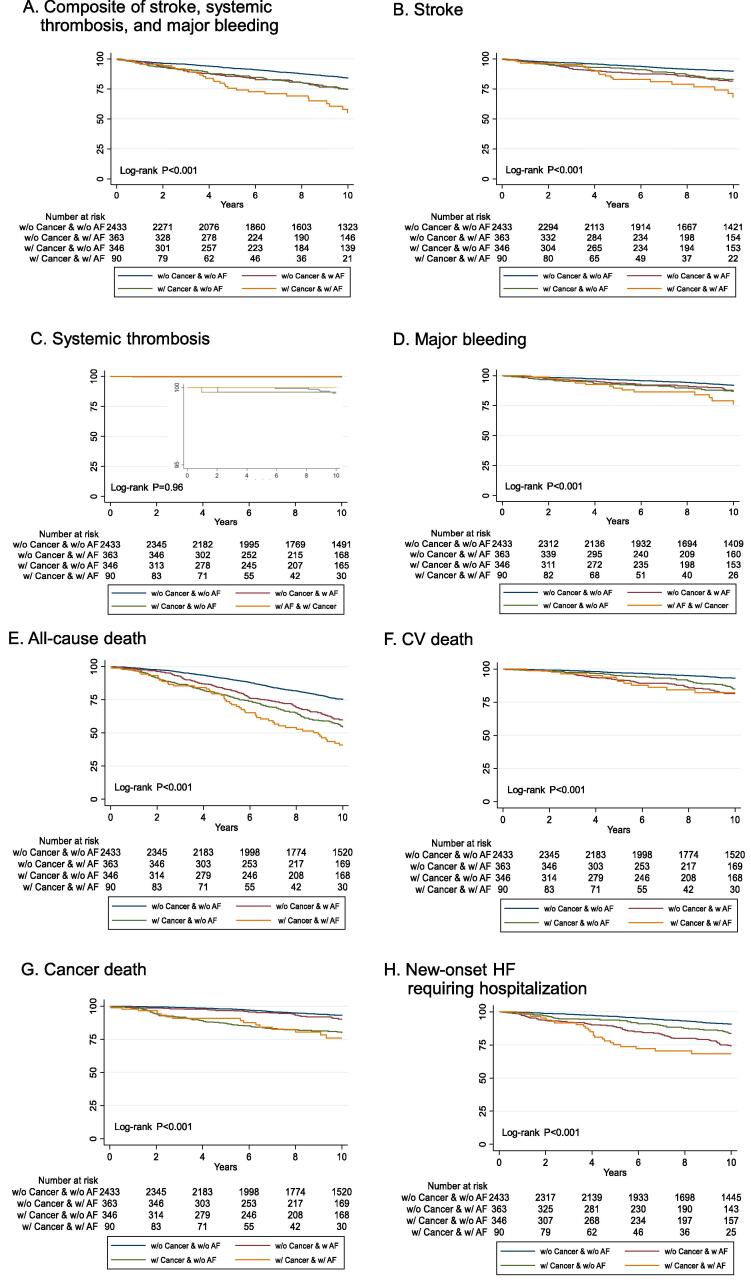
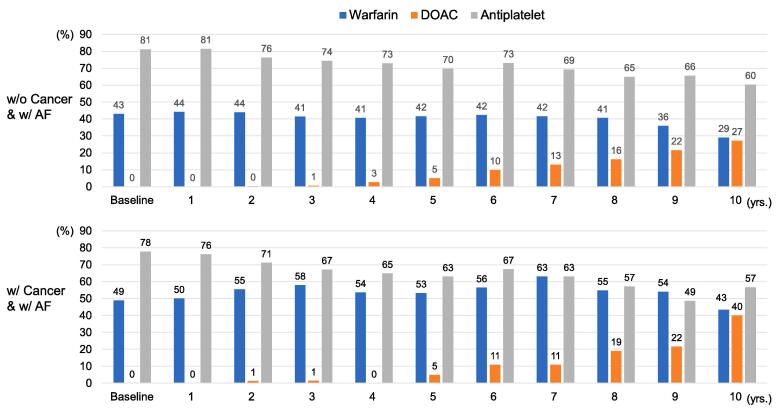
Of the 3,233 patients enrolled, 10.7% and 11.2% had a history of cancer and AF, respectively, while 2.8% had both. Patients with AF and a history of cancer were characterized by older age, male sex, and higher BNP levels. Anticoagulant use with warfarin or direct oral anticoagulants increased from 43% at baseline to 56% at 10 years in patients with CAD with AF and no history of cancer and increased from 49% to 83% in those with both. Patients with CAD with both comorbidities had a higher risk of a composite outcome including stroke, thrombosis, and major bleeding (Hazard Ratio [HR], 2.26; 1.50-3.40, P < 0.001). Furthermore, patients with both comorbidities had a higher risk of all-cause death (1.55; 95% confidence interval [CI] 1.12-2.12, P = 0.007) including cancer death (2.62; 1.51-4.54, P = 0.001), and new-onset heart failure (HF) requiring hospitalization (2.47; 1.54-3.96, P < 0.001).
These results demonstrate that CAD patients with a history of cancer and AF have an increased risk of composite outcomes, including stroke, systemic thrombosis, major bleeding, all-cause death, cancer-related death, and new-onset HF.
关于冠状动脉疾病(CAD)患者中癌症病史和心房颤动(AF)的预后意义的数据有限。本研究旨在评估CAD患者中癌症病史、AF与长期预后之间的关联。
我们在一项基于多中心医院的队列研究CHART - 2中研究了3233例CAD患者(69±11岁;女性占23%),并将癌症病史和AF与心血管结局相关联,中位随访时间为10.8年。
在纳入的3233例患者中,分别有10.7%和11.2%有癌症病史和AF病史,而2.8%两者都有。有AF和癌症病史的患者具有年龄较大、男性以及较高的脑钠肽(BNP)水平的特征。在无癌症病史的CAD合并AF患者中,使用华法林或直接口服抗凝剂的比例从基线时的43%增加到10年时的56%,而在两者都有的患者中,这一比例从49%增加到83%。CAD合并这两种合并症的患者发生包括中风、血栓形成和大出血在内的复合结局的风险更高(风险比[HR],2.26;1.50 - 3.40,P < 0.001)。此外,合并这两种合并症的患者全因死亡风险更高(1.55;95%置信区间[CI] 1.12 - 2.12,P = 0.007),包括癌症死亡(2.62;1.51 - 4.54,P = 0.001)以及需要住院治疗的新发心力衰竭(HF)(2.47;1.54 - 3.96,P < 0.001)。
这些结果表明,有癌症病史和AF的CAD患者发生复合结局的风险增加,包括中风、全身血栓形成、大出血、全因死亡、癌症相关死亡和新发HF。