Departament de Sanitat i Anatomia Animals, Facultat de Veterinària, Travessera dels Turons S/N, Universitat Autònoma de Barcelona, 08193, Cerdanyola del Vallès, Spain.
BMC Vet Res. 2023 Oct 20;19(1):217. doi: 10.1186/s12917-023-03785-z.
Vertical transmission is key for the maintenance of porcine reproductive and respiratory syndrome virus (PRRSV) infection. In vaccinated farms, vertical transmission can still occur despite sows having some level of immunity because of repeated vaccination or contact with the wild-type virus. The present study aimed to correlate the age of sows and the amplitude of neutralizing antibodies (Nab) (heterologous neutralization) with PRRSV-1 vertical transmission (VT). For this purpose, umbilical cords of 1,554 newborns (corresponding to 250 litters) were tested for PRRSV by RT-PCR in two PRRSV-unstable vaccinated farms. In parallel, the sows were bled after farrowing and the levels of antibodies were determined by ELISA and by the viral neutralization test against the vaccine virus, the virus circulating in the farm, and other unrelated contemporary PRRSV-1 strains. The relationship between the parity and the probability of delivering infected piglets and the presence of broadly Nabs examined.
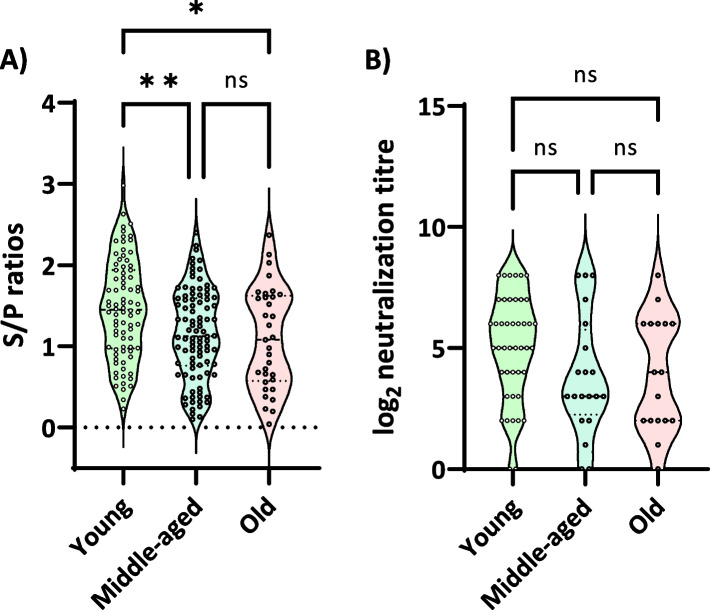
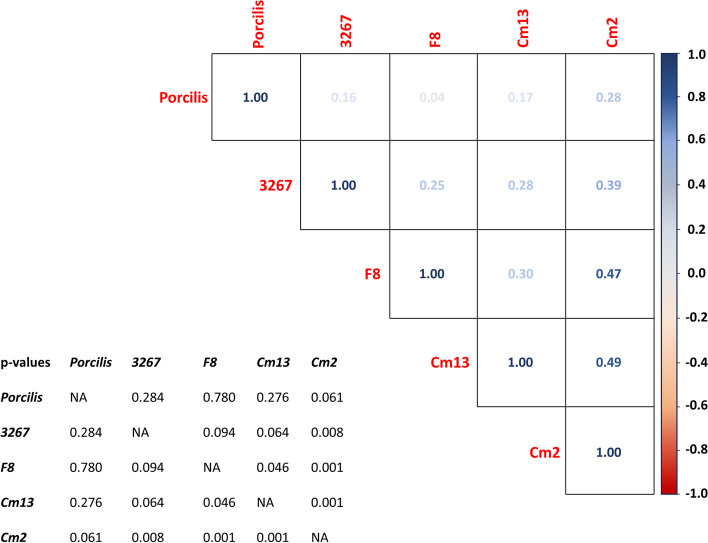
The proportion of VT events in the two examined farms ranged from 18.9% to 23.0%. Young sows (parity 1-2) were 1.7 times more likely to have VT than older sows (p < 0.05). Despite higher ELISA S/P antibody ratios in younger sows (p < 0.05), NAb against the resident farm strain were at a similar level between sows delivering infected and healthy piglets regardless of age, mostly with low titers (2-3 log). The titers of NAb against the vaccine virus were also low, and no correlations with VT were observed. When a panel of another 4 strains (1 isolated in the 1990s, and 3 contemporary strains) were used for the neutralization test, most sow sera were not capable of neutralizing the contemporary strains.
Titers of NAb could not be correlated with the occurrence of PRRSV VT. The amplitude of NAb present in most vaccinated sows is limited with a considerable proportion unresponsive regarding NAb production.
垂直传播是维持猪繁殖与呼吸综合征病毒(PRRSV)感染的关键。在接种疫苗的农场中,尽管母猪具有一定程度的免疫力(由于重复接种或接触野毒株),但垂直传播仍可能发生。本研究旨在将母猪的年龄和中和抗体(Nab)的幅度(异源中和)与 PRRSV-1 垂直传播(VT)相关联。为此,在两个不稳定的 PRRSV 接种疫苗的农场中,通过 RT-PCR 对 1554 头新生仔猪(对应 250 窝)的脐带进行了 PRRSV 检测。同时,在分娩后对母猪进行采血,并通过 ELISA 和针对疫苗病毒、农场内循环病毒以及其他不相关的当代 PRRSV-1 株的病毒中和试验来测定抗体水平。检查了产仔时感染仔猪的比例与存在广泛 Nab 的关系。
在检查的两个农场中,VT 事件的比例范围为 18.9%至 23.0%。年轻母猪(1-2 胎)发生 VT 的可能性比年长母猪高 1.7 倍(p<0.05)。尽管年轻母猪的 ELISA S/P 抗体比值更高(p<0.05),但与感染和健康仔猪分娩的母猪之间,针对常驻农场株的 Nab 水平相似,且主要为低滴度(2-3 对数)。针对疫苗病毒的 Nab 滴度也较低,与 VT 无关。当使用另一组 4 株(1 株分离于 20 世纪 90 年代,3 株当代株)进行中和试验时,大多数母猪血清不能中和当代株。
Nab 的滴度不能与 PRRSV VT 的发生相关联。大多数接种疫苗的母猪中的 Nab 幅度有限,并且相当大比例的母猪对 Nab 产生无反应。