Department of Mathematics and Statistics, University of Massachusetts Amherst, Amherst, MA, USA.
Department of Genetics, University of North Carolina at Chapel Hill, Chapel Hill, NC, USA.
HGG Adv. 2024 Jan 11;5(1):100252. doi: 10.1016/j.xhgg.2023.100252. Epub 2023 Oct 19.
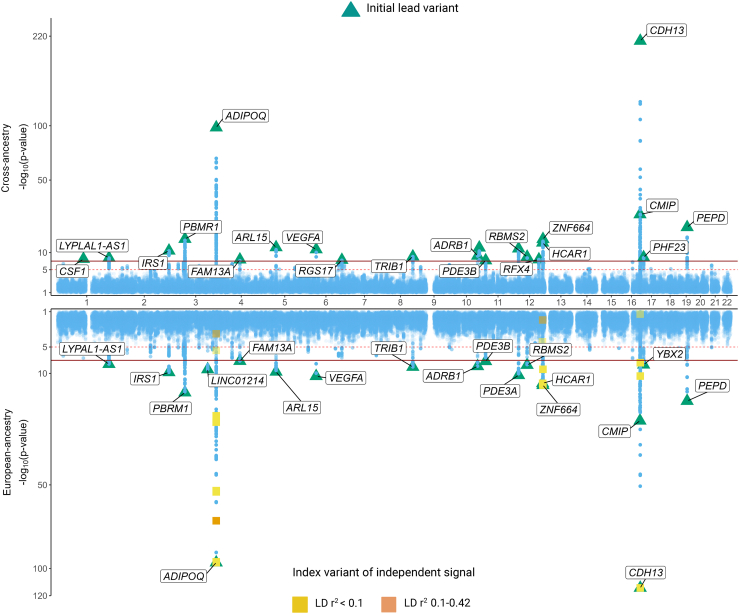
Previous genome-wide association studies (GWASs) for adiponectin, a complex trait linked to type 2 diabetes and obesity, identified >20 associated loci. However, most loci were identified in populations of European ancestry, and many of the target genes underlying the associations remain unknown. We conducted a cross-ancestry adiponectin GWAS meta-analysis in ≤46,434 individuals from the Metabolic Syndrome in Men (METSIM) cohort and the ADIPOGen and AGEN consortiums. We combined study-specific association summary statistics using a fixed-effects, inverse variance-weighted approach. We identified 22 loci associated with adiponectin (p < 5×10), including 15 known and seven previously unreported loci. Among individuals of European ancestry, Genome-wide Complex Traits Analysis joint conditional analysis (GCTA-COJO) identified 14 additional distinct signals at the ADIPOQ, CDH13, HCAR1, and ZNF664 loci. Leveraging the cross-ancestry data, FINEMAP + SuSiE identified 45 causal variants (PP > 0.9), which also exhibited potential pleiotropy for cardiometabolic traits. To prioritize target genes at associated loci, we propose a combinatorial likelihood scoring formalism (Gene Priority Score [GPScore]) based on measures derived from 11 gene prioritization strategies and the physical distance to the transcription start site. With GPScore, we prioritize the 30 most probable target genes underlying the adiponectin-associated variants in the cross-ancestry analysis, including well-known causal genes (e.g., ADIPOQ, CDH13) and additional genes (e.g., CSF1, RGS17). Functional association networks revealed complex interactions of prioritized genes, their functionally connected genes, and their underlying pathways centered around insulin and adiponectin signaling, indicating an essential role in regulating energy balance in the body, inflammation, coagulation, fibrinolysis, insulin resistance, and diabetes. Overall, our analyses identify and characterize adiponectin association signals and inform experimental interrogation of target genes for adiponectin.
先前的脂联素全基因组关联研究(GWAS)发现,脂联素是与 2 型糖尿病和肥胖相关的复杂性状,其与 20 多个相关位点有关。然而,大多数位点是在欧洲血统人群中发现的,并且许多与关联相关的目标基因仍然未知。我们在代谢综合征男性(METSIM)队列和 ADIPOGen 和 AGEN 联盟中≤46434 名个体中进行了跨种族脂联素 GWAS 荟萃分析。我们使用固定效应、逆方差加权方法合并了研究特异性关联汇总统计数据。我们确定了与脂联素相关的 22 个位点(p<5×10),包括 15 个已知和 7 个以前未报道的位点。在欧洲血统个体中,全基因组复杂性状分析联合条件分析(GCTA-COJO)在 ADIPOQ、CDH13、HCAR1 和 ZNF664 基因座鉴定了 14 个额外的独特信号。利用跨种族数据,FINEMAP+SuSiE 鉴定了 45 个因果变异(PP>0.9),这些变异也表现出对心脏代谢特征的潜在多效性。为了优先考虑关联位点的靶基因,我们提出了一种组合似然评分形式(基因优先级评分[GPScore]),该形式基于从 11 种基因优先级策略和与转录起始位点的物理距离得出的度量。使用 GPScore,我们对跨种族分析中与脂联素相关变异相关的 30 个最可能的靶基因进行优先级排序,包括已知的因果基因(例如,ADIPOQ、CDH13)和其他基因(例如,CSF1、RGS17)。功能关联网络揭示了优先基因、其功能连接基因及其潜在途径的复杂相互作用,这些途径围绕胰岛素和脂联素信号转导,表明它们在调节体内能量平衡、炎症、凝血、纤维蛋白溶解、胰岛素抵抗和糖尿病方面发挥着重要作用。总体而言,我们的分析确定并描述了脂联素关联信号,并为脂联素靶基因的实验研究提供了信息。