Elhalis Hosam, See Xin Yi, Osen Raffael, Chin Xin Hui, Chow Yvonne
Singapore Institute of Food and Biotechnology Innovation (SIFBI), Agency for Science, Technology and Research (A*STAR), Singapore, Singapore.
Food Science and Technology, School of Chemical Engineering, The University of New South Wales, Sydney, NSW, Australia.
Front Microbiol. 2023 Oct 4;14:1267227. doi: 10.3389/fmicb.2023.1267227. eCollection 2023.
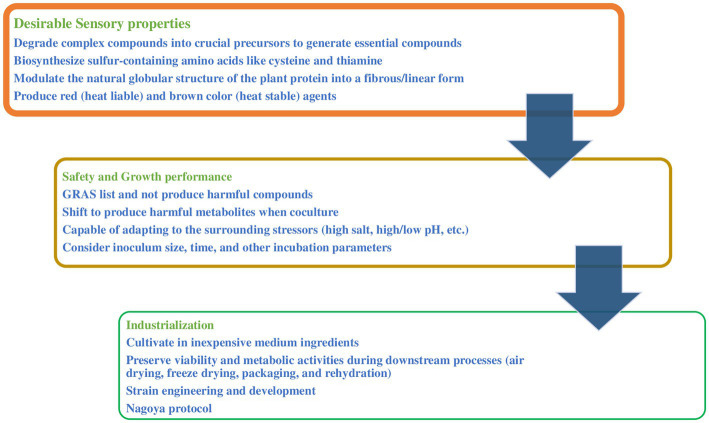
Despite the advancements made in improving the quality of plant-based meat substitutes, more work needs to be done to match the texture, appearance, and flavor of real meat. This review aims to cover the sensory quality constraints of plant-based meat analogs and provides fermentation as a sustainable approach to push these boundaries. Plant-based meat analogs have been observed to have weak and soft textural quality, poor mouth feel, an unstable color, and unpleasant and beany flavors in some cases, necessitating the search for efficient novel technologies. A wide range of microorganisms, including bacteria such as and , as well as fungi like and , have improved the product texture to mimic fibrous meat structures. Additionally, the chewiness and hardness of the resulting meat analogs have been further improved through the use of . However, excessive fermentation may result in a decrease in the final product's firmness and produce a slimy texture. Similarly, several microbial metabolites can mimic the color and flavor of meat, with some concerns. It appears that fermentation is a promising approach to modulating the sensory profiles of plant-derived meat ingredients without adverse consequences. In addition, the technology of starter cultures can be optimized and introduced as a new strategy to enhance the organoleptic properties of plant-based meat while still meeting the needs of an expanding and sustainable economy.
尽管在提高植物性肉类替代品质量方面取得了进展,但仍需做更多工作来使其在质地、外观和风味上与真正的肉类相匹配。本综述旨在涵盖植物性肉类类似物的感官质量限制,并提供发酵作为突破这些界限的可持续方法。据观察,植物性肉类类似物质地质量薄弱且柔软,口感不佳,颜色不稳定,在某些情况下还带有不愉快的豆腥味,因此需要寻找高效的新技术。包括[具体细菌名称1]和[具体细菌名称2]等细菌以及[具体真菌名称1]和[具体真菌名称2]等真菌在内的多种微生物,已改善了产品质地以模仿纤维状肉类结构。此外,通过使用[具体物质名称],所得肉类类似物的咀嚼性和硬度得到了进一步提高。然而,过度发酵可能会导致最终产品硬度降低并产生黏滑的质地。同样,几种微生物代谢产物可以模仿肉类的颜色和风味,但也存在一些问题。看来发酵是一种有前景的方法,可以调节植物源性肉类成分的感官特征而不会产生不良后果。此外,发酵剂技术可以优化并作为一种新策略引入,以增强植物性肉类的感官特性,同时仍满足不断发展的可持续经济的需求。