Muazzam Ayesha, Samad Abdul, Alam Amm Nurul, Hwang Young-Hwa, Joo Seon-Tea
Division of Applied Life Science (BK21 Four), Gyeongsang National University, Jinju 52828, Republic of Korea.
Institute of Agriculture & Life Science, Gyeongsang National University, Jinju 52828, Republic of Korea.
Foods. 2025 Jul 28;14(15):2636. doi: 10.3390/foods14152636.
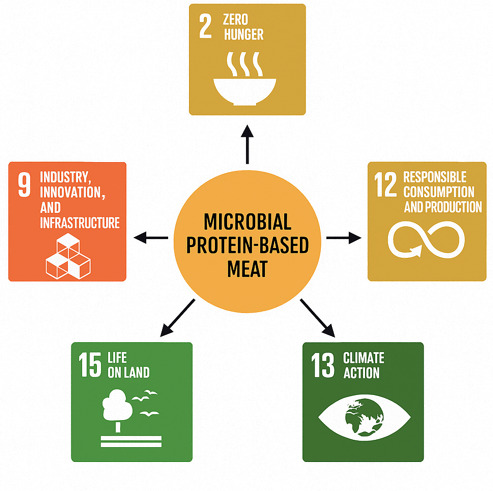
The global population is increasing rapidly and, according to the United Nations (UN), it is expected to reach 9.8 billion by 2050. The demand for food is also increasing with a growing population. Food shortages, land scarcity, resource depletion, and climate change are significant issues raised due to an increasing population. Meat is a vital source of high-quality protein in the human diet, and addressing the sustainability of meat production is essential to ensuring long-term food security. To cover the meat demand of a growing population, meat scientists are working on several meat alternatives. Bacteria, fungi, yeast, and algae have been identified as sources of microbial proteins that are both effective and sustainable, making them suitable for use in the development of meat analogs. Unlike livestock farming, microbial proteins produce less environmental pollution, need less space and water, and contain all the necessary dietary components. This review examines the status and future of microbial proteins in regard to consolidating and stabilizing the global food system. This review explores the production methods, nutritional benefits, environmental impact, regulatory landscape, and consumer perception of microbial protein-based meat analogs. Additionally, this review highlights the importance of microbial proteins by elaborating on the connection between microbial protein-based meat analogs and multiple UN Sustainable Development Goals.
全球人口正在迅速增长,据联合国预计,到2050年将达到98亿。随着人口增长,对食物的需求也在增加。粮食短缺、土地稀缺、资源枯竭和气候变化是人口增长引发的重大问题。肉类是人类饮食中优质蛋白质的重要来源,解决肉类生产的可持续性对于确保长期粮食安全至关重要。为了满足不断增长的人口对肉类的需求,肉类科学家正在研究多种肉类替代品。细菌、真菌、酵母和藻类已被确定为微生物蛋白的来源,这些微生物蛋白既有效又可持续,使其适合用于开发肉类替代品。与畜牧业不同,微生物蛋白产生的环境污染更少,所需空间和水更少,并且包含所有必要的膳食成分。本综述探讨了微生物蛋白在巩固和稳定全球粮食系统方面的现状和未来。本综述探讨了基于微生物蛋白的肉类替代品的生产方法、营养益处、环境影响、监管环境以及消费者认知。此外,本综述通过阐述基于微生物蛋白的肉类替代品与多个联合国可持续发展目标之间的联系,突出了微生物蛋白的重要性。