Pfaffinger Katharina F, Reif Julia A M, Huber Andreas K, Eger Vera M, Dengler Melina K, Czakert Jan Philipp, Spieß Erika, Berger Rita
Ludwig-Maximilians-Universität München, Munich, Germany.
University of Barcelona, Barcelona, Spain.
Discov Ment Health. 2021 Nov 29;1(1):3. doi: 10.1007/s44192-021-00003-w.
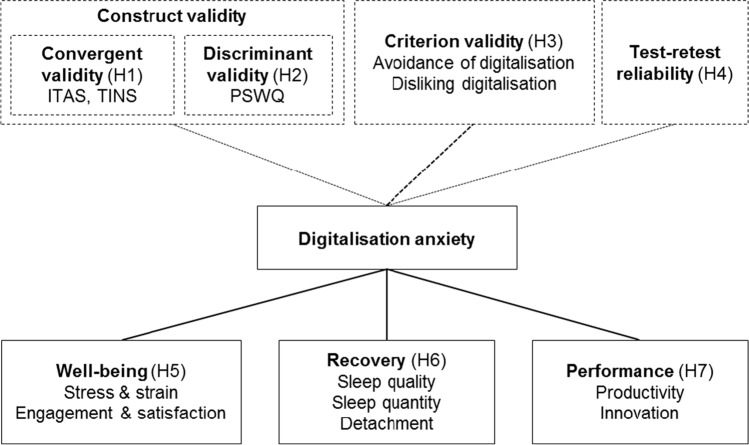
The increasing spread of digital technologies and respective consequences for the way we live, work, and communicate can evoke feelings of tension and discomfort. This so-called digitalisation anxiety is related to existing and future technologies, includes the process of digitalisation in everyday life, and refers to multiple levels (the individual, organisations, and society). Existing scales measuring technology-related fears due not adequately reflect these features. Therefore, we developed the German version of the Digitalisation Anxiety Scale (DAS). Having generated items based on a qualitative interview study (Study 1, n = 26), we demonstrated the DAS's factor structure, internal consistency and construct validity in Study 2a (n = 109) and test-retest reliability in Study 2b (n = 30). In Study 3 (n = 223), the scale's structure was confirmed and correlates of digitalisation anxiety were examined. The final version of the DAS consists of 35 items with a four-factor structure (societal triggers for digitalisation anxiety, triggers related to interaction and leadership, triggers within oneself and triggers resulting from the digitalisation implementation process). Digitalisation Anxiety had negative relationships with well-being and performance. The scale allows practitioners and researchers to measure and benchmark individuals' levels of digitalisation anxiety, and to track changes over time. The scale can inform interventions aiming at reducing digitalisation anxiety and stress resulting from digitalisation.
数字技术的日益普及及其对我们生活、工作和交流方式产生的相应影响,可能会引发紧张和不适的情绪。这种所谓的数字化焦虑与现有及未来的技术相关,涵盖日常生活中的数字化进程,涉及多个层面(个人、组织和社会)。现有的测量与技术相关恐惧的量表未能充分反映这些特征。因此,我们开发了德语版的数字化焦虑量表(DAS)。在基于定性访谈研究(研究1,n = 26)生成条目后,我们在研究2a(n = 109)中展示了DAS的因子结构、内部一致性和结构效度,并在研究2b(n = 30)中检验了重测信度。在研究3(n = 223)中,该量表的结构得到确认,并对数字化焦虑的相关因素进行了考察。DAS的最终版本由35个条目组成,具有四因子结构(数字化焦虑的社会触发因素、与互动和领导相关的触发因素、自身内部的触发因素以及数字化实施过程产生的触发因素)。数字化焦虑与幸福感和表现呈负相关。该量表使从业者和研究人员能够测量和比较个体的数字化焦虑水平,并跟踪随时间的变化。该量表可为旨在减少数字化焦虑和数字化带来的压力的干预措施提供参考。