Yen Shirley, Suazo Nazaret, Doerr Jackson, Macrynikola Natalia, Villarreal Leanna S, Sodano Sophia, O'Brien Kimberly H M, Wolff Jennifer C, Breault Christopher, Gibb Brandon E, Elwy Rani, Kahler Christopher W, Ranney Megan, Jones Richard, Spirito Anthony
Department of Psychiatry, Beth Israel Deaconess Medical Center, Boston, MA, United States of America.
Massachusetts Mental Health Center, Boston, MA, United States of America.
PLoS One. 2023 Oct 20;18(10):e0287285. doi: 10.1371/journal.pone.0287285. eCollection 2023.
Suicide and suicidal behavior during adolescence have been steadily increasing over the past two decades. The preponderance of interventions focuses on crisis intervention, underlying psychiatric disorders, regulating negative affect, and reducing cognitive distortions. However, low positive affectivity may be a mechanism that contributes to adolescent suicidal ideation and behaviors independent of other risk factors. Skills to Enhance Positivity (STEP) is an acceptance-based intervention, designed to increase attention to, and awareness of, positive affect and positive experiences. Results from a pilot RCT demonstrated engagement of the target (positive affect) and a decrease in clinical outcomes (suicidal events; i.e., either a suicide attempt or an emergency intervention for an acute suicidal crisis), providing support to test the clinical effectiveness of STEP in a larger clinical trial with clinical staff implementing the intervention.
To test the effectiveness of STEP, compared to Enhanced Treatment as Usual (ETAU), in reducing suicidal events and ideation in adolescents admitted to inpatient psychiatric care due to suicide risk. We hypothesize that those randomized to STEP, compared to ETAU, will have lower rates of suicide events, active suicidal ideation (SI), and depressed mood over the 6-month follow-up period. We hypothesize that those randomized to STEP, compared to ETAU, will demonstrate greater improvement in the hypothesized mechanisms of attention to positive affect stimuli and gratitude and satisfaction with life.
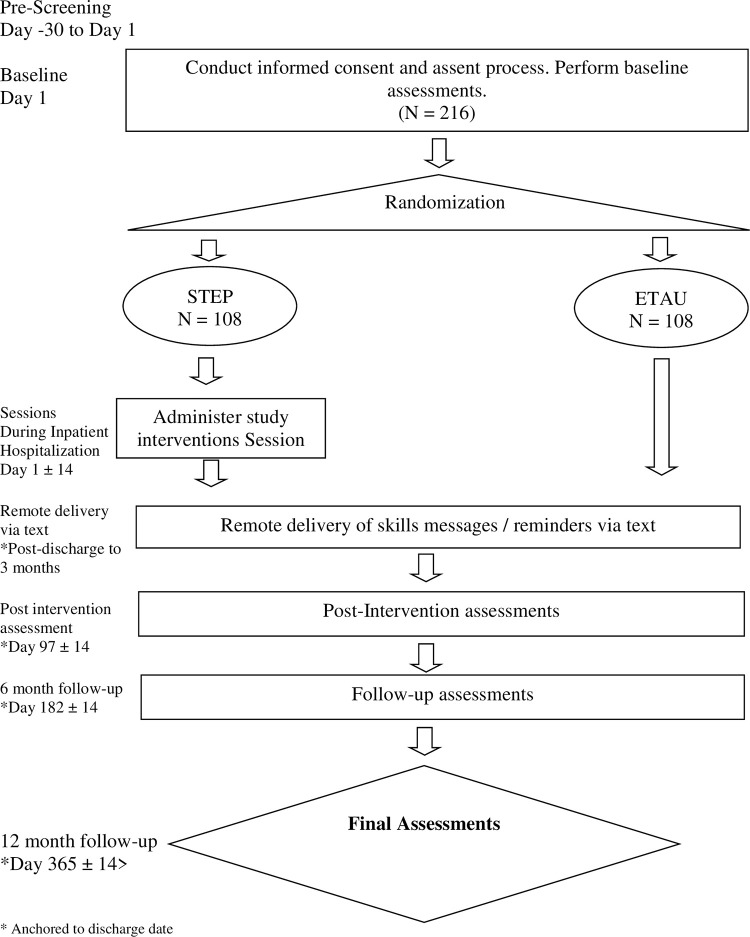
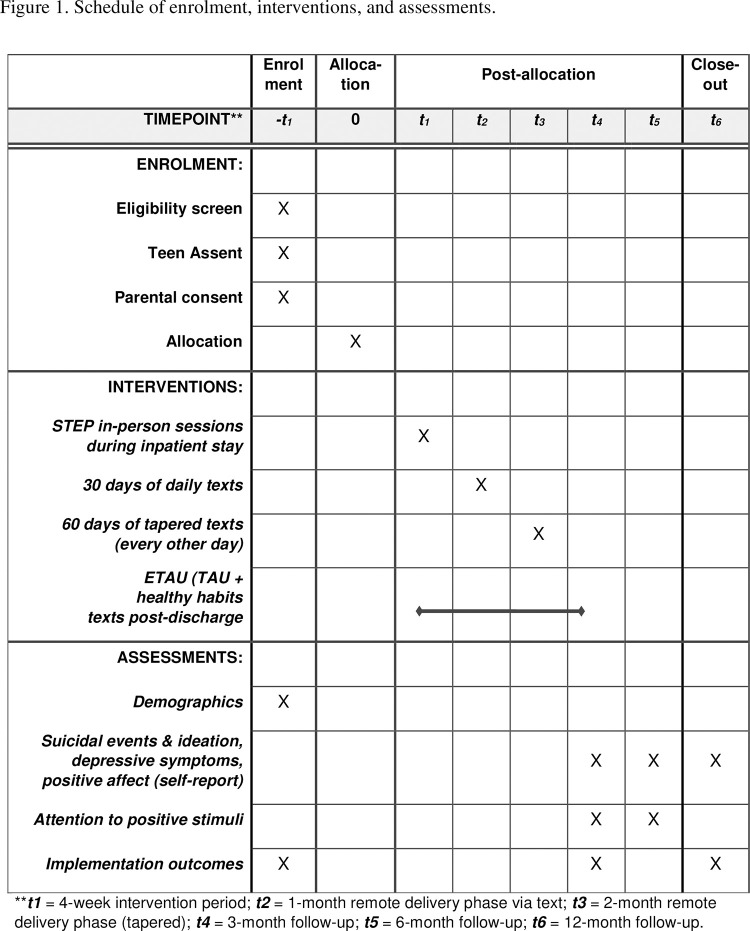
Participants will be randomized to either STEP or ETAU. STEP consists of four in-person sessions focused on psychoeducation regarding positive and negative affect, mindfulness meditation, gratitude, and savoring. Mood monitoring prompts and skill reminders will be sent via text messaging daily for the first month post-discharge and every other day for the following two months. The ETAU condition will receive text-delivered reminders to use a safety plan provided at discharge from the hospital and healthy habits messages, matched in frequency to the STEP group. This trial was registered on 6 August 2021 (ClinicalTrials.gov NCT04994873).
The STEP protocol was approved by the National Institute of Mental Health (NIMH) Data and Safety Monitoring Board on March 4, 2022. The RCT is currently in progress.
The STEP protocol is an innovative, adjunctive treatment that has the potential to have positive effects on adolescent suicidal ideation and attempts beyond that found for standard treatment alone.
在过去二十年中,青少年自杀及自杀行为呈稳步上升趋势。大多数干预措施集中在危机干预、潜在精神障碍、调节消极情绪以及减少认知扭曲方面。然而,低积极情感可能是一种导致青少年自杀意念和行为的机制,独立于其他风险因素。增强积极感技能(STEP)是一种基于接纳的干预措施,旨在提高对积极情感和积极体验的关注及意识。一项随机对照试验的初步结果显示,该干预措施能够针对目标(积极情感),并改善临床结局(自杀事件,即自杀未遂或针对急性自杀危机的紧急干预),为在更大规模临床试验中由临床工作人员实施该干预措施以检验其临床效果提供了支持。
与强化常规治疗(ETAU)相比,检验STEP在降低因自杀风险入住精神科住院治疗的青少年自杀事件和自杀意念方面的有效性。我们假设,与ETAU组相比,随机分配到STEP组的青少年在6个月随访期内自杀事件、活跃自杀意念(SI)和抑郁情绪的发生率更低。我们还假设,与ETAU组相比,随机分配到STEP组的青少年在对积极情感刺激的关注、感恩以及对生活的满意度等假设机制方面会有更大改善。
参与者将被随机分配到STEP组或ETAU组。STEP包括四次面对面课程,重点是关于积极和消极情感的心理教育、正念冥想、感恩和品味。出院后的第一个月,每天通过短信发送情绪监测提示和技能提醒,接下来的两个月每隔一天发送一次。ETAU组将收到短信提醒,使用出院时提供的安全计划,并接收与健康习惯相关的信息,发送频率与STEP组匹配。该试验于2021年8月6日注册(ClinicalTrials.gov NCT04994873)。
STEP方案于2022年3月4日获得美国国立精神卫生研究所(NIMH)数据与安全监测委员会批准。随机对照试验目前正在进行中。
STEP方案是一种创新的辅助治疗方法,有可能对青少年自杀意念和自杀未遂产生积极影响,其效果超过单独的标准治疗。