College of Health and Life Sciences, Hamad Bin Khalifa University, Doha, Qatar.
Department of Research, Sidra Medicine, Doha, Qatar.
Cell Death Dis. 2023 Oct 20;14(10):692. doi: 10.1038/s41419-023-06215-y.
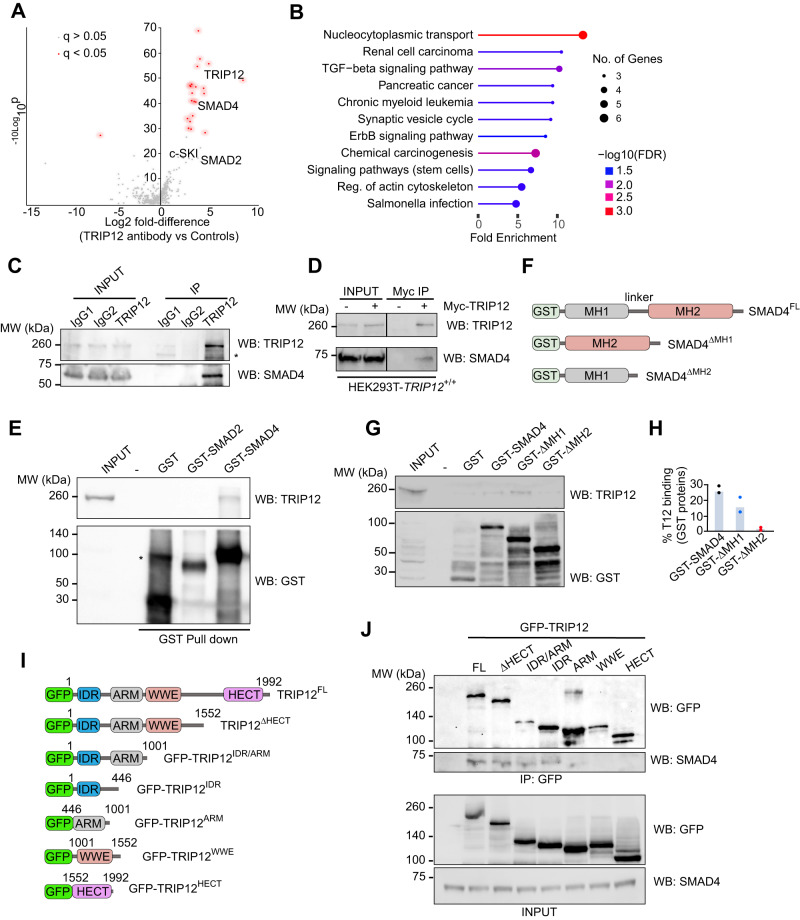
Transforming growth factor β (TGFβ) pathway is a master regulator of cell proliferation, differentiation, and death. Deregulation of TGFβ signalling is well established in several human diseases including autoimmune disorders and cancer. Thus, understanding molecular pathways governing TGFβ signalling may help better understand the underlying causes of some of those conditions. Here, we show that a HECT domain E3 ubiquitin ligase TRIP12 controls TGFβ signalling in multiple models. Interestingly, TRIP12 control of TGFβ signalling is completely independent of its E3 ubiquitin ligase activity. Instead, TRIP12 recruits SMURF2 to SMAD4, which is most likely responsible for inhibitory monoubiquitination of SMAD4, since SMAD4 monoubiquitination and its interaction with SMURF2 were dramatically downregulated in TRIP12 cells. Additionally, genetic inhibition of TRIP12 in human and murine cells leads to robust activation of TGFβ signalling which was rescued by re-introducing wildtype TRIP12 or a catalytically inactive C1959A mutant. Importantly, TRIP12 control of TGFβ signalling is evolutionary conserved. Indeed, genetic inhibition of Drosophila TRIP12 orthologue, ctrip, in gut leads to a reduced number of intestinal stem cells which was compensated by the increase in differentiated enteroendocrine cells. These effects were completely normalised in Drosophila strain where ctrip was co-inhibited together with Drosophila SMAD4 orthologue, Medea. Similarly, in murine 3D intestinal organoids, CRISPR/Cas9 mediated genetic targeting of Trip12 enhances TGFβ mediated proliferation arrest and cell death. Finally, CRISPR/Cas9 mediated genetic targeting of TRIP12 in MDA-MB-231 breast cancer cells enhances the TGFβ induced migratory capacity of these cells which was rescued to the wildtype level by re-introducing wildtype TRIP12. Our work establishes TRIP12 as an evolutionary conserved modulator of TGFβ signalling in health and disease.
转化生长因子 β(TGFβ)途径是细胞增殖、分化和死亡的主调控因子。TGFβ 信号的失调在几种人类疾病中得到了很好的证实,包括自身免疫性疾病和癌症。因此,了解调控 TGFβ 信号的分子途径可能有助于更好地理解这些疾病的潜在原因。在这里,我们显示了一个 HECT 结构域 E3 泛素连接酶 TRIP12 在多种模型中控制 TGFβ 信号。有趣的是,TRIP12 对 TGFβ 信号的控制完全独立于其 E3 泛素连接酶活性。相反,TRIP12 将 SMURF2 募集到 SMAD4 上,这很可能是导致 SMAD4 抑制性单泛素化的原因,因为 TRIP12 细胞中的 SMAD4 单泛素化及其与 SMURF2 的相互作用显著下调。此外,在人和鼠细胞中遗传抑制 TRIP12 会导致 TGFβ 信号的强烈激活,而通过重新引入野生型 TRIP12 或催化失活的 C1959A 突变体可以挽救这种激活。重要的是,TRIP12 对 TGFβ 信号的控制是进化保守的。事实上,在肠道中遗传抑制果蝇 TRIP12 的同源物 ctrip 会导致肠干细胞数量减少,而分化的肠内分泌细胞数量增加则对此进行了补偿。在果蝇菌株中,ctrip 与果蝇 SMAD4 同源物 Medea 一起被共同抑制,这些效应完全正常化。同样,在鼠 3D 肠类器官中,CRISPR/Cas9 介导的 Trip12 基因靶向增强了 TGFβ 介导的增殖停滞和细胞死亡。最后,在 MDA-MB-231 乳腺癌细胞中,CRISPR/Cas9 介导的 TRIP12 基因靶向增强了这些细胞 TGFβ 诱导的迁移能力,而通过重新引入野生型 TRIP12 可将其恢复至野生型水平。我们的工作确立了 TRIP12 作为健康和疾病中 TGFβ 信号的进化保守调节剂。