Critical Care Department, Ziekenhuis Oost-Limburg, Schiepse Bos 6, 3600, Genk, Belgium.
Faculty of Medicine and Life Sciences & Limburg Clinical Research Center, UHasselt, Diepenbeek, Belgium.
Eur J Med Res. 2023 Oct 20;28(1):450. doi: 10.1186/s40001-023-01435-6.
Perioperative neuro-endocrine stress response may contribute to acquired muscle weakness. Regional anaesthesia has been reported to improve the outcome of patients having total hip arthroplasty. In this study, it was hypothesized that spinal anaesthesia (SA) decreases the perioperative neuro-endocrine stress response and perioperatively acquired muscle weakness (PAMW), as compared to general anaesthesia (GA).
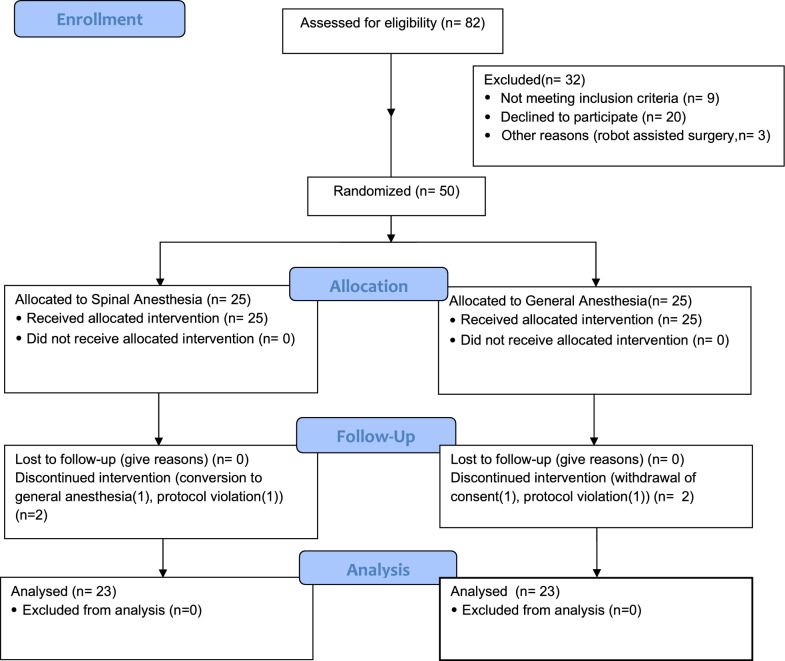
Fifty subjects undergoing bilateral total hip arthroplasty (THA) were randomly allocated to receive a standardized SA (n = 25) or GA (n = 25). Handgrip strength was assessed preoperatively, on the first postoperative day (primary endpoint) and on day 7 and 28. Respiratory muscle strength was measured by maximal inspiratory pressure (MIP). Stress response was assessed by measuring levels of Adrenocorticotropic hormone (ACTH), cortisol and interleukin-6 (IL-6).
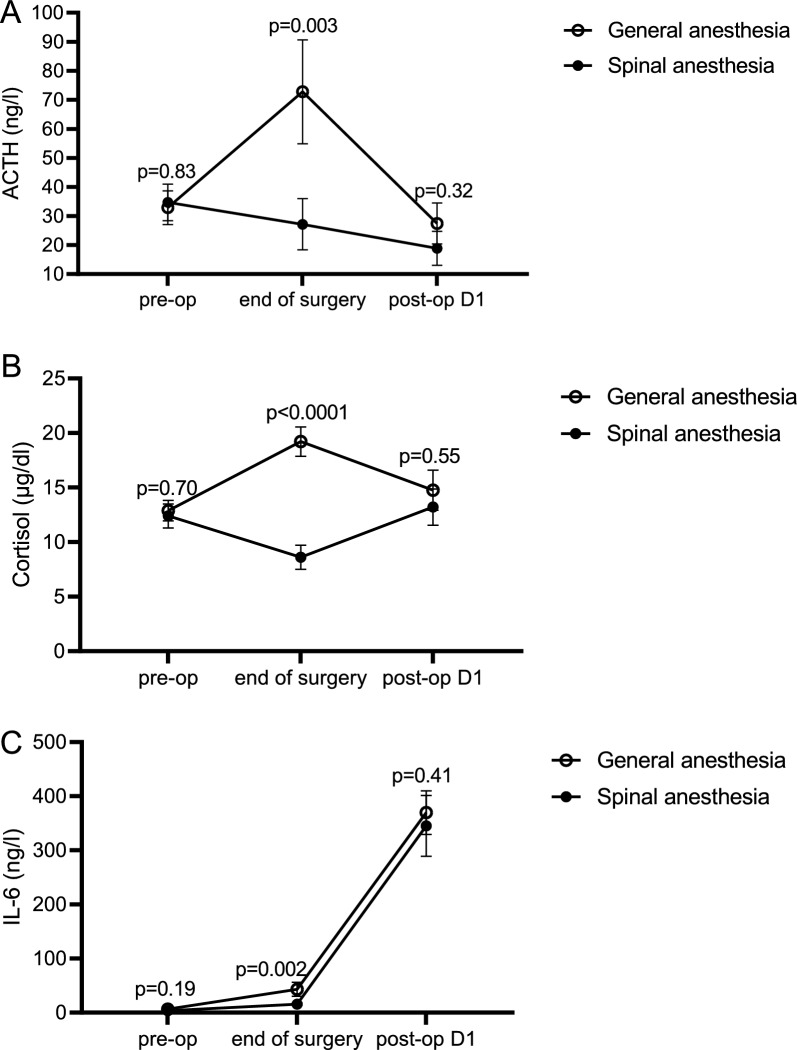
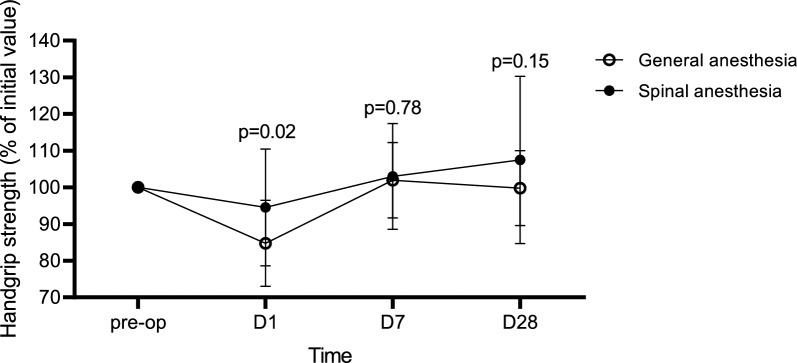
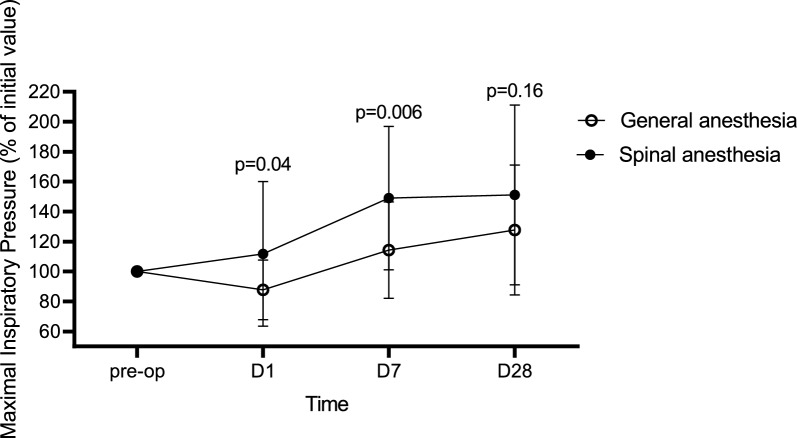
Handgrip strength postoperatively (day 1) decreased by 5.4 ± 15.9% in the SA group, versus 15.2 ± 11.7% in the GA group (p = 0.02). The handgrip strength returned to baseline at day 7 and did not differ between groups at day 28. MIP increased postoperatively in patients randomized to SA by 11.7 ± 48.3%, whereas it decreased in GA by 12.2 ± 19.9% (p = 0.04). On day 7, MIP increased in both groups, but more in the SA (49.0 ± 47.8%) than in the GA group (14.2 ± 32.1%) (p = 0.006). Postoperatively, the levels of ACTH, cortisol and IL-6 increased in the GA, but not in the SA group (p < 0.004).
In patients having bilateral THA, SA preserved the postoperative respiratory and peripheral muscle strength and attenuated the neuro-endocrine and inflammatory responses.
clinicaltrials.gov NCT03600454.
围手术期神经内分泌应激反应可能导致获得性肌肉无力。有报道称区域麻醉可改善全髋关节置换术患者的预后。在这项研究中,假设与全身麻醉(GA)相比,脊髓麻醉(SA)可降低围手术期神经内分泌应激反应和围手术期获得性肌肉无力(PAMW)。
50 例拟行双侧全髋关节置换术(THA)的患者被随机分配接受标准 SA(n=25)或 GA(n=25)。术前、术后第 1 天(主要终点)以及术后第 7 天和第 28 天评估握力。通过最大吸气压力(MIP)测量呼吸肌力量。通过测量促肾上腺皮质激素(ACTH)、皮质醇和白细胞介素-6(IL-6)的水平来评估应激反应。
SA 组术后第 1 天握力下降 5.4%±15.9%,GA 组下降 15.2%±11.7%(p=0.02)。第 7 天握力恢复至基线,第 28 天两组间无差异。SA 组患者术后 MIP 增加 11.7%±48.3%,而 GA 组下降 12.2%±19.9%(p=0.04)。第 7 天,两组 MIP 均增加,但 SA 组增加更多(49.0%±47.8%),GA 组增加较少(14.2%±32.1%)(p=0.006)。术后,GA 组的 ACTH、皮质醇和 IL-6 水平升高,但 SA 组无变化(p<0.004)。
在接受双侧 THA 的患者中,SA 保持了术后呼吸和外周肌肉力量,并减轻了神经内分泌和炎症反应。
clinicaltrials.gov NCT03600454。