Steiber Nadia
Wittgenstein Centre for Demography and Global Human Capital (IIASA, VID/ÖAW, WU), International Institute for Applied Systems Analysis (IIASA), Laxenburg, Austria.
Department of Economic Sociology, University of Vienna, Vienna, Austria.
PLoS One. 2016 Oct 4;11(10):e0163917. doi: 10.1371/journal.pone.0163917. eCollection 2016.
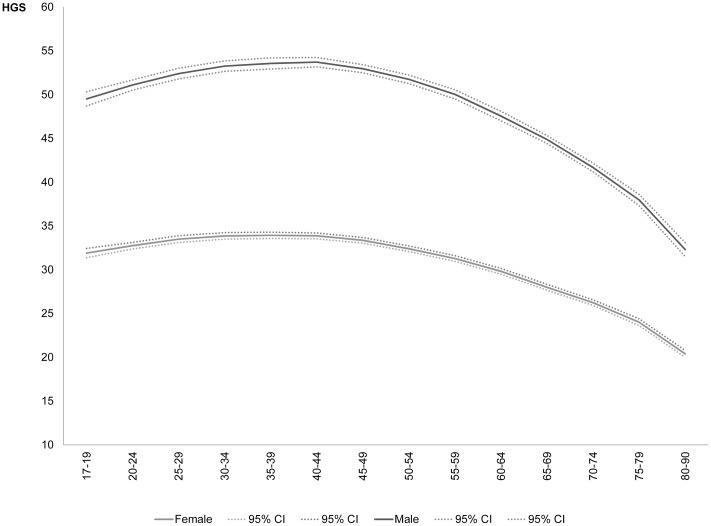
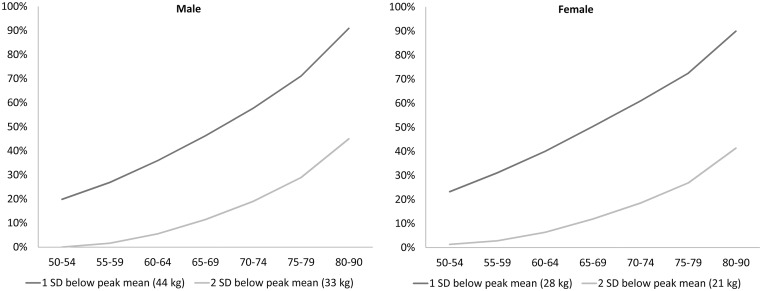
Handgrip strength is an important biomarker of healthy ageing and a powerful predictor of future morbidity and mortality both in younger and older populations. Therefore, the measurement of handgrip strength is increasingly used as a simple but efficient screening tool for health vulnerability. This study presents normative reference values for handgrip strength in Germany for use in research and clinical practice. It is the first study to provide normative data across the life course that is stratified by sex, age, and body height. The study used a nationally representative sample of test participants ages 17-90. It was based on pooled data from five waves of the German Socio-Economic Panel (2006-2014) and involved a total of 11,790 persons living in Germany (providing 25,285 observations). Handgrip strength was measured with a Smedley dynamometer. Results showed that peak mean values of handgrip strength are reached in men's and women's 30s and 40s after which handgrip strength declines in linear fashion with age. Following published recommendations, the study used a cut-off at 2 SD below the sex-specific peak mean value across the life course to define a 'weak grip'. Less than 10% of women and men aged 65-69 were classified as weak according to this definition, shares increasing to about half of the population aged 80-90. Based on survival analysis that linked handgrip strength to a relevant outcome, however, a 'critically weak grip' that warrants further examination was estimated to commence already at 1 SD below the group-specific mean value.
握力是健康老龄化的一项重要生物标志物,也是年轻人群和老年人群未来发病和死亡的有力预测指标。因此,握力测量越来越多地被用作一种简单而有效的健康脆弱性筛查工具。本研究给出了德国握力的标准参考值,供研究和临床实践使用。这是第一项提供按性别、年龄和身高分层的全生命周期标准数据的研究。该研究使用了一个具有全国代表性的17至90岁测试参与者样本。它基于德国社会经济面板五轮(2006 - 2014年)的汇总数据,共涉及11790名居住在德国的人(提供了25285条观测数据)。握力用斯梅德利测力计测量。结果显示,男性和女性在30多岁和40多岁时握力达到峰值平均值,之后握力随年龄呈线性下降。按照已发表的建议,该研究使用全生命周期中低于特定性别峰值平均值2个标准差的临界值来定义“握力弱”。根据这一定义,65至69岁的女性和男性中不到10%被归类为握力弱,而在80至90岁的人群中这一比例增至约一半。然而,基于将握力与相关结果联系起来的生存分析,估计在低于特定组平均值1个标准差时就开始出现需要进一步检查的“严重握力弱”情况。