Jennissen Charles A, Krupp Treyton D, Vakkalanka J Priyanka, Hoogerwerf Pamela J
Department of Emergency Medicine, Roy J. and Lucille A. Carver College of Medicine, University of Iowa, Iowa City, IA, USA.
Stead Family Department of Pediatrics, Roy J. and Lucille A. Carver College of Medicine, University of Iowa, Iowa City, IA, USA.
Inj Epidemiol. 2023 Oct 20;10(Suppl 1):51. doi: 10.1186/s40621-023-00468-z.
Riding lawn mower injuries are the most common cause of major limb loss in young U.S. children. Our study objective was to investigate the circumstances surrounding pediatric riding lawn mower injuries and to identify potential contributing risk factors and behaviors leading to these events.
Followers/members of both a public and a private lawn mower injury support and prevention Facebook page who had or were aware of children who had suffered a lawn mower-related injury were invited to complete an electronic survey on Qualtrics. Duplicate cases and those involving push mowers were removed. Frequencies and chi-square analyses were performed.
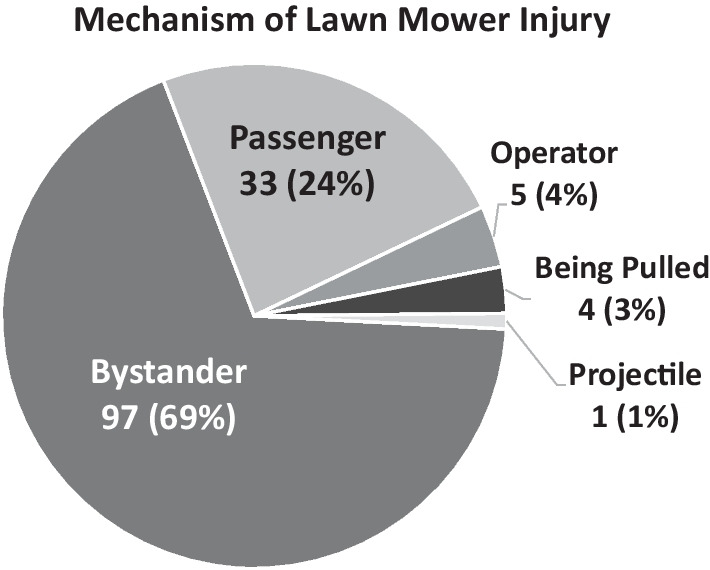
140 injured children were identified with 71% of surveys completed by parents and 19% by an adult survivor of a childhood incident. The majority of injured children were Caucasian (94%), male (64%), and ≤ 5 years of age at the time of the incident (63%). Bystanders were 69% of those injured, 24% were lawn mower riders, and mower operators and others accounted for 7%. The lawn mower operator was usually male (77%), being the father/stepfather in almost half. Overall, 59% of injuries occurred while traveling in reverse, 29% while moving forward. Nearly all (92%) had an amputation and/or permanent disability. Subgroup analysis (n = 130) found injured bystanders were younger than injured passengers with 71% versus 45% being < 5 years of age, respectively (p = 0.01). Over three-quarters of bystander incidents occurred while moving in reverse as compared to 17% of passenger incidents (p < 0.01). Amputations and/or permanent disabilities were greater among bystanders (97%) as compared to passengers (79%, p = 0.01). Only 3% of bystanders had an upper extremity injury as compared to 21% of passengers (p = 0.01). Seventy-three percent of bystander victims had received at least one ride on a lawn mower prior to their injury incident.
Child bystanders seriously injured by riding lawn mowers were frequently given prior rides likely desensitizing them to their inherent dangers and leading them to seek rides when mowers were being used. Engineering changes preventing blade rotation when traveling in reverse and not giving children rides (both when and when not mowing) may be critical in preventing mower-related injuries.
在美国,骑乘式割草机伤害是导致幼儿严重肢体缺失的最常见原因。我们的研究目的是调查小儿骑乘式割草机伤害事件的相关情况,并确定导致这些事件的潜在风险因素和行为。
邀请公共和私人的割草机伤害支持与预防脸书页面的关注者/成员,他们自己或知晓有儿童遭受与割草机相关的伤害,让他们在Qualtrics上完成一项电子调查。去除重复案例和涉及手推式割草机的案例。进行频率分析和卡方分析。
共识别出140名受伤儿童,71%的调查问卷由家长完成,19%由童年事故的成年幸存者完成。大多数受伤儿童为白人(94%),男性(64%),事故发生时年龄≤5岁(63%)。旁观者占受伤者的69%,骑乘割草机者占24%,割草机操作员和其他人员占7%。割草机操作员通常为男性(77%),近半数是父亲/继父。总体而言,59%的伤害发生在倒车时,29%发生在前进时。几乎所有(92%)受伤儿童都有截肢和/或永久性残疾。亚组分析(n = 130)发现,受伤的旁观者比受伤的乘客年龄更小:分别有71%和45%的旁观者及乘客年龄<5岁(p = 0.01)。超过四分之三的旁观者受伤事件发生在倒车时,而乘客受伤事件中这一比例为17%(p < 0.01)。旁观者的截肢和/或永久性残疾比例(97%)高于乘客(79%,p = 0.01)。只有3%的旁观者上肢受伤,而乘客的这一比例为21%(p = 0.01)。73%的旁观者受害者在受伤事件发生前至少乘坐过一次割草机。
骑乘式割草机严重伤害的儿童旁观者之前经常乘坐割草机,这可能使他们对其固有危险失去警惕,并导致他们在割草机使用时寻求乘坐。进行工程改进,使割草机倒车时刀片停止旋转,并且不让儿童乘坐(无论是否在割草),对于预防与割草机相关的伤害可能至关重要。