Neuroscience Research Australia, University of New South Wales, Randwick, NSW, Australia.
School of Population Health, University of New South Wales, Randwick, NSW, Australia.
Neurorehabil Neural Repair. 2023 Oct;37(10):694-704. doi: 10.1177/15459683231206743. Epub 2023 Oct 21.
Falls are frequent and devastating events for people with Parkinson's disease (PD). Here, we investigated whether laboratory-based reactive step training combined with home-based volitional step training was effective in improving balance recovery and stepping ability in people with PD.
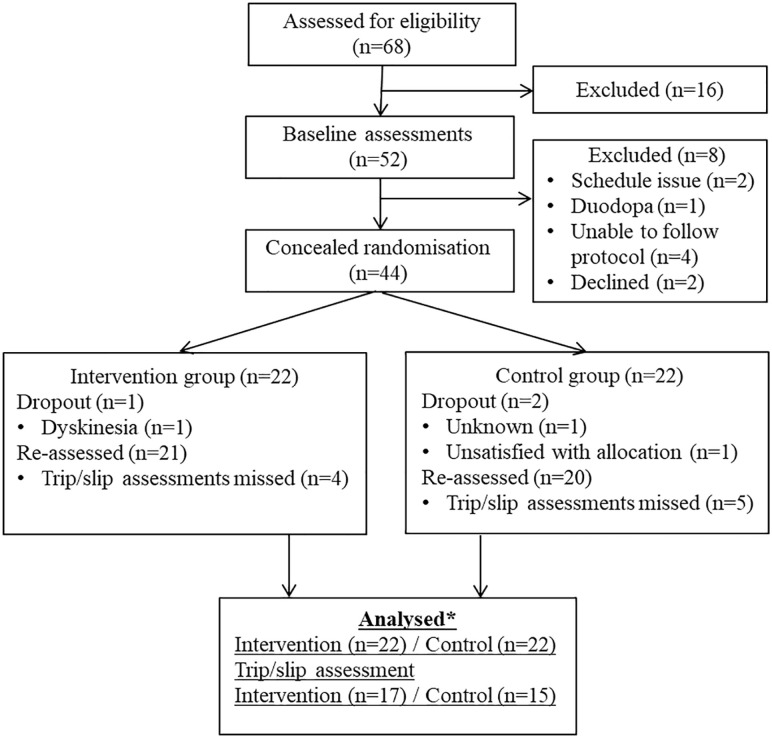
Forty-four people with idiopathic PD were randomized into intervention or control groups. Intervention participants performed unsupervised volitional step training using home-based exergames (80+ minutes/week) for 12 weeks and attended reactive step training sessions in which they were exposed to slip and trip perturbations at 4 and 8 weeks. Control participants continued their usual activities. Primary outcomes were balance recovery following an induced-trip/slip and choice stepping reaction time (CSRT) at the 12-week reassessment. Secondary outcomes comprised sensorimotor, balance, cognitive, psychological, complex stepping (inhibitory CSRT and Stroop Stepping Test [SST]), gait measures, and falls experienced in everyday life.
At reassessment, the intervention group had significantly fewer total laboratory-induced falls and faster CSRT compared to the control group ( < .05). The intervention group also had significantly faster inhibitory CSRT and SST movement times and made fewer mistakes in the SST ( < .05). There were no significant differences in the rate of every day falls or other secondary outcome measures between the groups.
Combined volitional and reactive step training improved balance recovery from an induced-perturbation, voluntary stepping time, and stepping accuracy in cognitively challenging tests in people with PD. Further research is required to determine whether such combined step training can prevent daily-life falls in this population.
跌倒对于帕金森病(PD)患者来说是频繁且具有破坏性的事件。在这里,我们研究了基于实验室的反应性跨步训练与基于家庭的自主跨步训练相结合是否能有效改善 PD 患者的平衡恢复和跨步能力。
44 名特发性 PD 患者被随机分为干预组和对照组。干预组参与者使用基于家庭的运动游戏进行自主的、无监督的跨步训练(每周 80 分钟以上),并在第 4 周和第 8 周接受反应性跨步训练,以暴露于滑倒和绊倒的干扰。对照组参与者继续进行他们的日常活动。主要结果是在 12 周的重新评估中,在诱发的绊倒/滑倒后和选择跨步反应时间(CSRT)的平衡恢复。次要结果包括感觉运动、平衡、认知、心理、复杂跨步(抑制性 CSRT 和 Stroop 跨步测试[SST])、步态测量以及日常生活中的跌倒次数。
在重新评估时,与对照组相比,干预组的总实验室诱发跌倒次数明显减少,CSRT 更快( < .05)。干预组的抑制性 CSRT 和 SST 运动时间也明显更快,SST 中的错误更少( < .05)。两组在日常跌倒率或其他次要结果测量上均无显著差异。
结合自主和反应性跨步训练改善了 PD 患者在认知挑战性测试中从诱发干扰后平衡恢复、自主跨步时间和跨步准确性。需要进一步研究来确定这种联合跨步训练是否可以预防该人群的日常生活中的跌倒。