Department of Cardiology, Guangdong Provincial People's Hospital, Guangdong Cardiovascular Institute, Southern Medical University, Guangzhou, China.
Guangdong Provincial Key Laboratory of Coronary Heart Disease Prevention, Guangdong Provincial People's Hospital, Guangdong Academy of Medical Sciences, Guangzhou, China.
Cardiovasc Diabetol. 2023 Oct 21;22(1):281. doi: 10.1186/s12933-023-02012-1.
Among patients with acute coronary syndrome and percutaneous coronary intervention, stress hyperglycemia ratio (SHR) is primarily associated with short-term unfavorable outcomes. However, the relationship between SHR and long-term worsen prognosis in acute myocardial infarction (AMI) patients admitted in intensive care unit (ICU) are not fully investigated, especially in those with different ethnicity. This study aimed to clarify the association of SHR with all-cause mortality in critical AMI patients from American and Chinese cohorts.
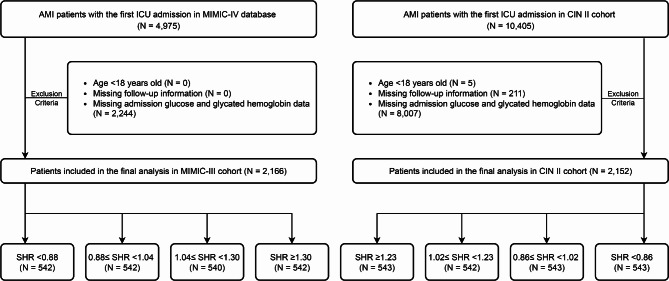
Overall 4,337 AMI patients with their first ICU admission from the American Medical Information Mart for Intensive Care (MIMIC)-IV database (n = 2,166) and Chinese multicenter registry cohort Cardiorenal ImprovemeNt II (CIN-II, n = 2,171) were included in this study. The patients were divided into 4 groups based on quantiles of SHR in both two cohorts.
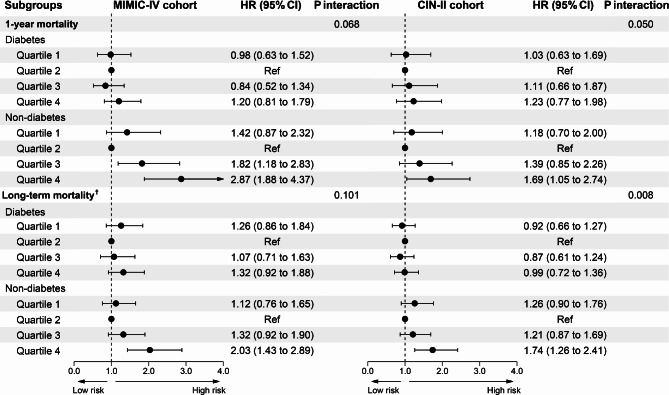
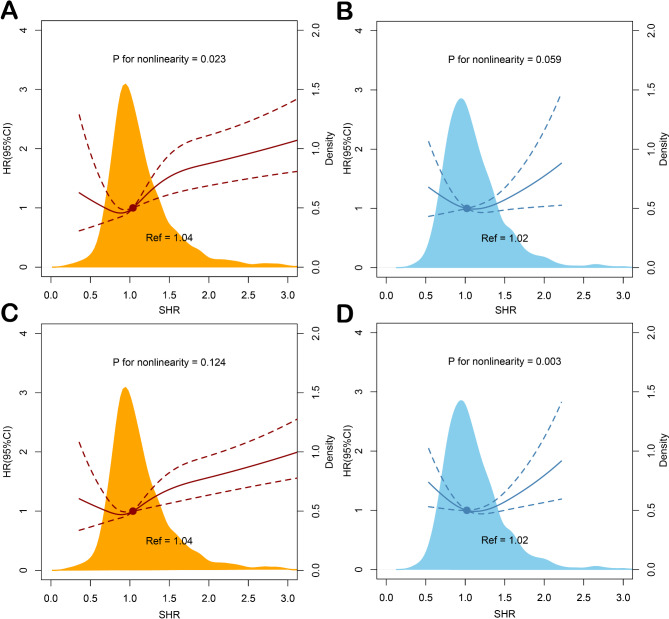
The total mortality was 23.8% (maximum follow-up time: 12.1 years) in American MIMIC-IV and 29.1% (maximum follow-up time: 14.1 years) in Chinese CIN-II. In MIMIC-IV cohort, patients with SHR of quartile 4 had higher risk of 1-year (adjusted hazard radio [aHR] = 1.87; 95% CI: 1.40-2.50) and long-term (aHR = 1.63; 95% CI: 1.27-2.09) all-cause mortality than quartile 2 (as reference). Similar results were observed in CIN-II cohort (1-year mortality: aHR = 1.44; 95%CI: 1.03-2.02; long-term mortality: aHR = 1.32; 95%CI: 1.05-1.66). In both two group, restricted cubic splines indicated a J-shaped correlation between SHR and all-cause mortality. In subgroup analysis, SHR was significantly associated with higher 1-year and long-term all-cause mortality among patients without diabetes in both MIMIC-IV and CIN-II cohort.
Among critical AMI patients, elevated SHR is significantly associated with and 1-year and long-term all-cause mortality, especially in those without diabetes, and the results are consistently in both American and Chinese cohorts.
在急性冠状动脉综合征和经皮冠状动脉介入治疗的患者中,应激性高血糖比值(SHR)主要与短期不良结局相关。然而,应激性高血糖比值与重症监护病房(ICU)收治的急性心肌梗死(AMI)患者的长期预后恶化之间的关系尚未完全研究,尤其是在不同种族的患者中。本研究旨在阐明 SHR 与来自美国和中国队列的重症 AMI 患者全因死亡率之间的关系。
总体上,来自美国医学信息集市重症监护(MIMIC-IV)数据库的首次 ICU 入院的 4337 例 AMI 患者(n=2166)和中国多中心注册队列 Cardiorenal ImprovemeNt II(CIN-II,n=2171)被纳入本研究。根据两个队列中 SHR 的四分位数,将患者分为 4 组。
在美国 MIMIC-IV 中,总死亡率为 23.8%(最大随访时间:12.1 年),在中国 CIN-II 中为 29.1%(最大随访时间:14.1 年)。在 MIMIC-IV 队列中,SHR 四分位 4 的患者 1 年(校正后的危险比[aHR],1.87;95%可信区间:1.40-2.50)和长期(aHR,1.63;95%可信区间:1.27-2.09)全因死亡率的风险均高于四分位 2(作为参考)。在 CIN-II 队列中也观察到了类似的结果(1 年死亡率:aHR,1.44;95%可信区间:1.03-2.02;长期死亡率:aHR,1.32;95%可信区间:1.05-1.66)。在两个队列中,受限立方样条表明 SHR 与全因死亡率之间呈 J 形相关。在亚组分析中,在 MIMIC-IV 和 CIN-II 队列中,无糖尿病的患者的 SHR 与 1 年和长期全因死亡率显著相关。
在重症 AMI 患者中,升高的 SHR 与 1 年和长期全因死亡率显著相关,尤其是在无糖尿病的患者中,并且这些结果在美国和中国队列中一致。