Paediatric Rheumatology Department, Great North Children's Hospital, Newcastle Upon Tyne, UK.
RTI Health Solutions, Belfast, Northern Ireland, UK.
Pediatr Rheumatol Online J. 2023 Oct 21;21(1):129. doi: 10.1186/s12969-023-00906-8.
This study aimed to elicit and quantify preferences for treatments for juvenile idiopathic arthritis (JIA).
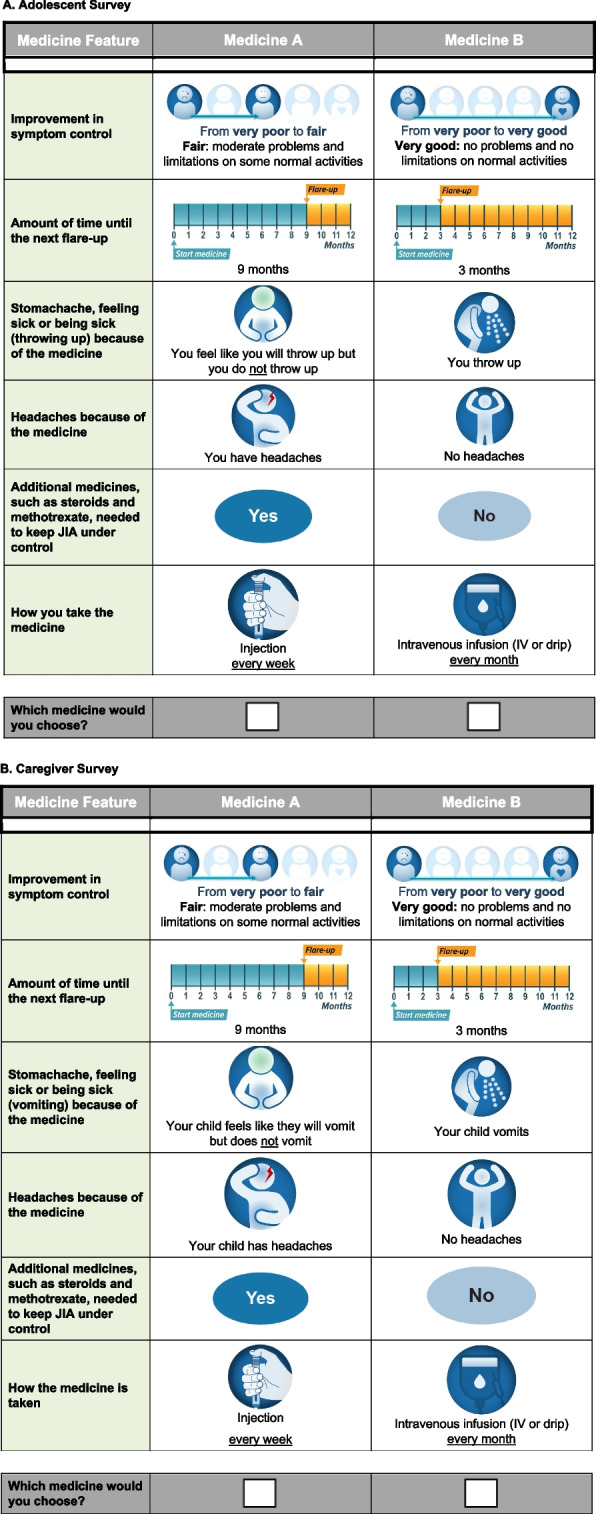
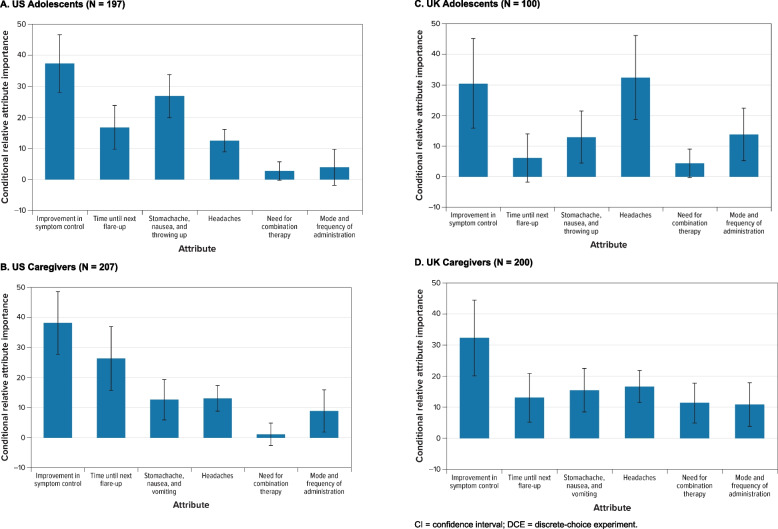
We conducted a discrete-choice experiment among adolescents with JIA in the United States (US) (n = 197) and United Kingdom (UK) (n = 100) and caregivers of children with JIA in the US (n = 207) and UK (n = 200). In a series of questions, respondents chose between experimentally designed profiles for hypothetical JIA treatments that varied in efficacy (symptom control; time until next flare-up), side effects (stomachache, nausea, and vomiting; headaches), mode and frequency of administration, and the need for combination therapy. Using a random-parameters logit model, we estimated preference weights for these attributes, from which we derived their conditional relative importance.
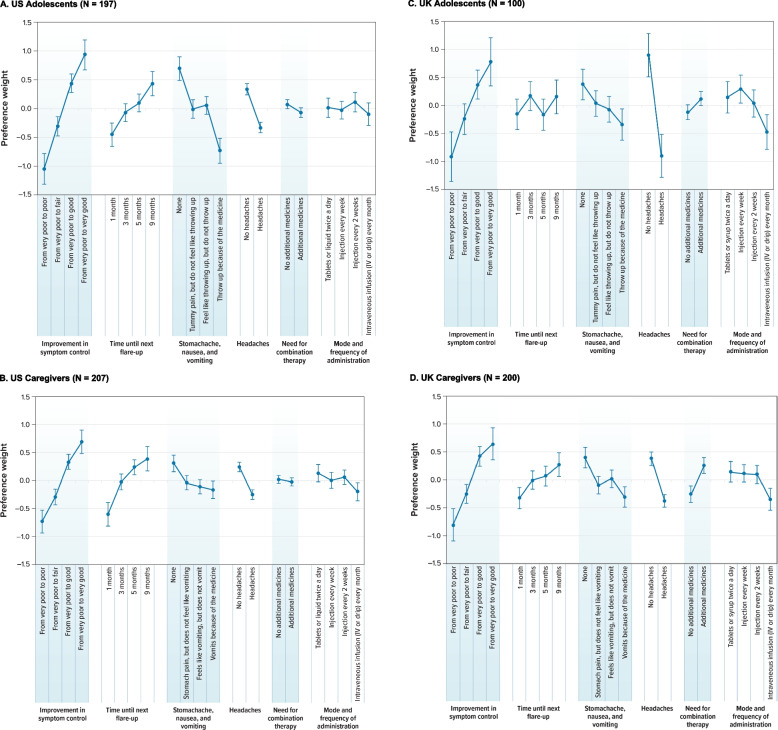
On average, respondents preferred greater symptom control; greater time until the next flare-up; less stomachache, nausea, and vomiting; and fewer headaches. However, adolescents and caregivers in the US were generally indifferent across varying modes and frequencies of administration. UK adolescents and caregivers preferred tablets, syrup, or injections to intravenous infusions. US and UK adolescents were indifferent between treatment with monotherapy or combination therapy; caregivers in the UK preferred treatment with combination therapy to monotherapy. Subgroup analysis showed preference heterogeneity across characteristics including gender, treatment experience, and symptom experience in both adolescents and caregivers.
Improved symptom control, prolonged time to next flare-up, and avoidance of adverse events such as headache, stomachache, nausea, and vomiting are desirable characteristics of treatment regimens for adolescents with JIA and their caregivers.
本研究旨在探讨并量化青少年特发性关节炎(JIA)治疗方案的偏好。
我们在美国(n=197)和英国(n=100)的青少年 JIA 患者中以及在美国(n=207)和英国(n=200)的儿童 JIA 照护者中开展了一项离散选择实验。在一系列问题中,受访者在疗效(症状控制;下次发作前的时间)、副作用(胃痛、恶心和呕吐;头痛)、给药方式和频率以及联合治疗的必要性方面对假设性 JIA 治疗方案的实验设计概况进行了选择。使用随机参数对数模型,我们估计了这些属性的偏好权重,并从这些权重中得出了它们的条件相对重要性。
平均而言,受访者更倾向于更大的症状控制、更长的下次发作前时间、更少的胃痛、恶心和呕吐以及更少的头痛。然而,美国的青少年和照护者在不同的给药方式和频率方面普遍持中立态度。美国和英国的青少年更喜欢片剂、糖浆或注射剂而不是静脉输液。美国和英国的青少年在单药治疗与联合治疗之间无差异;英国的照护者更倾向于联合治疗而非单药治疗。亚组分析显示,青少年和照护者在性别、治疗经验和症状体验等特征方面存在偏好异质性。
改善症状控制、延长下次发作前的时间以及避免头痛、胃痛、恶心和呕吐等不良事件是青少年 JIA 患者及其照护者理想的治疗方案特征。