Ratnam Sutharshan, Kulasingam Sureshkumar, Kanagallingam Abilashini
Obstetrics and Gynaecology, Postgraduate Institute of Medicine, University of Colombo, Colombo, LKA.
Obstetrics and Gynaecology, Teaching Hospital Jaffna, Jaffna, LKA.
Cureus. 2023 Sep 21;15(9):e45731. doi: 10.7759/cureus.45731. eCollection 2023 Sep.
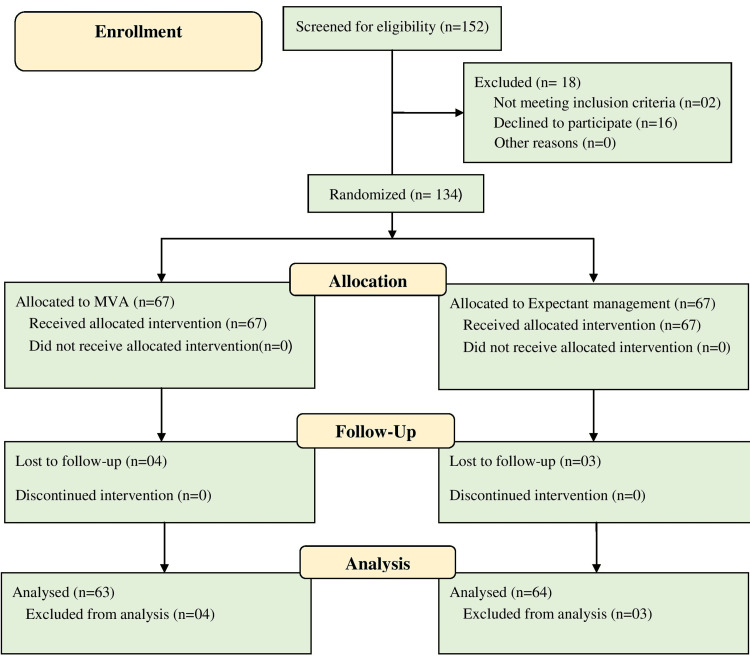
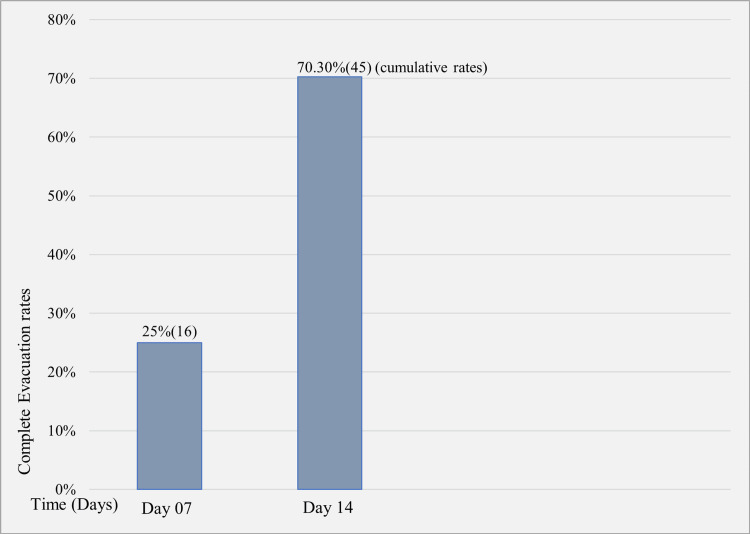
Background Miscarriage is one of the common problems encountered in pregnancy. The treatment modalities are expectant, medical, and surgical management. This study compared the effectiveness and safety of manual vacuum aspiration (MVA) with expectant management for first trimester miscarriage. Method This randomized controlled trial was conducted in Teaching Hospital Jaffna, Jaffna, Sri Lanka, and 134 eligible patients with first trimester spontaneous miscarriage were randomized to expectant management (67) and MVA (67). Those allocated to expectant management were managed expectantly for up to two weeks, and those allocated to MVA underwent aspiration under a paracervical block in the ward. The primary outcome was complete evacuation of the uterus, and the secondary outcomes were duration of bleeding, duration of pain, level of pain, need for the second procedure, cervical or uterine injuries, and patient satisfaction. Results Of the 134 eligible women, seven were lost to follow-up and 127 were analyzed. The MVA was superior in achieving complete evacuation compared to expectant management (95.2% vs. 70.3%; p ≤ 0.001). Notably, in both groups, complete evacuation was more readily achievable in incomplete miscarriage than in missed miscarriage. Duration of bleeding (mean days, 1.6 vs. 4.3; p ≤ 0.0001), duration of pain (mean days, 1.0 vs. 4.2; p ≤ 0.0001), and the need for additional surgical procedure in the form of dilatation and curettage (4.8% vs. 29.7%; p ≤ 0.001) were lower in MVA. Patient satisfaction was higher in the MVA group than in the expectant group (93.7% vs. 65.6%; p ≤ 0.001). No statistically significant differences were observed between the groups in terms of blood transfusion and infection. There wasn't any incidence of cervical damage or uterine perforation. Conclusion MVA is an effective and safe treatment method for first trimester miscarriage with higher patient satisfaction.
流产是孕期常见问题之一。治疗方式包括期待治疗、药物治疗和手术治疗。本研究比较了人工流产负压吸引术(MVA)与期待治疗对早期流产的有效性和安全性。
本随机对照试验在斯里兰卡贾夫纳的贾夫纳教学医院进行,134例符合条件的早期自然流产患者被随机分为期待治疗组(67例)和MVA组(67例)。分配到期待治疗组的患者接受长达两周的期待治疗,分配到MVA组的患者在病房宫颈旁阻滞下进行清宫术。主要结局是子宫完全排空,次要结局包括出血持续时间、疼痛持续时间、疼痛程度、是否需要二次手术、宫颈或子宫损伤以及患者满意度。
134例符合条件的女性中,7例失访,127例纳入分析。与期待治疗相比,MVA在实现子宫完全排空方面更具优势(95.2%对70.3%;p≤0.001)。值得注意的是,在两组中,不全流产比稽留流产更容易实现完全排空。MVA组的出血持续时间(平均天数,1.6对4.3;p≤0.0001)、疼痛持续时间(平均天数,1.0对4.2;p≤0.0001)以及以刮宫术形式进行额外手术的需求(4.8%对29.7%;p≤0.001)均较低。MVA组的患者满意度高于期待治疗组(93.7%对65.6%;p≤0.001)。两组在输血和感染方面未观察到统计学显著差异。未发生宫颈损伤或子宫穿孔事件。
MVA是一种治疗早期流产的有效且安全的方法,患者满意度较高。