Bao Jiantong, Betzler Annika C, Hess Jochen, Brunner Cornelia
Department of Otorhinolaryngology and Head & Neck Surgery, University Medical Center Ulm, Head & Neck Cancer Center of the Comprehensive Cancer Center Ulm, Ulm, Germany.
School of Medicine, Southeast University, Nanjing, China.
Front Immunol. 2023 Oct 5;14:1233085. doi: 10.3389/fimmu.2023.1233085. eCollection 2023.
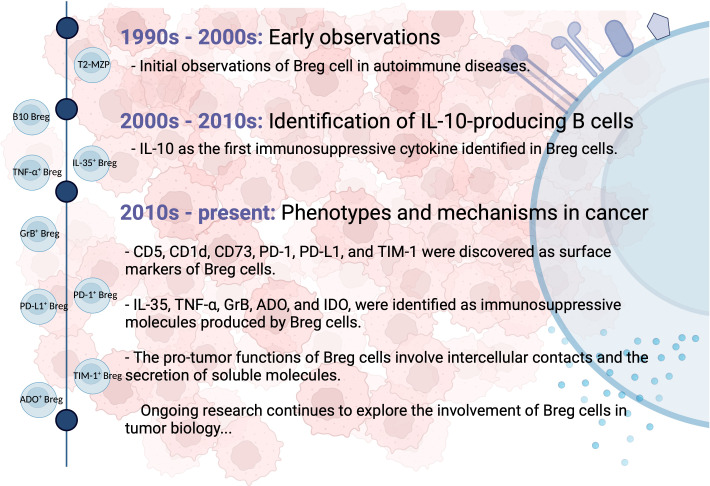
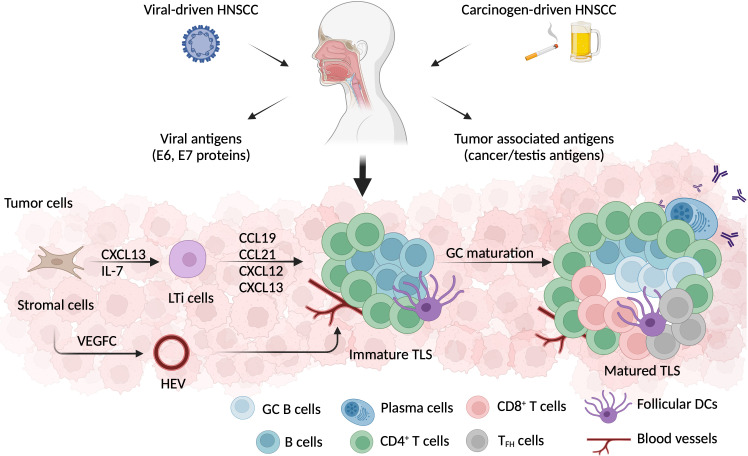
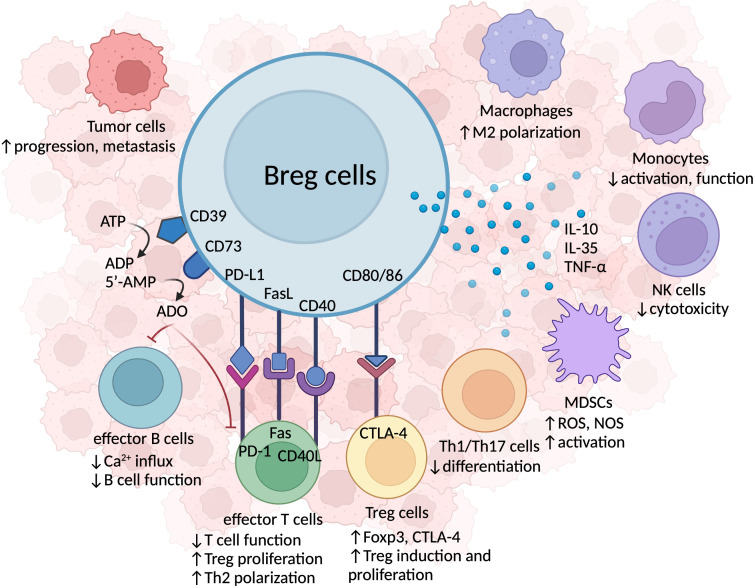
In the tumor milieu of head and neck squamous cell carcinoma (HNSCC), distinct B cell subpopulations are present, which exert either pro- or anti-tumor activities. Multiple factors, including hypoxia, cytokines, interactions with tumor cells, and other immune infiltrating lymphocytes (TILs), alter the equilibrium between the dual roles of B cells leading to cancerogenesis. Certain B cell subsets in the tumor microenvironment (TME) exhibit immunosuppressive function. These cells are known as regulatory B (Breg) cells. Breg cells suppress immune responses by secreting a series of immunosuppressive cytokines, including IL-10, IL-35, TGF-β, granzyme B, and adenosine or dampen effector TILs by intercellular contacts. Multiple Breg phenotypes have been discovered in human and mouse cancer models. However, when compartmentalized within a tertiary lymphoid structure (TLS), B cells predominantly play anti-tumor effects. A mature TLS contains a CD20 B cell zone with several important types of B cells, including germinal-center like B cells, antibody-secreting plasma cells, and memory B cells. They kill tumor cells via antibody-dependent cytotoxicity and phagocytosis, and local complement activation effects. TLSs are also privileged sites for local T and B cell coordination and activation. Nonetheless, in some cases, TLSs may serve as a niche for hidden tumor cells and indicate a bad prognosis. Thus, TIL-B cells exhibit bidirectional immune-modulatory activity and are responsive to a variety of immunotherapies. In this review, we discuss the functional distinctions between immunosuppressive Breg cells and immunogenic effector B cells that mature within TLSs with the focus on tumors of HNSCC patients. Additionally, we review contemporary immunotherapies that aim to target TIL-B cells. For the development of innovative therapeutic approaches to complement T-cell-based immunotherapy, a full understanding of either effector B cells or Breg cells is necessary.
在头颈部鳞状细胞癌(HNSCC)的肿瘤微环境中,存在不同的B细胞亚群,它们发挥着促肿瘤或抗肿瘤活性。多种因素,包括缺氧、细胞因子、与肿瘤细胞的相互作用以及其他免疫浸润淋巴细胞(TILs),改变了B细胞双重作用之间的平衡,从而导致肿瘤发生。肿瘤微环境(TME)中的某些B细胞亚群具有免疫抑制功能。这些细胞被称为调节性B(Breg)细胞。Breg细胞通过分泌一系列免疫抑制细胞因子(包括IL-10、IL-35、TGF-β、颗粒酶B和腺苷)来抑制免疫反应,或通过细胞间接触来抑制效应TILs。在人类和小鼠癌症模型中已发现多种Breg表型。然而,当B细胞分隔在三级淋巴结构(TLS)内时,它们主要发挥抗肿瘤作用。成熟的TLS包含一个CD20 B细胞区,其中有几种重要类型的B细胞,包括生发中心样B细胞、分泌抗体的浆细胞和记忆B细胞。它们通过抗体依赖性细胞毒性、吞噬作用以及局部补体激活作用来杀死肿瘤细胞。TLS也是局部T细胞和B细胞协调与激活的特殊部位。尽管如此,在某些情况下,TLS可能成为隐藏肿瘤细胞的微环境,并预示不良预后。因此,TIL-B细胞表现出双向免疫调节活性,并且对多种免疫疗法有反应。在本综述中,我们讨论了在TLS内成熟的免疫抑制性Breg细胞和免疫原性效应B细胞之间的功能差异,重点关注HNSCC患者的肿瘤。此外,我们回顾了旨在靶向TIL-B细胞的当代免疫疗法。为了开发创新的治疗方法以补充基于T细胞的免疫疗法,全面了解效应B细胞或Breg细胞是必要的。