Ruiz-Tagle Cinthya, Naves Rodrigo, García Patricia, Günther Anna, Schneiderhan-Marra Nicole, Balcells María Elvira
Departamento de Enfermedades Infecciosas del Adulto, Escuela de Medicina, Pontificia Universidad Católica de Chile, Santiago, Chile.
Instituto de Ciencias Biomédicas, Facultad de Medicina, Universidad de Chile, Santiago, Chile.
Front Med (Lausanne). 2023 Oct 6;10:1267670. doi: 10.3389/fmed.2023.1267670. eCollection 2023.
Mucosal immunity is strongly elicited in early stages of many respiratory and enteric infections; however, its role in tuberculosis pathogenesis has been scarcely explored. We aimed to investigate (Mtb) specific IgA levels in saliva in different stages of latent Tuberculosis Infection (TBI).
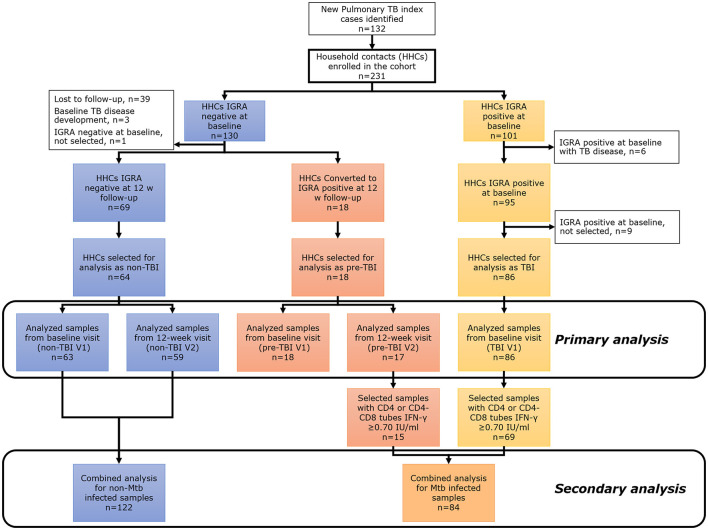
A multiplex bead-based Luminex immunoassay was developed to detect specific IgA against 12 highly immunogenic Mtb antigens. A prospective cohort of household contacts (>14 years) of pulmonary TB cases was established in Santiago, Chile. Contacts were classified as Mtb-infected or not depending on serial interferon-γ release assay results. Saliva samples were collected and tested at baseline and at a 12-week follow-up.
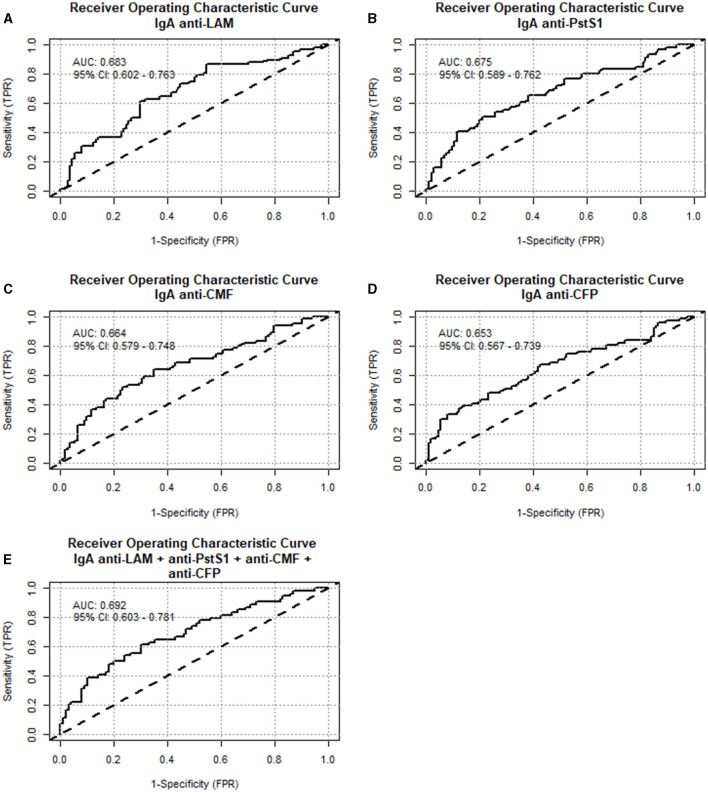
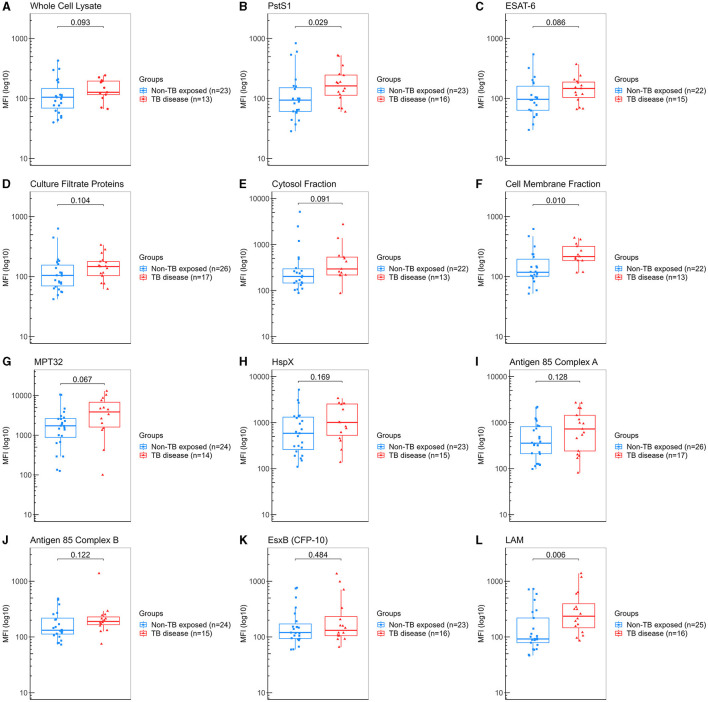
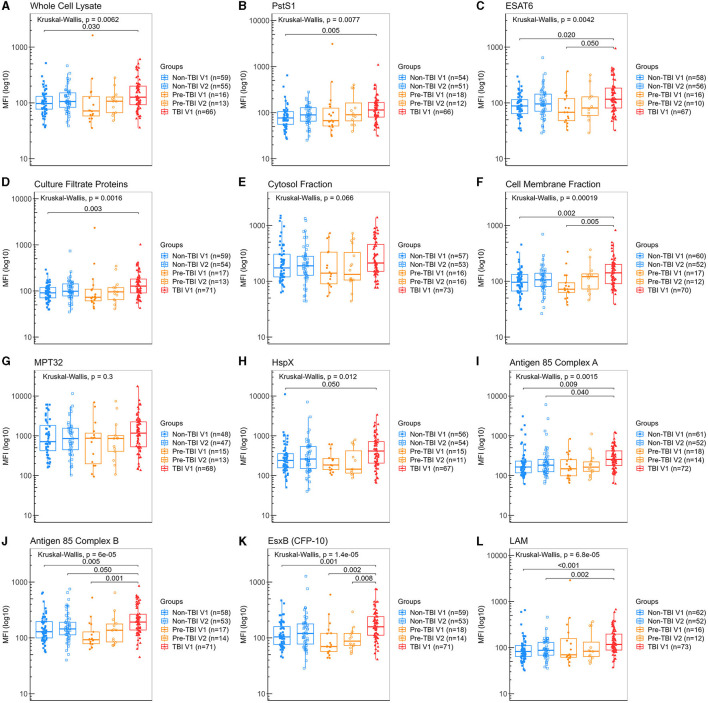
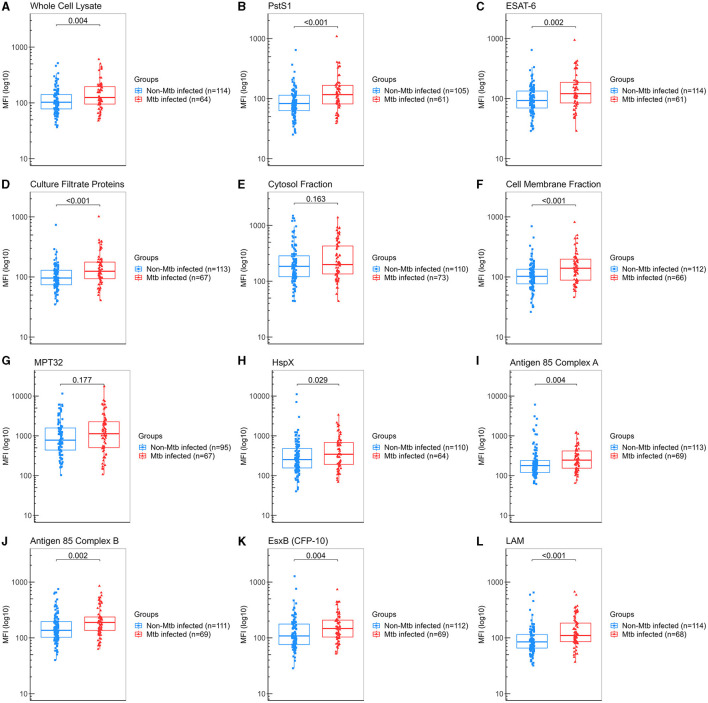
Mtb-specific IgA was detectable at all visits in all participants ( = 168), including the "non-Mtb infected" ( = 64). Significantly higher median levels of IgA were found in the "Mtb infected" compared to the uninfected for anti-lipoarabinomannan (LAM) (110 vs. 84.8 arbitrary units (AU), < 0.001), anti-PstS1 (117 vs. 83 AU, < 0.001), anti-Cell Membrane Fraction (CMF) (140 vs. 103 AU, < 0.001) and anti-Culture Filtrate Proteins (CFP) (median 125 vs. 96 AU, < 0.001), respectively. Nonetheless, the discriminatory performance of these specific mucosal IgA for TBI diagnosis was low.
Saliva holds Mtb-specific IgA against several antigens with increased levels for anti-LAM, anti-PstS1, anti-CMF and anti-CFP found in household contacts with an established TBI. The role of these mucosal antibodies in TB pathogenesis, and their kinetics in different stages of Mtb infection merits further exploring.
在许多呼吸道和肠道感染的早期阶段,黏膜免疫会被强烈激发;然而,其在结核病发病机制中的作用鲜有研究。我们旨在调查潜伏性结核感染(TBI)不同阶段唾液中结核分枝杆菌(Mtb)特异性IgA水平。
开发了一种基于多重磁珠的Luminex免疫测定法,以检测针对12种高免疫原性Mtb抗原的特异性IgA。在智利圣地亚哥建立了一个肺结核病例家庭接触者(>14岁)的前瞻性队列。根据系列干扰素-γ释放试验结果,将接触者分为Mtb感染组和未感染组。在基线和12周随访时收集唾液样本并进行检测。
在所有参与者(n = 168)的所有访视中均检测到Mtb特异性IgA,包括“未感染Mtb”者(n = 64)。与未感染者相比,“感染Mtb”者中抗脂阿拉伯甘露聚糖(LAM)(110对84.8任意单位(AU),P < 0.001)、抗PstS1(117对83 AU,P < 0.001)、抗细胞膜组分(CMF)(140对103 AU,P < 0.001)和抗培养滤液蛋白(CFP)(中位数125对96 AU,P < 0.001)的IgA中位水平显著更高。尽管如此,这些特异性黏膜IgA对TBI诊断的鉴别性能较低。
唾液中存在针对多种抗原的Mtb特异性IgA,在已确诊TBI的家庭接触者中,抗LAM、抗PstS1、抗CMF和抗CFP的水平升高。这些黏膜抗体在结核病发病机制中的作用及其在Mtb感染不同阶段的动力学值得进一步探索。