Institute of Obstetrics and Gynecology, Università Cattolica del Sacro Cuore, Rome, Italy.
Department of Cancer Treatment, Copenhagen University Hospital, Copenhagen, Denmark.
Curr Oncol Rep. 2023 Nov;25(11):1307-1326. doi: 10.1007/s11912-023-01463-9. Epub 2023 Oct 23.
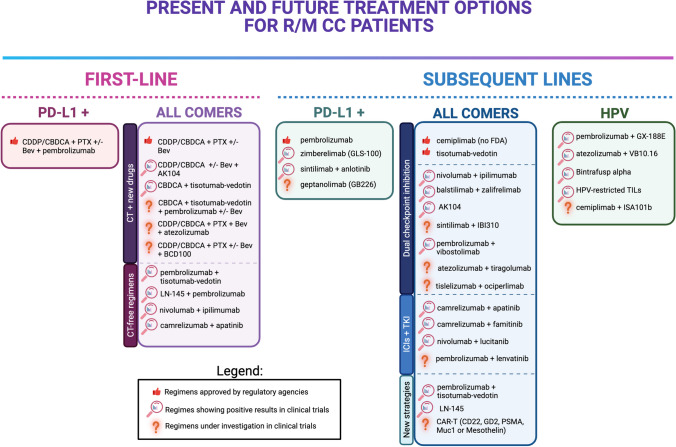
This review aims to give an insight into the currently available options for recurrent/metastatic (R/M) cervical cancer (CC), along with the main future, potentially practice-changing perspectives in this field.
Improvements in terms of tumor responses were observed with the use of immune checkpoints inhibitors (ICIs) in the previously treated CC population, followed by emerging striking data in terms of both antitumor activity and survival rates with the addition of the ICIs to platinum-based chemotherapy with or without bevacizumab in the first-line setting. Furthermore, the CC treatment landscape took another step forward in 2021 with the introduction of antibody-drug conjugates (ADCs) in the second-line setting, a highly targeted therapeutic strategy, which demonstrated to be a valid alternative option in the recurrent setting. R/M CC is a hard-to-treat disease. However, after several years of limited systemic therapeutic options for the recurrent setting, the year 2018 marked a turning point for R/M CC patients, with the introduction of immunotherapy in the treatment paradigm, which completely reshaped the therapeutic armamentarium of the disease. Besides, another valuable treatment option represented by ADCs demonstrated its efficacy in the recurrent setting, thus further widening the treatment landscape for those patients. Yet, the introduction of immunotherapy in the upfront setting brought along new issues to be addressed such as the emerging ICIs resistance and the following need for alternative options in the post-ICIs setting. Several innovative therapeutic strategies are under investigation in ongoing clinical trials, with the aim of overcoming ICIs resistance with the addition of immunomodulatory agents or bypassing the ICIs resistance with novel alternative drugs.
本文旨在深入探讨复发性/转移性(R/M)宫颈癌(CC)的现有治疗选择,并介绍该领域未来可能改变临床实践的潜在新方向。
在先前接受过治疗的 CC 人群中使用免疫检查点抑制剂(ICIs)可提高肿瘤应答率,随后的数据显示,在一线治疗中加入 ICIs 联合或不联合贝伐珠单抗的铂类化疗方案,无论是抗肿瘤活性还是生存率方面,均取得了显著效果。此外,2021 年二线治疗中引入抗体药物偶联物(ADC)也进一步推动了 CC 治疗领域的发展,这是一种高度靶向的治疗策略,在复发性疾病中是一种有效的替代选择。R/M CC 是一种难以治疗的疾病。然而,在复发性疾病的治疗方案中,经过多年的系统治疗选择有限后,2018 年免疫疗法的引入标志着 R/M CC 患者治疗的一个转折点,这彻底改变了该疾病的治疗策略。此外,ADC 等另一种有价值的治疗选择在复发性疾病中也显示出了疗效,从而进一步拓宽了这些患者的治疗选择。然而,免疫疗法在一线治疗中的应用也带来了新的问题,如出现 ICI 耐药性,以及在 ICI 治疗后需要新的替代方案。目前正在进行的临床试验中正在研究多种创新的治疗策略,旨在通过添加免疫调节剂或使用新型替代药物来克服 ICI 耐药性。