From Shanghai Pulmonary Hospital, Tongji University School of Medicine (C.Z.), and the Department of Respiratory and Critical Care Medicine, Shanghai Chest Hospital, School of Medicine, Shanghai Jiao Tong University (B.H.), Shanghai, the Chinese University of Hong Kong, Hong Kong (H.H.L.), and the First Affiliated Hospital, Zhejiang University School of Medicine, Hangzhou (J.Z.) - all in China; Peter MacCallum Cancer Institute, Melbourne, VIC, Australia (B.S.); Samsung Medical Center, Sungkyunkwan University School of Medicine, Seoul, South Korea (K.P.); Centre Léon Bérard, Lyon, France (M.P.); Hospital del Mar, Barcelona (E.A.); the Department of Oncology, Azienda Ospedaliero-Universitaria San Luigi-Orbassano, University of Turin, Turin (S.N.), and IRCCS Azienda Ospedaliero-Universitaria di Bologna, Bologna (A.A.) - both in Italy; Instituto do Câncer do Estado de São Paulo, University of São Paulo Medical School and Instituto D'Or de Ensino e Pesquisa (M.P.M.), and the Oncology Center, Hospital Śırio Libanês (F.C.S.) - both in São Paulo; the University of Texas M.D. Anderson Cancer Center, Houston (Y.Y.E.); Memorial Sloan Kettering Cancer Center and Weill Cornell Medical College, New York (A.D.); the Center for Integrated Oncology, University Hospital of Cologne, Cologne, Germany (J.W.); Loxo@Lilly (H.H.) and Eli Lilly (N.P., M.K.U., D.R., T.P., V.S., A.B.L., B.K.L.) - both in Indianapolis; and National Cancer Center Hospital East, Kashiwa, Japan (K.G.).
N Engl J Med. 2023 Nov 16;389(20):1839-1850. doi: 10.1056/NEJMoa2309457. Epub 2023 Oct 21.
Selpercatinib, a highly selective potent and brain-penetrant RET inhibitor, was shown to have efficacy in patients with advanced fusion-positive non-small-cell lung cancer (NSCLC) in a nonrandomized phase 1-2 study.
In a randomized phase 3 trial, we evaluated the efficacy and safety of first-line selpercatinib as compared with control treatment that consisted of platinum-based chemotherapy with or without pembrolizumab at the investigator's discretion. The primary end point was progression-free survival assessed by blinded independent central review in both the intention-to-treat-pembrolizumab population (i.e., patients whose physicians had planned to treat them with pembrolizumab in the event that they were assigned to the control group) and the overall intention-to-treat population. Crossover from the control group to the selpercatinib group was allowed if disease progression as assessed by blinded independent central review occurred during receipt of control treatment.
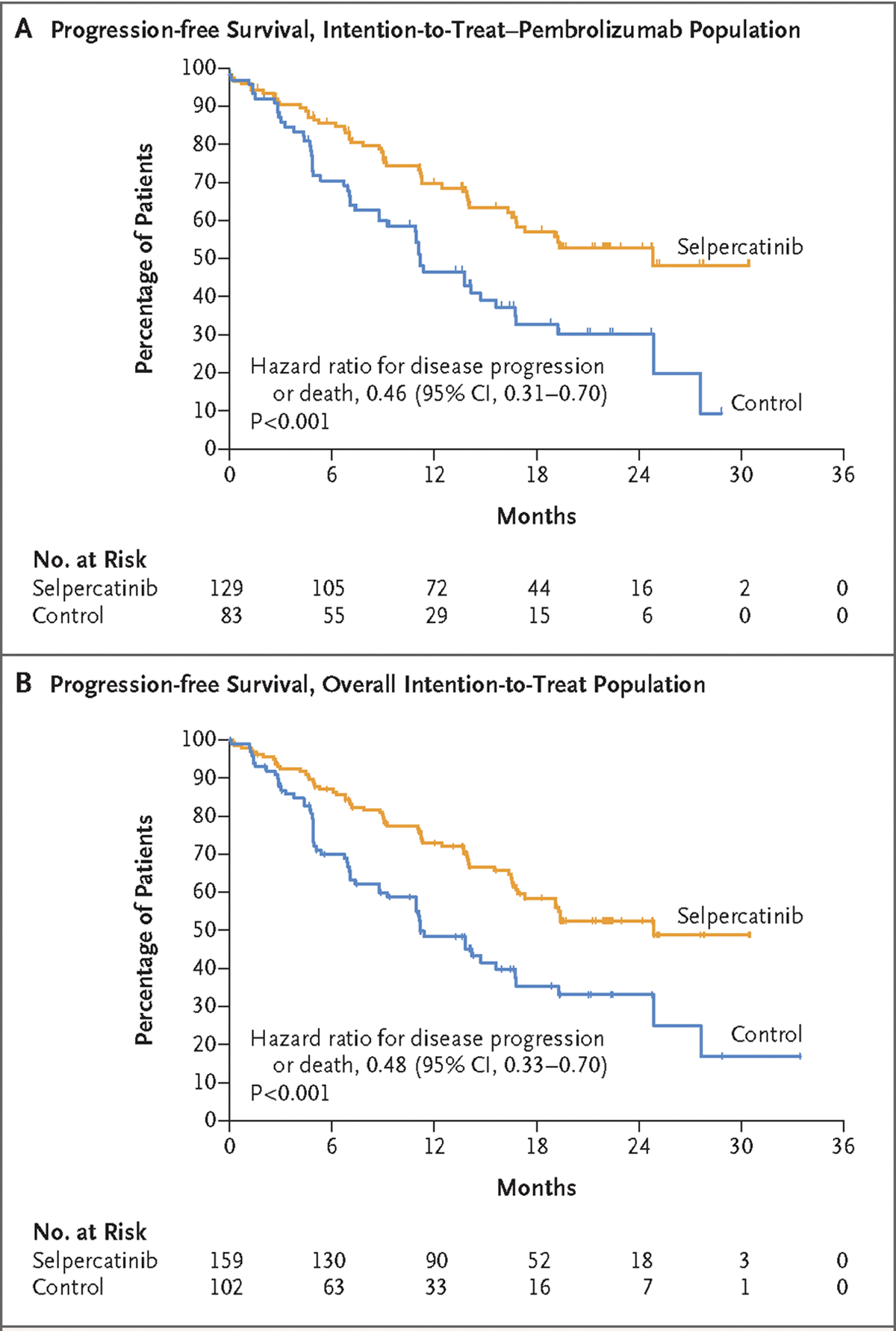
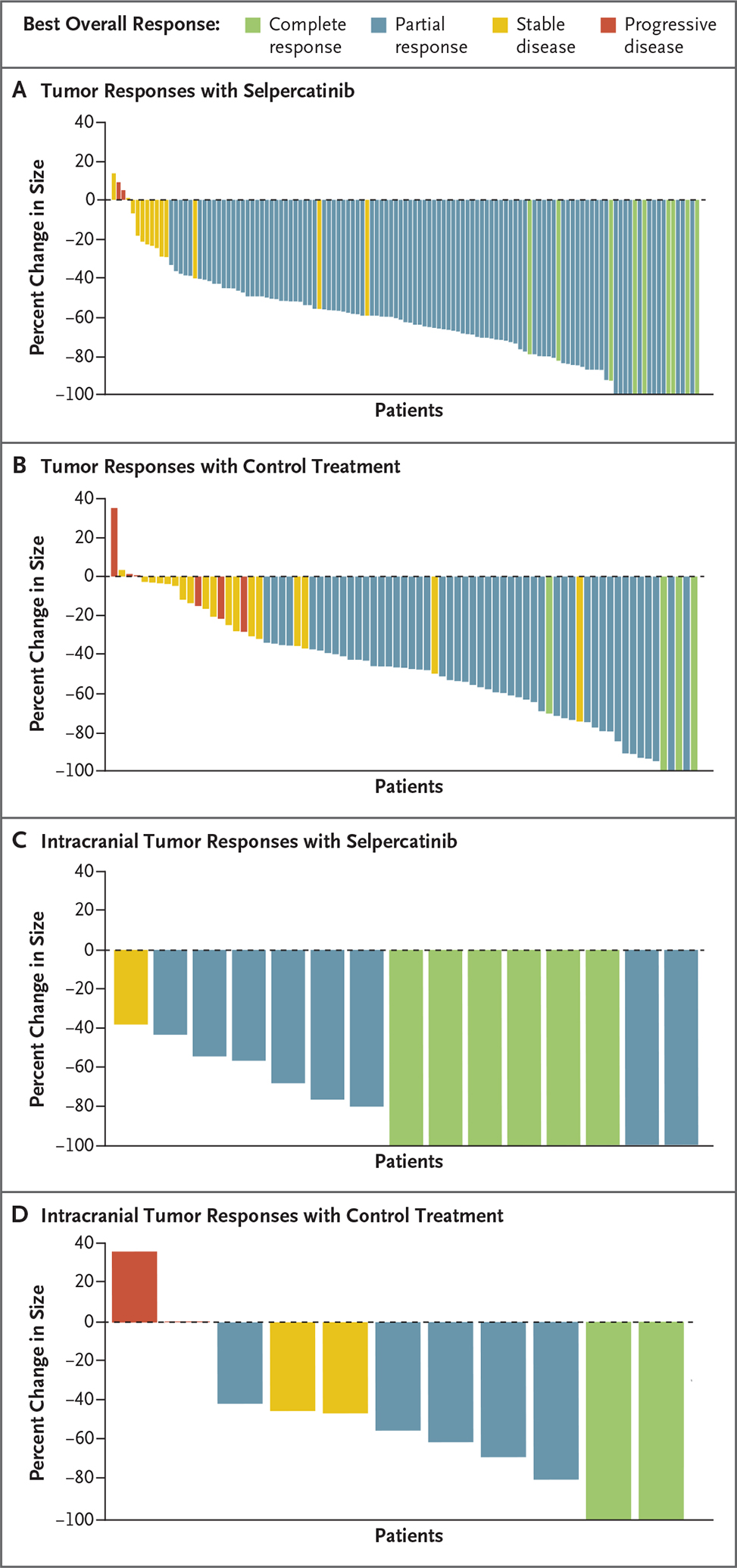
In total, 212 patients underwent randomization in the intention-to-treat-pembrolizumab population. At the time of the preplanned interim efficacy analysis, median progression-free survival was 24.8 months (95% confidence interval [CI], 16.9 to not estimable) with selpercatinib and 11.2 months (95% CI, 8.8 to 16.8) with control treatment (hazard ratio for progression or death, 0.46; 95% CI, 0.31 to 0.70; P<0.001). The percentage of patients with an objective response was 84% (95% CI, 76 to 90) with selpercatinib and 65% (95% CI, 54 to 75) with control treatment. The cause-specific hazard ratio for the time to progression affecting the central nervous system was 0.28 (95% CI, 0.12 to 0.68). Efficacy results in the overall intention-to-treat population (261 patients) were similar to those in the intention-to-treat-pembrolizumab population. The adverse events that occurred with selpercatinib and control treatment were consistent with those previously reported.
Treatment with selpercatinib led to significantly longer progression-free survival than platinum-based chemotherapy with or without pembrolizumab among patients with advanced fusion-positive NSCLC. (Funded by Eli Lilly and others; ClinicalTrials.gov number, NCT04194944.).
在一项非随机的 1-2 期研究中,高度选择性的强效且能穿透血脑屏障的 RET 抑制剂塞普替尼(Selpercatinib)在晚期融合阳性非小细胞肺癌(NSCLC)患者中显示出疗效。
在一项随机 3 期试验中,我们评估了一线塞普替尼治疗与根据研究者的判断选择铂类化疗加或不加派姆单抗的对照组相比的疗效和安全性。主要终点是在在意向治疗人群(即,如果他们被分配到对照组,他们的医生计划用派姆单抗治疗他们的患者)和总体意向治疗人群中通过盲法独立中心审查评估的无进展生存期。如果在接受对照治疗期间发生盲法独立中心审查评估的疾病进展,允许从对照组交叉到塞普替尼组。
共有 212 名患者在意向治疗人群中接受了随机分组。在预先计划的中期疗效分析时,塞普替尼组的中位无进展生存期为 24.8 个月(95%置信区间[CI],16.9 至无法估计),对照组为 11.2 个月(95%CI,8.8 至 16.8)(进展或死亡的风险比,0.46;95%CI,0.31 至 0.70;P<0.001)。塞普替尼组客观缓解率为 84%(95%CI,76%至 90%),对照组为 65%(95%CI,54%至 75%)。影响中枢神经系统进展的特异性风险比为 0.28(95%CI,0.12 至 0.68)。在总体意向治疗人群(261 名患者)中,疗效结果与在意向治疗人群中相似。塞普替尼和对照组治疗相关的不良事件与先前报道的一致。
与铂类化疗加或不加派姆单抗相比,晚期融合阳性 NSCLC 患者接受塞普替尼治疗可显著延长无进展生存期。(由礼来公司和其他公司资助;ClinicalTrials.gov 编号,NCT04194944)。