Xie Yajun, Reid Christopher M, Granados Alejandro A, Garcia Miguel Turrero, Dale-Huang Fiona, Hanson Sarah M, Mancia Walter, Liu Jonathan, Adam Manal, Mosto Olivia, Pisco Angela O, Alvarez-Buylla Arturo, Harwell Corey C
Department of Neurology, University of California, San Francisco, CA.
Eli and Edythe Broad Center of Regeneration Medicine and Stem Cell Research, San Francisco, CA.
bioRxiv. 2023 Oct 10:2023.10.08.561428. doi: 10.1101/2023.10.08.561428.
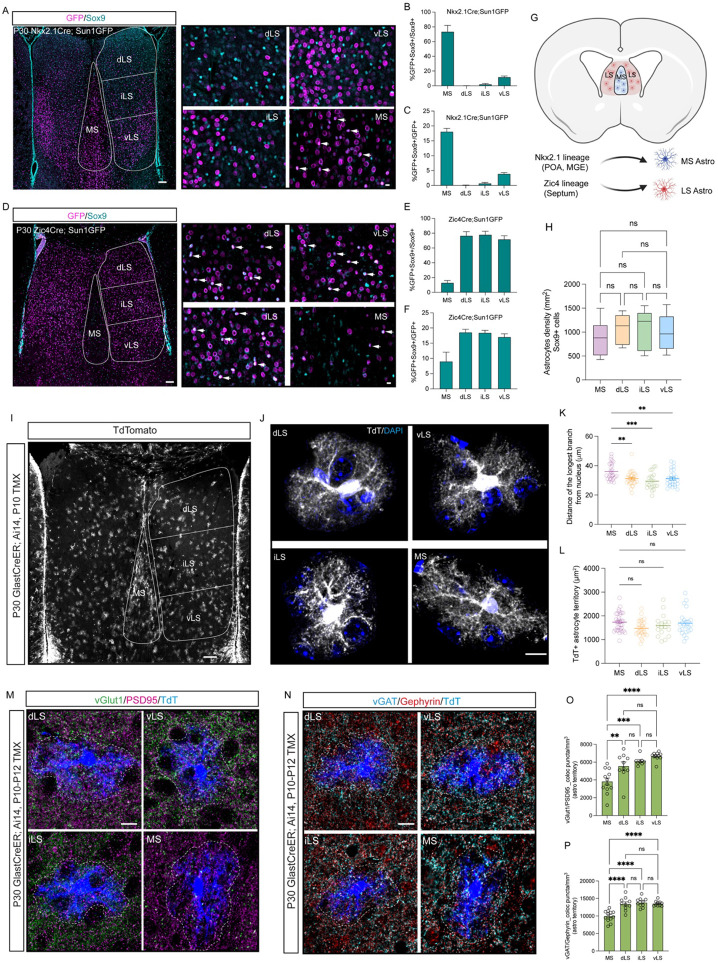
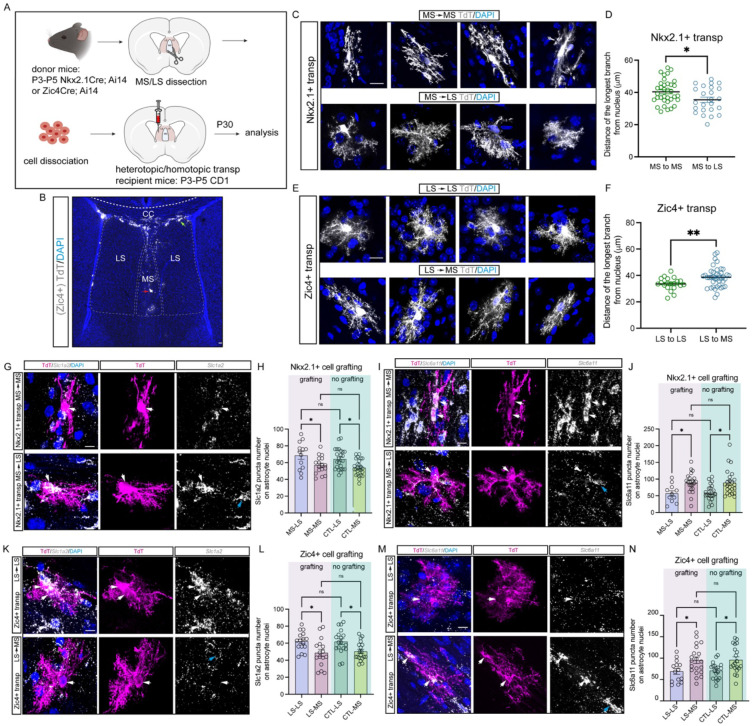
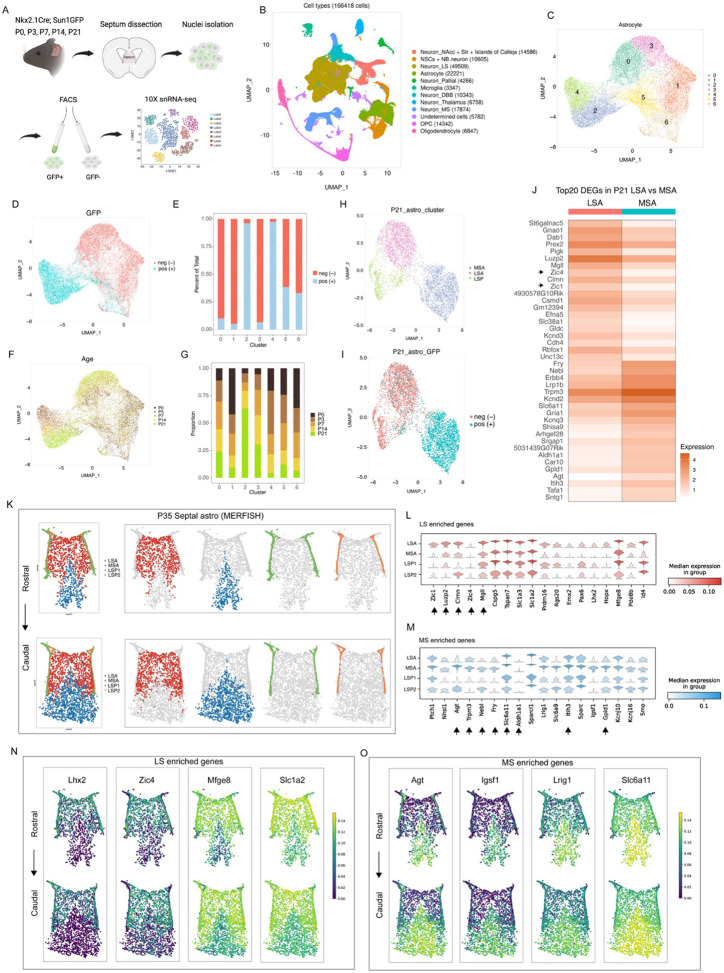
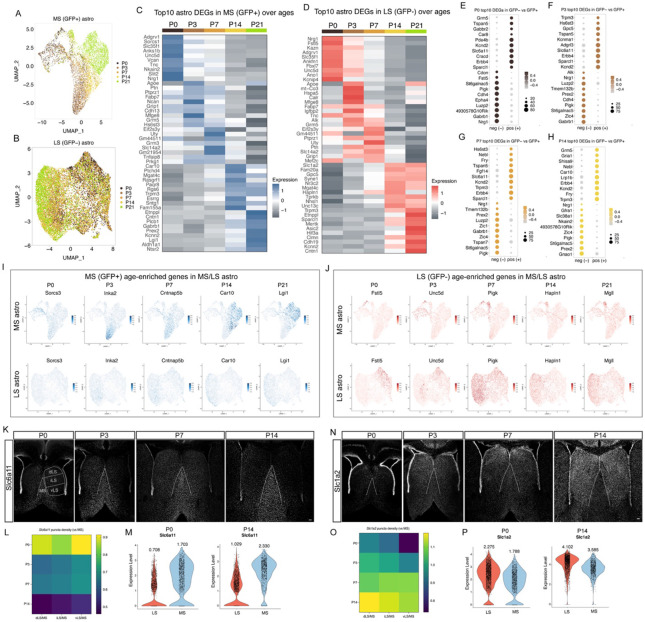
Astrocyte specification during development is influenced by both intrinsic and extrinsic factors, but the precise contribution of each remains poorly understood. Here we show that septal astrocytes from Nkx2.1 and Zic4 expressing progenitor zones are allocated into non-overlapping domains of the medial (MS) and lateral septal nuclei (LS) respectively. Astrocytes in these areas exhibit distinctive molecular and morphological features tailored to the unique cellular and synaptic circuit environment of each nucleus. Using single-nucleus (sn) RNA sequencing, we trace the developmental trajectories of cells in the septum and find that neurons and astrocytes undergo region and developmental stage-specific local cell-cell interactions. We show that expression of the classic morphogens Sonic hedgehog (Shh) and Fibroblast growth factors (Fgfs) by MS and LS neurons respectively, functions to promote the molecular specification of local astrocytes in each region. Finally, using heterotopic cell transplantation, we show that both morphological and molecular specifications of septal astrocytes are highly dependent on the local microenvironment, regardless of developmental origins. Our data highlights the complex interplay between intrinsic and extrinsic factors shaping astrocyte identities and illustrates the importance of the local environment in determining astrocyte functional specialization.
发育过程中星形胶质细胞的特化受到内在和外在因素的影响,但每种因素的确切作用仍知之甚少。在这里,我们表明,来自表达Nkx2.1和Zic4的祖细胞区的隔区星形胶质细胞分别被分配到内侧隔核(MS)和外侧隔核(LS)的非重叠区域。这些区域的星形胶质细胞表现出独特的分子和形态特征,以适应每个核独特的细胞和突触回路环境。使用单核(sn)RNA测序,我们追踪了隔区细胞的发育轨迹,发现神经元和星形胶质细胞经历区域和发育阶段特异性的局部细胞间相互作用。我们表明,MS和LS神经元分别表达经典形态发生素音猬因子(Shh)和成纤维细胞生长因子(Fgfs),其作用是促进每个区域局部星形胶质细胞的分子特化。最后,使用异位细胞移植,我们表明隔区星形胶质细胞的形态和分子特化都高度依赖于局部微环境,而与发育起源无关。我们的数据突出了塑造星形胶质细胞身份的内在和外在因素之间的复杂相互作用,并说明了局部环境在决定星形胶质细胞功能特化中的重要性。