Cooper Benjamin F, Clark Robert, Kudhail Anju, Bhabha Gira, Ekiert Damian C, Khalid Syma, Isom Georgia L
Sir William Dunn School of Pathology, University of Oxford, Oxford, OX1 3RE, UK.
Department of Biochemistry, University of Oxford, Oxford, OX1 3QU, UK.
bioRxiv. 2023 Oct 5:2023.10.05.561070. doi: 10.1101/2023.10.05.561070.
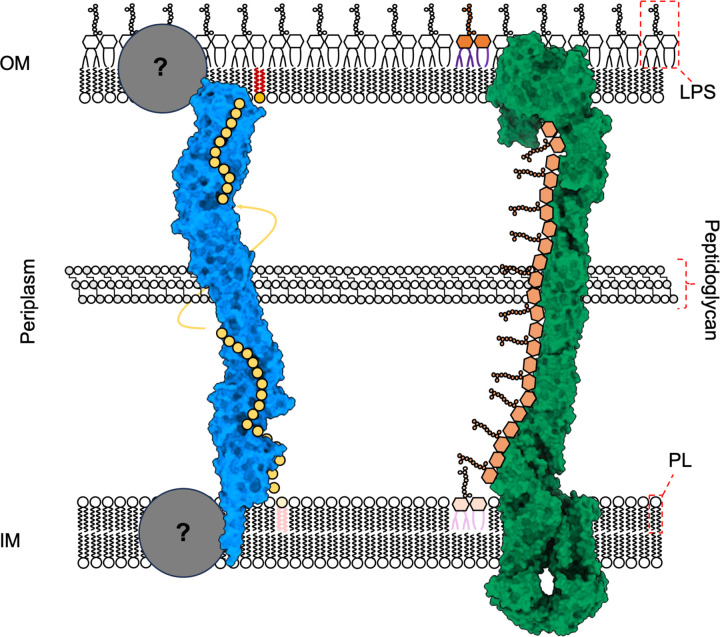
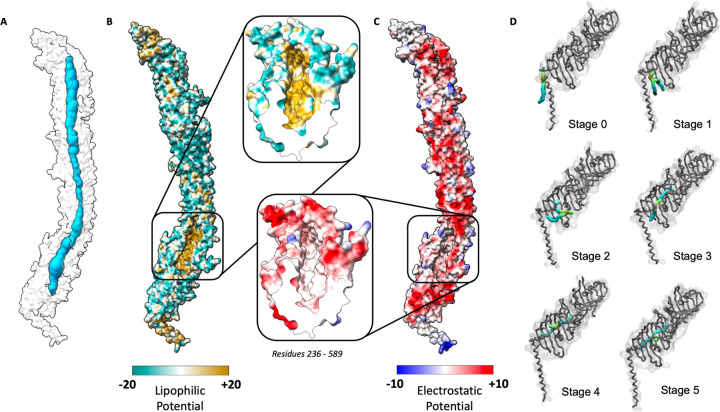
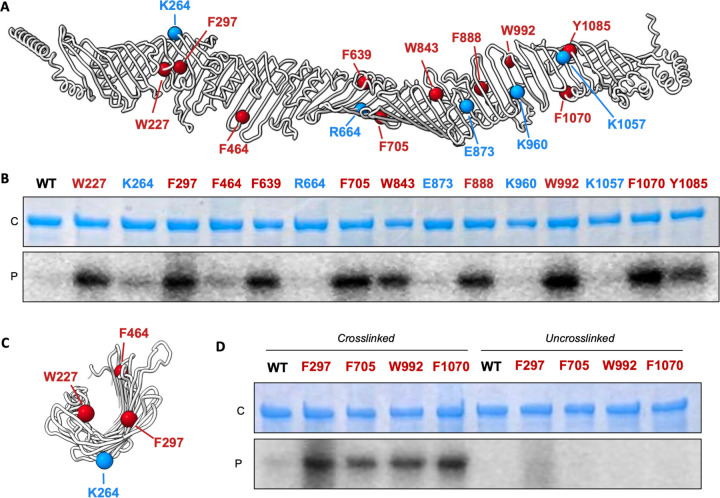
The outer membrane of Gram-negative bacteria provides a formidable barrier, essential for both pathogenesis and antimicrobial resistance. Biogenesis of the outer membrane requires the transport of phospholipids across the cell envelope. Recently, YhdP was implicated as a major protagonist in the transport of phospholipids from the inner membrane to the outer membrane however the molecular mechanism of YhdP mediated transport remains elusive. Here, utilising AlphaFold, we observe YhdP to form an elongated assembly of 60 β strands that curve to form a continuous hydrophobic groove. This architecture is consistent with our negative stain electron microscopy data which reveals YhdP to be approximately 250 Å in length and thus sufficient to span the bacterial cell envelope. Furthermore, molecular dynamics simulations and in vivo bacterial growth assays indicate essential helical regions at the N- and C-termini of YhdP, that may embed into the inner and outer membranes respectively, reinforcing its envelope spanning nature. Our in vivo crosslinking data reveal phosphate-containing substrates captured along the length of the YhdP groove, providing direct evidence that YhdP transports phospholipids. This finding is congruent with our molecular dynamics simulations which demonstrate the propensity for inner membrane lipids to spontaneously enter the groove of YhdP. Collectively, our results support a model in which YhdP bridges the cell envelope, providing a hydrophobic environment for the transport of phospholipids to the outer membrane.
革兰氏阴性菌的外膜构成了一道强大的屏障,这对于发病机制和抗菌耐药性都至关重要。外膜的生物合成需要磷脂穿过细胞包膜进行运输。最近,YhdP被认为是磷脂从内膜运输到外膜的主要参与者,然而,YhdP介导运输的分子机制仍然不清楚。在这里,利用AlphaFold,我们观察到YhdP形成了一个由60条β链组成的细长组装体,这些链弯曲形成一个连续的疏水凹槽。这种结构与我们的负染色电子显微镜数据一致,该数据显示YhdP的长度约为250 Å,因此足以跨越细菌细胞包膜。此外,分子动力学模拟和体内细菌生长试验表明,YhdP的N端和C端存在关键的螺旋区域,它们可能分别嵌入内膜和外膜,强化了其跨越包膜的性质。我们的体内交联数据揭示了沿YhdP凹槽长度捕获的含磷酸底物,提供了YhdP运输磷脂的直接证据。这一发现与我们的分子动力学模拟结果一致,该模拟结果表明内膜脂质有自发进入YhdP凹槽的倾向。总的来说,我们的结果支持了一个模型,即YhdP横跨细胞包膜,为磷脂运输到外膜提供了一个疏水环境。