Chang Daniel, Gupta Vinod K, Hur Benjamin, Cobo-López Sergio, Cunningham Kevin Y, Han Nam Soo, Lee Insuk, Kronzer Vanessa L, Teigen Levi M, Karnatovskaia Lioudmila V, Longbrake Erin E, Davis John M, Nelson Heidi, Sung Jaeyun
Department of Computer Science and Engineering, University of Minnesota, Minneapolis, MN 55455, USA.
Microbiome Program, Center for Individualized Medicine, Mayo Clinic, Rochester, MN 55905, USA.
bioRxiv. 2023 Oct 2:2023.09.30.560294. doi: 10.1101/2023.09.30.560294.
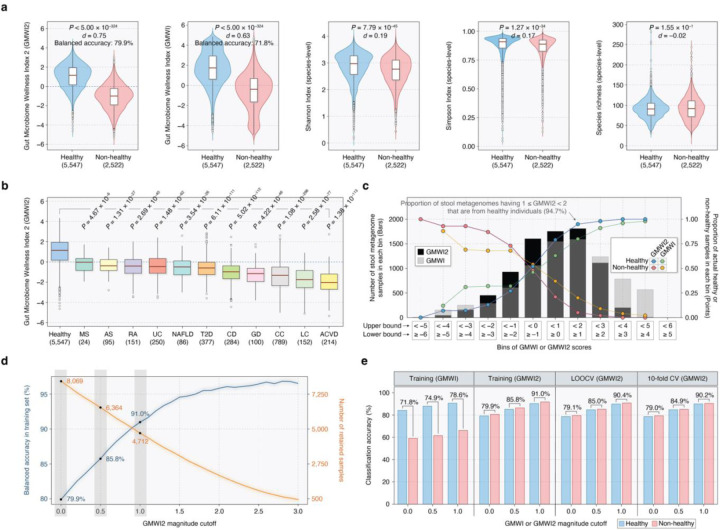
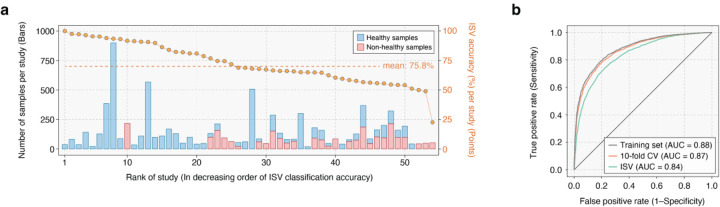
Recent advancements in human gut microbiome research have revealed its crucial role in shaping innovative predictive healthcare applications. We introduce Gut Microbiome Wellness Index 2 (GMWI2), an advanced iteration of our original GMWI prototype, designed as a robust, disease-agnostic health status indicator based on gut microbiome taxonomic profiles. Our analysis involved pooling existing 8069 stool shotgun metagenome data across a global demographic landscape to effectively capture biological signals linking gut taxonomies to health. GMWI2 achieves a cross-validation balanced accuracy of 80% in distinguishing healthy (no disease) from non-healthy (diseased) individuals and surpasses 90% accuracy for samples with higher confidence (i.e., outside the "reject option"). The enhanced classification accuracy of GMWI2 outperforms both the original GMWI model and traditional species-level α-diversity indices, suggesting a more reliable tool for differentiating between healthy and non-healthy phenotypes using gut microbiome data. Furthermore, by reevaluating and reinterpreting previously published data, GMWI2 provides fresh insights into the established understanding of how diet, antibiotic exposure, and fecal microbiota transplantation influence gut health. Looking ahead, GMWI2 represents a timely pivotal tool for evaluating health based on an individual's unique gut microbial composition, paving the way for the early screening of adverse gut health shifts. GMWI2 is offered as an open-source command-line tool, ensuring it is both accessible to and adaptable for researchers interested in the translational applications of human gut microbiome science.
人类肠道微生物组研究的最新进展揭示了其在塑造创新型预测性医疗保健应用方面的关键作用。我们推出了肠道微生物组健康指数2(GMWI2),这是我们原始GMWI原型的升级版,设计为一种基于肠道微生物组分类图谱的强大的、与疾病无关的健康状况指标。我们的分析涉及汇总全球不同人群的8069份粪便鸟枪法宏基因组现有数据,以有效捕捉将肠道分类与健康联系起来的生物信号。GMWI2在区分健康(无疾病)个体和非健康(患病)个体方面实现了80%的交叉验证平衡准确率,并在具有更高置信度的样本(即超出“拒绝选项”)中超过了90%的准确率。GMWI2提高的分类准确率优于原始GMWI模型和传统的物种水平α多样性指数,表明它是一种使用肠道微生物组数据区分健康和非健康表型的更可靠工具。此外,通过重新评估和重新解读先前发表的数据,GMWI2为饮食、抗生素暴露和粪便微生物群移植如何影响肠道健康的既定理解提供了新的见解。展望未来,GMWI2是一种基于个体独特的肠道微生物组成评估健康状况的适时关键工具,为早期筛查肠道健康的不良变化铺平了道路。GMWI2作为一个开源命令行工具提供,确保对人类肠道微生物组科学转化应用感兴趣的研究人员能够使用并进行调整。