Zhu Zhenglu, Li Xiaohui, Qi Xiaoqun, Ji Jie, Ji Yongsheng, Jiang Ruining, Liang Chaofan, Yang Dan, Yang Ze, Qie Long, Huang Yunhui
State Key Laboratory of Material Processing and Die and Mold Technology, School of Materials Science and Engineering, Huazhong University of Science and Technology, Wuhan, 430074, Hubei, People's Republic of China.
Institute of New Energy for Vehicles, School of Materials Science and Engineering, Tongji University, Shanghai, 201804, People's Republic of China.
Nanomicro Lett. 2023 Oct 24;15(1):234. doi: 10.1007/s40820-023-01205-3.
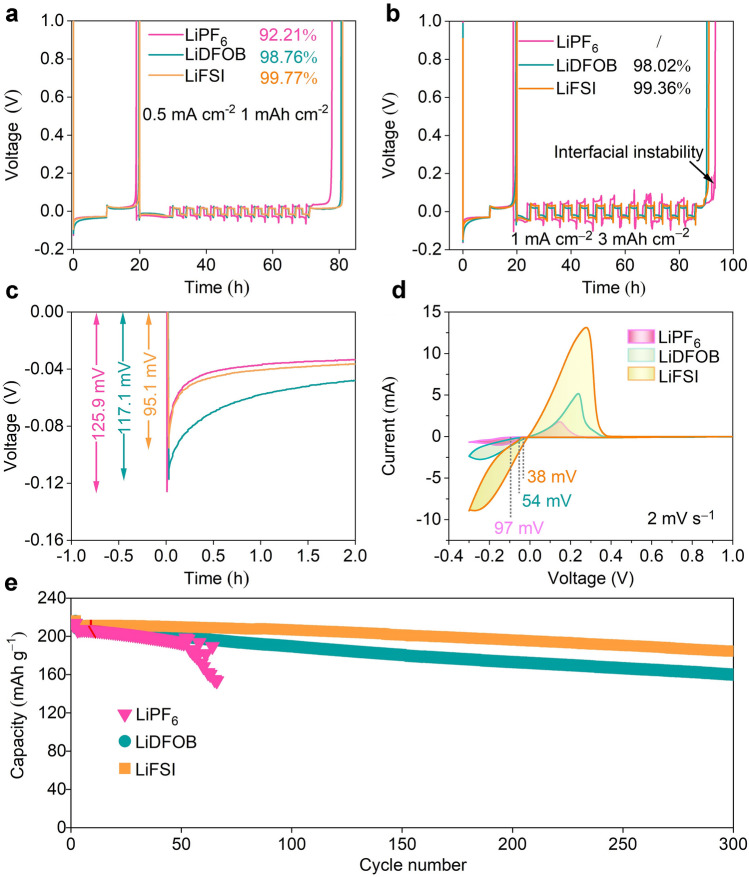
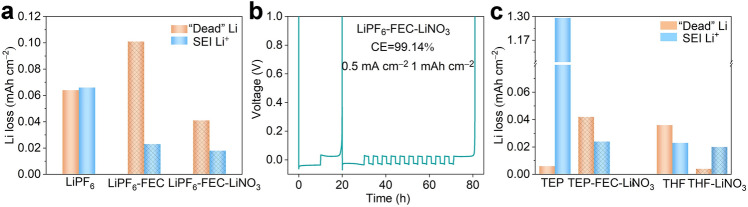
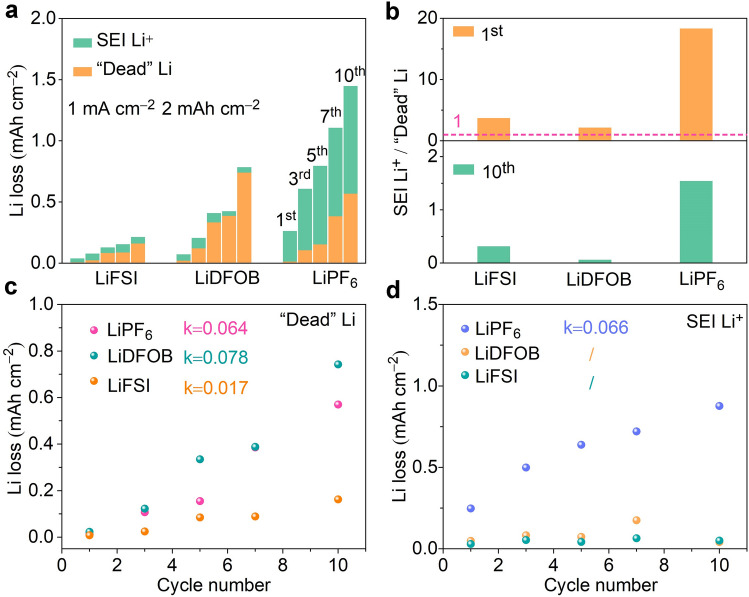
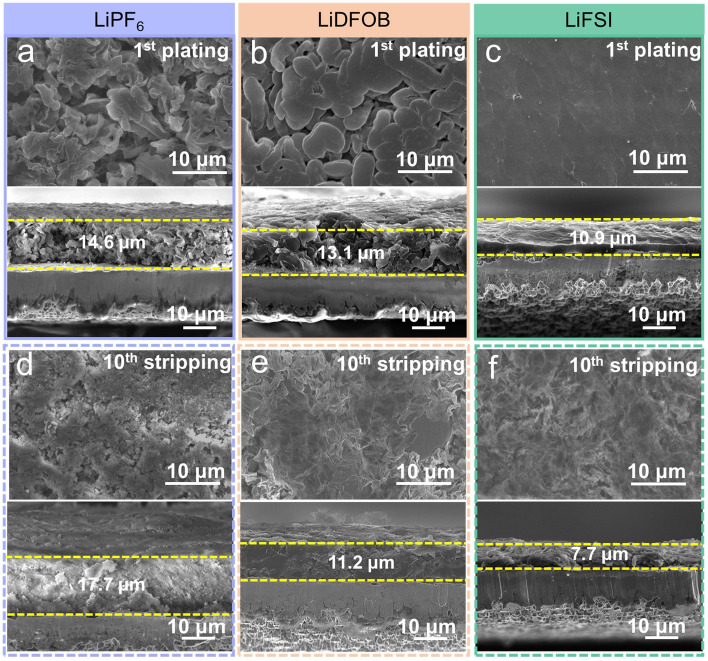
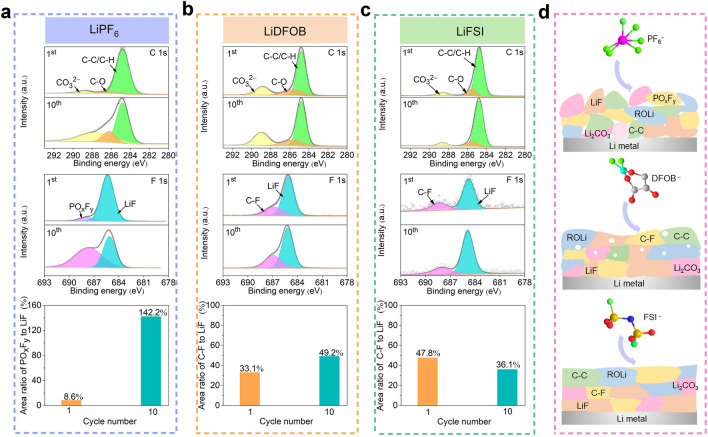
Lithium (Li) metal electrodes show significantly different reversibility in the electrolytes with different salts. However, the understanding on how the salts impact on the Li loss remains unclear. Herein, using the electrolytes with different salts (e.g., lithium hexafluorophosphate (LiPF), lithium difluoro(oxalato)borate (LiDFOB), and lithium bis(fluorosulfonyl)amide (LiFSI)) as examples, we decouple the irreversible Li loss (SEI Li and "dead" Li) during cycling. It is found that the accumulation of both SEI Li and "dead" Li may be responsible to the irreversible Li loss for the Li metal in the electrolyte with LiPF salt. While for the electrolytes with LiDFOB and LiFSI salts, the accumulation of "dead" Li predominates the Li loss. We also demonstrate that lithium nitrate and fluoroethylene carbonate additives could, respectively, function as the "dead" Li and SEI Li inhibitors. Inspired by the above understandings, we propose a universal procedure for the electrolyte design of Li metal batteries (LMBs): (i) decouple and find the main reason for the irreversible Li loss; (ii) add the corresponding electrolyte additive. With such a Li-loss-targeted strategy, the Li reversibility was significantly enhanced in the electrolytes with 1,2-dimethoxyethane, triethyl phosphate, and tetrahydrofuran solvents. Our strategy may broaden the scope of electrolyte design toward practical LMBs.
锂(Li)金属电极在含有不同盐类的电解质中表现出显著不同的可逆性。然而,关于盐类如何影响锂损失的理解仍不清楚。在此,以含有不同盐类(如六氟磷酸锂(LiPF)、二氟(草酸根)硼酸锂(LiDFOB)和双(氟磺酰)亚胺锂(LiFSI))的电解质为例,我们解析了循环过程中不可逆的锂损失(固体电解质界面锂和“死”锂)。研究发现,对于含有LiPF盐的电解质中的锂金属,固体电解质界面锂和“死”锂的积累都可能是不可逆锂损失的原因。而对于含有LiDFOB和LiFSI盐的电解质,“死”锂的积累主导了锂损失。我们还证明,硝酸锂和氟代碳酸乙烯酯添加剂可分别作为“死”锂和固体电解质界面锂的抑制剂。受上述认识的启发,我们提出了一种用于锂金属电池(LMBs)电解质设计的通用方法:(i)解析并找出不可逆锂损失的主要原因;(ii)添加相应的电解质添加剂。采用这种以锂损失为目标的策略,在含有1,2 - 二甲氧基乙烷、磷酸三乙酯和四氢呋喃溶剂的电解质中,锂的可逆性得到了显著提高。我们的策略可能会拓宽面向实用锂金属电池的电解质设计范围。