Department of Medicine, Division of Diabetes, Endocrinology and Metabolism, Vanderbilt University Medical Center, Nashville, TN.
Department of Biostatistics, Vanderbilt University Medical Center, Nashville, TN.
Diabetes. 2024 Jan 1;73(1):38-50. doi: 10.2337/db23-0356.
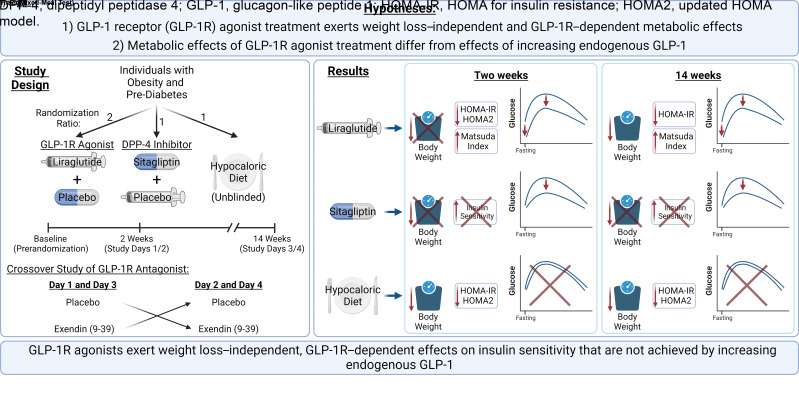
Metabolic effects of glucagon-like peptide 1 (GLP-1) receptor agonists are confounded by weight loss and not fully recapitulated by increasing endogenous GLP-1. We tested the hypothesis that GLP-1 receptor (GLP-1R) agonists exert weight loss-independent, GLP-1R-dependent effects that differ from effects of increasing endogenous GLP-1. Individuals with obesity and prediabetes were randomized to receive for 14 weeks the GLP-1R agonist liraglutide, a hypocaloric diet, or the dipeptidyl peptidase 4 (DPP-4) inhibitor sitagliptin. The GLP-1R antagonist exendin(9-39) and placebo were administered in a two-by-two crossover study during mixed-meal tests. Liraglutide and diet, but not sitagliptin, caused weight loss. Liraglutide improved insulin sensitivity measured by HOMA for insulin resistance (HOMA-IR), the updated HOMA model (HOMA2), and the Matsuda index after 2 weeks, prior to weight loss. Liraglutide decreased fasting and postprandial glucose levels, and decreased insulin, C-peptide, and fasting glucagon levels. In contrast, diet-induced weight loss improved insulin sensitivity by HOMA-IR and HOMA2, but not the Matsuda index, and did not decrease glucose levels. Sitagliptin increased endogenous GLP-1 and GIP values without altering insulin sensitivity or fasting glucose levels, but decreased postprandial glucose and glucagon levels. Notably, sitagliptin increased GIP without altering weight. Acute GLP-1R antagonism increased glucose levels in all groups, increased the Matsuda index and fasting glucagon level during liraglutide treatment, and increased endogenous GLP-1 values during liraglutide and sitagliptin treatments. Thus, liraglutide exerts rapid, weight loss-independent, GLP-1R-dependent effects on insulin sensitivity that are not achieved by increasing endogenous GLP-1.
Metabolic benefits of glucagon-like peptide 1 (GLP-1) receptor agonists are confounded by weight loss and are not fully achieved by increasing endogenous GLP-1 through dipeptidyl peptidase 4 (DPP-4) inhibition. We investigated weight loss-independent, GLP-1 receptor (GLP-1R)-dependent metabolic effects of liraglutide versus a hypocaloric diet or the DPP-4 inhibitor sitagliptin. GLP-1R antagonism with exendin(9-39) was used to assess GLP-1R-dependent effects during mixed meals. Liraglutide improved insulin sensitivity and decreased fasting and postprandial glucose prior to weight loss, and these benefits were reversed by exendin(9-39). GLP-1R agonists exert rapid, weight loss-independent, GLP-1R-dependent effects on insulin sensitivity not achieved by increasing endogenous GLP-1.
探讨胰高血糖素样肽 1(GLP-1)受体激动剂的代谢作用是否因体重减轻而受到影响,以及其是否可以通过增加内源性 GLP-1 来完全再现。
我们假设 GLP-1 受体(GLP-1R)激动剂可以发挥与体重减轻无关的 GLP-1R 依赖性作用,这些作用与增加内源性 GLP-1 的作用不同。将肥胖和前驱糖尿病患者随机分为接受利拉鲁肽、低热量饮食或二肽基肽酶 4(DPP-4)抑制剂西他列汀治疗 14 周。在混合餐试验中,采用二乘二交叉研究给予 GLP-1R 拮抗剂 exendin(9-39)和安慰剂。
利拉鲁肽和饮食而非西他列汀导致体重减轻。利拉鲁肽在 2 周内即可改善胰岛素敏感性,即通过 HOMA 评估的胰岛素抵抗(HOMA-IR)、更新的 HOMA 模型(HOMA2)和 Matsuda 指数,而此时体重尚未减轻。利拉鲁肽可降低空腹和餐后血糖水平,并降低胰岛素、C 肽和空腹胰高血糖素水平。相反,饮食诱导的体重减轻可通过 HOMA-IR 和 HOMA2 改善胰岛素敏感性,但不能改善 Matsuda 指数,也不能降低血糖水平。西他列汀可增加内源性 GLP-1 和 GIP 值,而不改变胰岛素敏感性或空腹血糖水平,但可降低餐后血糖和胰高血糖素水平。值得注意的是,西他列汀增加了 GIP 而体重并未减轻。急性 GLP-1R 拮抗作用会使所有组的血糖升高,在利拉鲁肽治疗期间增加 Matsuda 指数和空腹胰高血糖素水平,并增加利拉鲁肽和西他列汀治疗期间内源性 GLP-1 值。
利拉鲁肽可迅速发挥与体重减轻无关的 GLP-1R 依赖性作用,改善胰岛素敏感性,而这种作用不能通过增加内源性 GLP-1 来实现。