Department of Medicine, Vanderbilt University Medical Center, Nashville, Tennessee, USA.
Department of Veteran Affairs, Tennessee Valley Healthcare System, Nashville, Tennessee, USA.
Diabetes Obes Metab. 2023 Aug;25(8):2340-2350. doi: 10.1111/dom.15113. Epub 2023 May 15.
To investigate the hypothesis that weight loss with the glucagon-like peptide-1 receptor agonist (GLP-1RA) liraglutide alone would lead to a greater reduction in the proportion of fat to lean tissue mass when compared to caloric restriction (CR) alone, as well as when compared to treatment with sitagliptin, a dipeptidyl peptidase-4 (DPP-4) inhibitor, that also enhances GLP-1 activity - to determine the independent effects of each treatment.
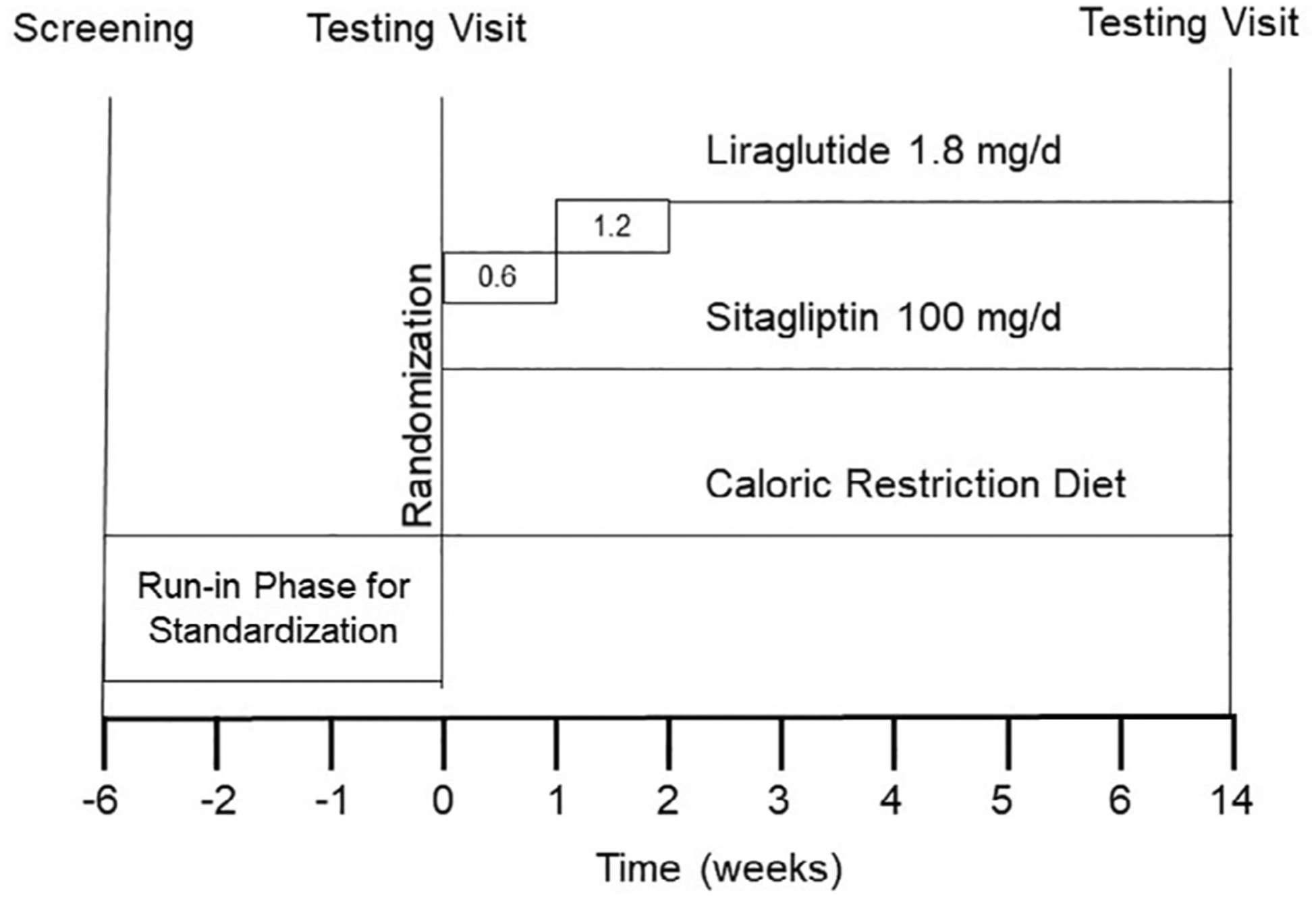
A total of 88 adults with obesity and prediabetes were randomized to 14 weeks of intervention with CR (-390 kcal/d), liraglutide (1.8 mg/d), or the dipeptidyl peptidase-4 inhibitor sitagliptin (100 mg/d) as a weight-neutral comparator. Changes between groups in appetite and hunger ratings measured via visual analogue scales, dietary intakes, body weight, body composition via dual energy x-ray absorptiometry, and resting energy expenditure via indirect calorimetry were assessed using the Kruskal-Wallis test or Pearson's chi-squared test.
Weight loss ≥5% of baseline body weight occurred in 44% of participants in the CR group, 22% of the liraglutide group and 5% of the sitagliptin group (p = 0.02). The ratio of fat to lean mass decreased by 6.5% in the CR group, 2.2% in the liraglutide group, and 0% in the sitagliptin group (p = 0.02). Visceral fat reduced by 9.5% in the CR group, 4.8% in the liraglutide group, and 0% in the sitagliptin group (p = 0.04). A spontaneous reduction in dietary simple carbohydrates in the CR group was associated with improved homeostatic model assessment of insulin resistance score (HOMA-IR).
Although both liraglutide and CR are valuable strategies for cardiometabolic risk reduction, CR was associated with greater weight loss and more favourable improvements in body composition than treatment with liraglutide alone. Differences in the response to each of these interventions enables patients to be stratified to the most optimal intervention for their personal risk factors.
研究假设,即与单纯热量限制(CR)相比,单独使用胰高血糖素样肽-1 受体激动剂(GLP-1RA)利拉鲁肽减肥会导致脂肪与瘦组织质量的比例更大幅度降低,与二肽基肽酶-4(DPP-4)抑制剂西他列汀(增强 GLP-1 活性的药物)治疗相比也是如此 - 以确定每种治疗的独立效果。
共有 88 名肥胖和前驱糖尿病患者被随机分为 14 周的干预组,接受 CR(-390kcal/d)、利拉鲁肽(1.8mg/d)或二肽基肽酶-4 抑制剂西他列汀(100mg/d)治疗,作为体重中性对照。通过视觉模拟量表评估食欲和饥饿评分、饮食摄入、双能 X 射线吸收法测量的体重、身体成分和间接热量法测量的静息能量消耗的变化,使用 Kruskal-Wallis 检验或 Pearson 的卡方检验。
体重减轻≥基线体重的 5%发生在 CR 组的 44%、利拉鲁肽组的 22%和西他列汀组的 5%的参与者中(p=0.02)。CR 组的脂肪与瘦组织质量比下降 6.5%,利拉鲁肽组下降 2.2%,西他列汀组下降 0%(p=0.02)。CR 组的内脏脂肪减少 9.5%,利拉鲁肽组减少 4.8%,西他列汀组减少 0%(p=0.04)。CR 组的膳食简单碳水化合物自发减少与稳态模型评估的胰岛素抵抗评分(HOMA-IR)改善相关。
尽管利拉鲁肽和 CR 都是降低心血管代谢风险的有效策略,但与单独使用利拉鲁肽相比,CR 与更大的体重减轻和更有利的身体成分改善相关。对这些干预措施的反应差异使患者能够根据其个人风险因素对最优化的干预措施进行分层。