Department of Biological Sciences, University of Arkansas, Fayetteville, Arkansas, United States of America.
National Research & Development Centre for Riverine and Lake Fisheries, Ministry of Agriculture & Forests, Royal Government of Bhutan, Thimphu, Bhutan.
PLoS One. 2023 Oct 24;18(10):e0289736. doi: 10.1371/journal.pone.0289736. eCollection 2023.
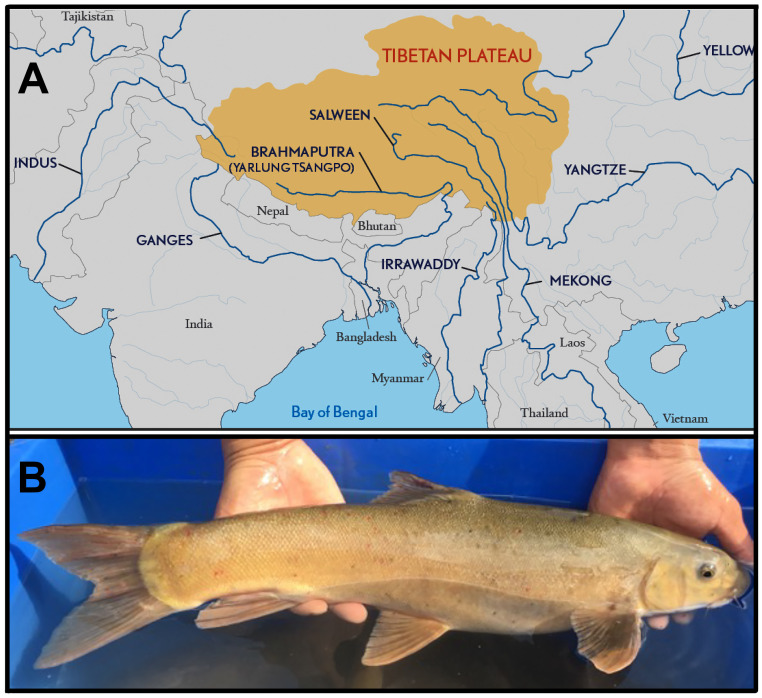
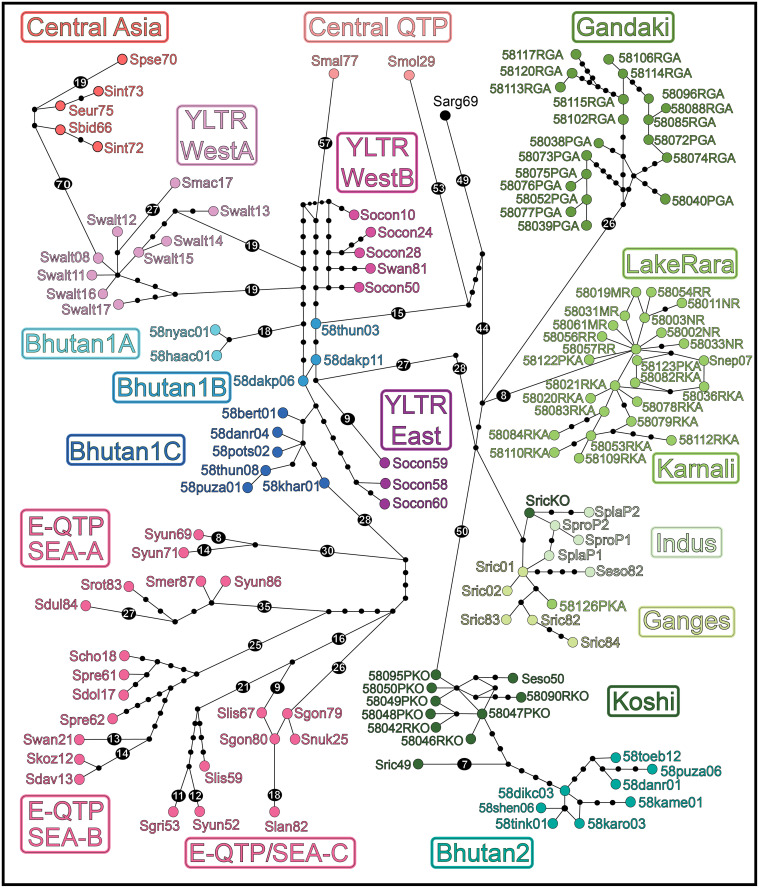
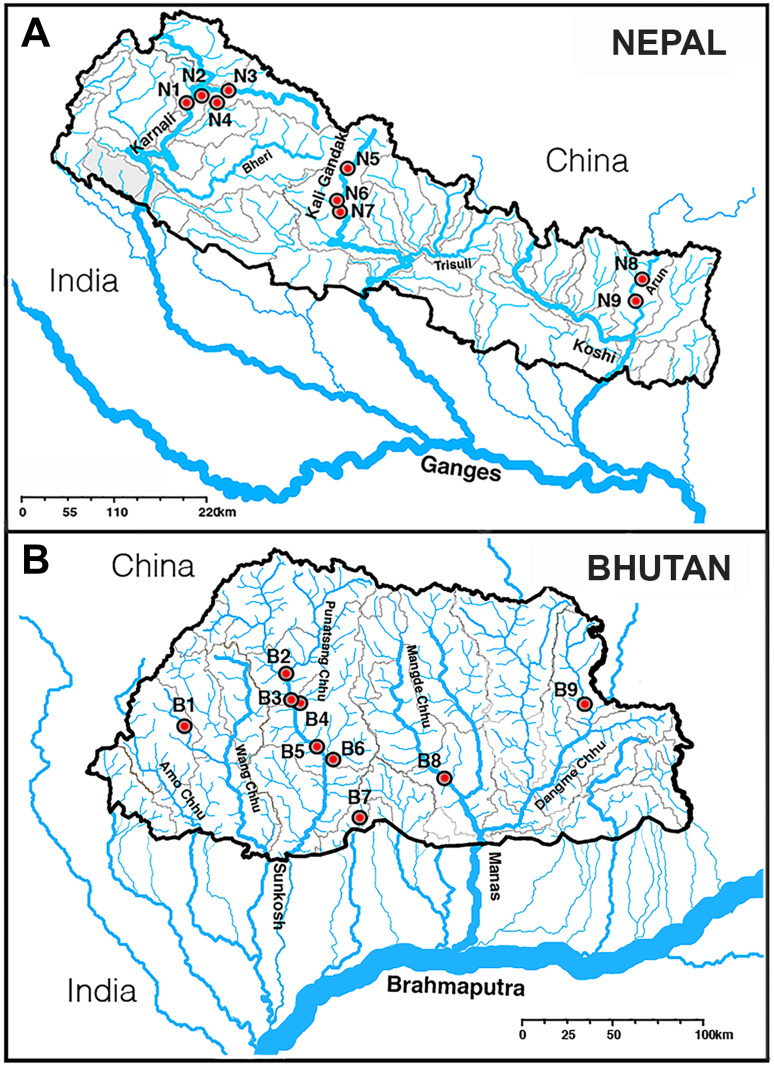
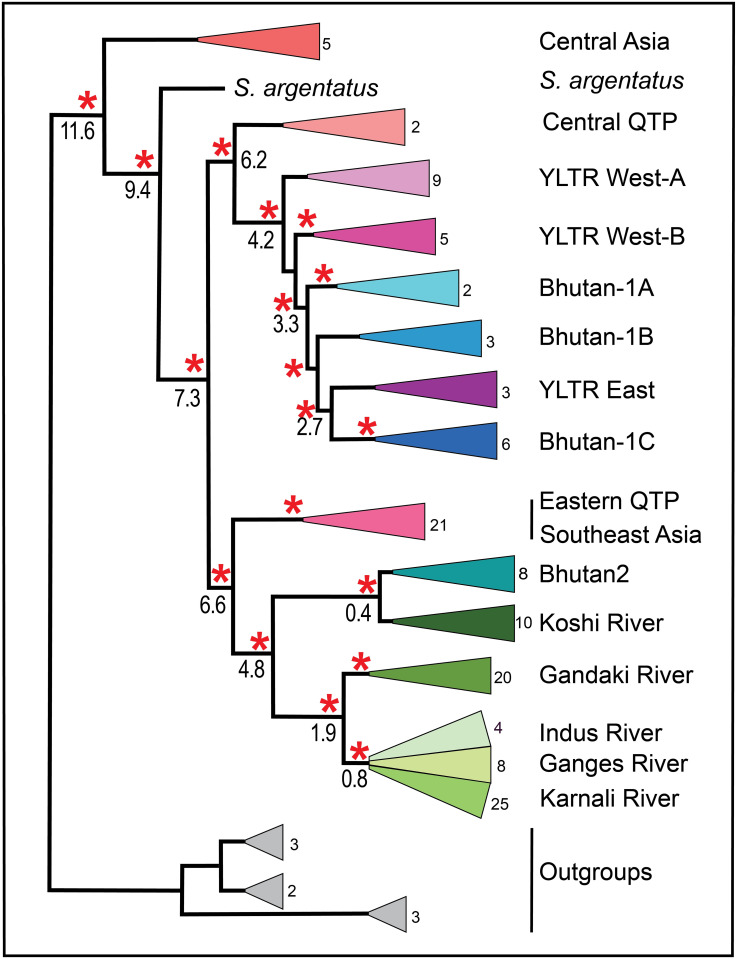
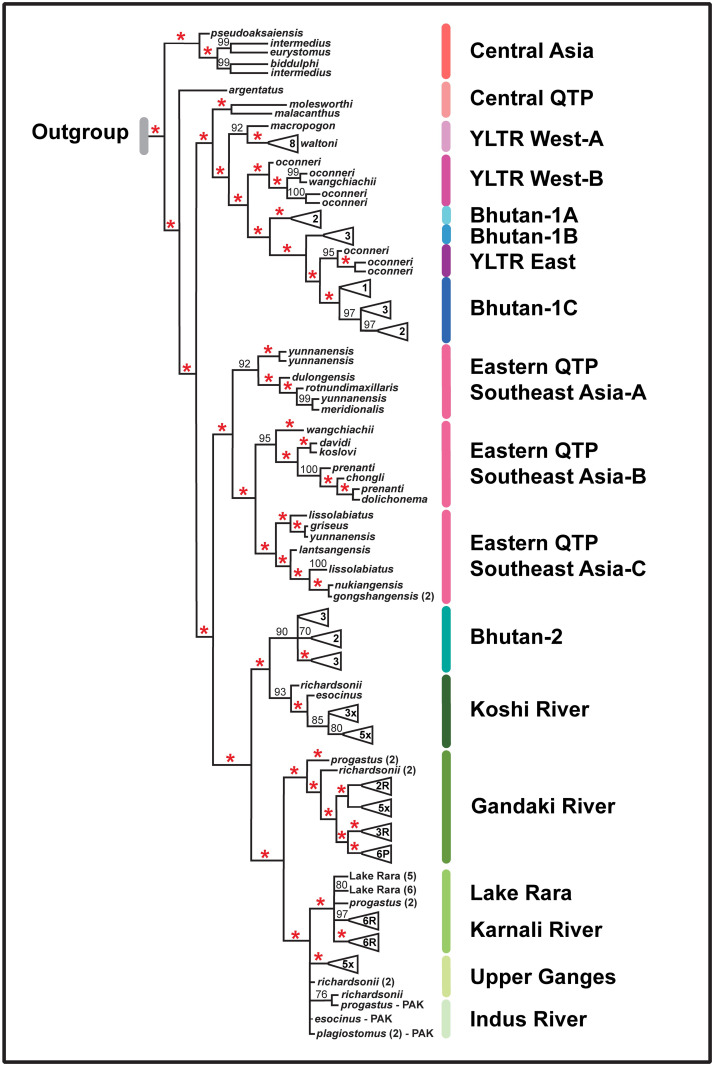
Global biodiversity hotspots are often remote, tectonically active areas undergoing climatic fluctuations, such as the Himalaya Mountains and neighboring Qinghai-Tibetan Plateau (QTP). They provide biogeographic templates upon which endemic biodiversity can be mapped to infer diversification scenarios. Yet, this process can be somewhat opaque for the Himalaya, given substantial data gaps separating eastern and western regions. To help clarify, we evaluated phylogeographic and phylogenetic hypotheses for a widespread fish (Snowtrout: Cyprininae; Schizothorax) by sequencing 1,140 base pair of mtDNA cytochrome-b (cytb) from Central Himalaya samples (Nepal: N = 53; Bhutan: N = 19), augmented with 68 GenBank sequences (N = 60 Schizothorax/N = 8 outgroups). Genealogical relationships (N = 132) were analyzed via maximum likelihood (ML), Bayesian (BA), and haplotype network clustering, with clade divergence estimated via TimeTree. Snowtrout seemingly originated in Central Asia, dispersed across the QTP, then into Bhutan via southward-flowing tributaries of the east-flowing Yarlung-Tsangpo River (YLTR). Headwaters of five large Asian rivers provided dispersal corridors from Central into eastern/southeastern Asia. South of the Himalaya, the YLTR transitions into the Brahmaputra River, facilitating successive westward colonization of Himalayan drainages first in Bhutan, then Nepal, followed by far-western drainages subsequently captured by the (now) westward-flowing Indus River. Two distinct Bhutanese phylogenetic groups were recovered: Bhutan-1 (with three subclades) seemingly represents southward dispersal from the QTP; Bhutan-2 apparently illustrates northward colonization from the Lower Brahmaputra. The close phylogenetic/phylogeographic relationships between the Indus River (Pakistan) and western tributaries of the Upper Ganges (India/Nepal) potentially implicate an historic, now disjunct connection. Greater species-divergences occurred across rather than within-basins, suggesting vicariance as a driver. The Himalaya is a component of the Earth's largest glacial reservoir (i.e., the "third-pole") separate from the Arctic/Antarctic. Its unique aquatic biodiversity must be defined and conserved through broad, trans-national collaborations. Our study provides an initial baseline for this process.
全球生物多样性热点地区通常是偏远的、构造活跃的地区,经历着气候波动,如喜马拉雅山脉和邻近的青藏高原(QTP)。它们为特有生物多样性提供了生物地理模板,可以对其进行映射以推断多样化情景。然而,由于喜马拉雅山脉东西部地区的数据差距很大,这个过程对于喜马拉雅山脉来说有些不透明。为了帮助澄清这一点,我们通过对中央喜马拉雅山脉的样本(尼泊尔:N=53;不丹:N=19)进行了 1140 个碱基对的线粒体 DNA 细胞色素 b(cytb)测序,并结合了 68 个 GenBank 序列(N=60 个 Schizothorax/N=8 个外群),评估了一种广泛分布的鱼类(Snowtrout:Cyprininae;Schizothorax)的系统地理学和系统发育假说。通过最大似然法(ML)、贝叶斯法(BA)和单倍型网络聚类分析了系统发育关系(N=132),通过 TimeTree 估计了分支分化。Snowtrout 似乎起源于中亚,通过 QTP 扩散,然后通过向东流动的雅鲁藏布江(YLTR)的南向支流进入不丹。亚洲五条大河的源头提供了从中央流向东亚/东南亚的扩散走廊。在喜马拉雅山脉以南,YLTR 转变为布拉马普特拉河,促进了喜马拉雅河流首先在不丹、然后在尼泊尔的向西殖民,随后被现在向西流动的印度河捕获。我们发现了两个不同的不丹族系群体:不丹-1(有三个亚群)似乎代表了从 QTP 的南向扩散;不丹-2 显然代表了从下布拉马普特拉河的向北殖民。印度河(巴基斯坦)和上恒河(印度/尼泊尔)的西部支流之间的密切的系统发育/系统地理学关系可能暗示了一个历史性的、现在已经断开的联系。更大的物种差异发生在流域之间而不是流域内,表明隔离是一个驱动因素。喜马拉雅山脉是地球上最大的冰川储库(即“第三极”)的一部分,与北极/南极分开。它独特的水生生物多样性必须通过广泛的跨国合作来定义和保护。我们的研究为这一过程提供了一个初步的基础。