Mussmann Steven M, Douglas Marlis R, Oakey David D, Douglas Michael E
Department of Biological Sciences University of Arkansas Fayetteville AR USA.
School of Life Sciences Arizona State University Tempe AZ USA.
Ecol Evol. 2020 Sep 1;10(19):10798-10817. doi: 10.1002/ece3.6736. eCollection 2020 Oct.
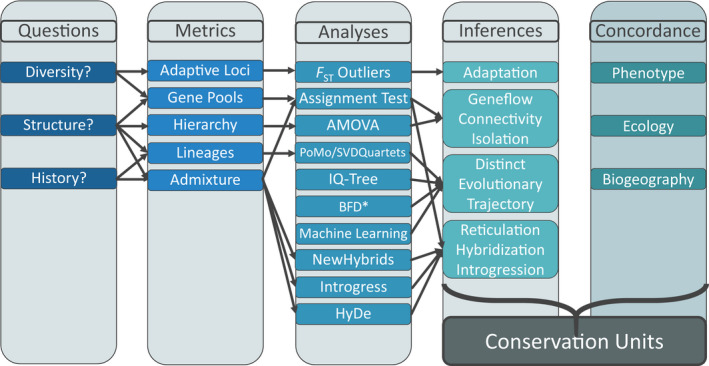
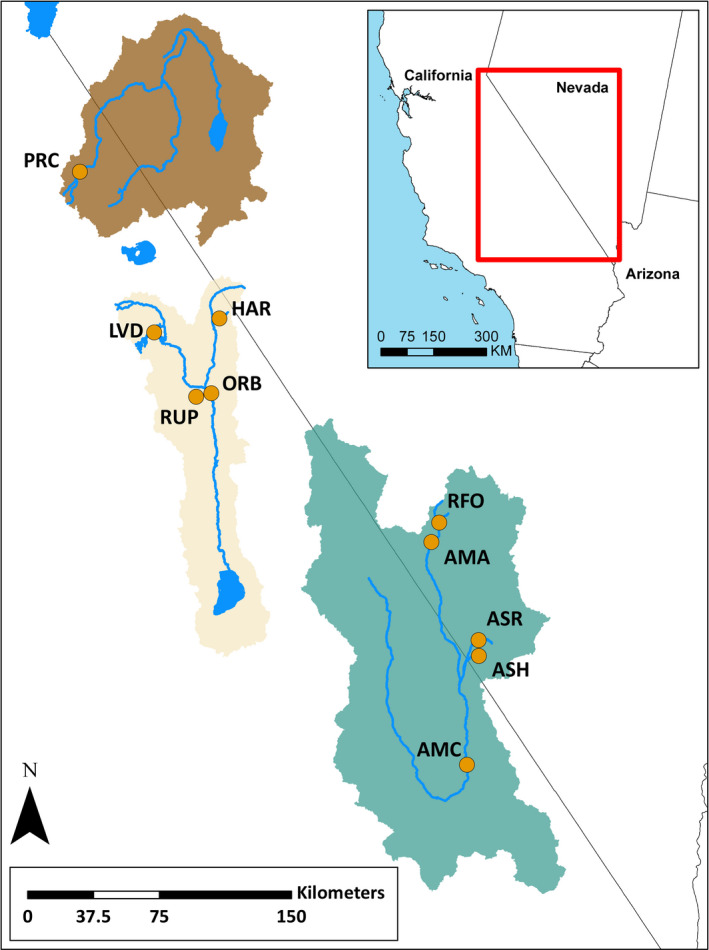
The tips in the tree of life serve as foci for conservation and management, yet clear delimitations are masked by inherent variance at the species-population interface. Analyses using thousands of nuclear loci can potentially sort inconsistencies, yet standard categories applied to this parsing are themselves potentially conflicting and/or subjective [e.g., DPS (distinct population segments); DUs (Diagnosable Units-Canada); MUs (management units); SSP (subspecies); ESUs (Evolutionarily Significant Units); and UIEUs (uniquely identified evolutionary units)]. One potential solution for consistent categorization is to create a comparative framework by accumulating statistical results from independent studies and evaluating congruence among data sets. Our study illustrates this approach in speckled dace (Leuciscidae: ) endemic to two basins (Owens and Amargosa) in the Death Valley ecosystem. These fish persist in the Mojave Desert as isolated Plio-Pleistocene relicts and are of conservation concern, but lack formal taxonomic descriptions/designations. Double digest RAD (ddRAD) methods identified 14,355 SNP loci across 10 populations ( = 140). Species delimitation analyses [multispecies coalescent (MSC) and unsupervised machine learning (UML)] delineated four putative ESUs. outlier loci ( = 106) were juxtaposed to uncover the potential for localized adaptations. We detected one hybrid population that resulted from upstream reconnection of habitat following contemporary pluvial periods, whereas remaining populations represent relics of ancient tectonism within geographically isolated springs and groundwater-fed streams. Our study offers three salient conclusions: a blueprint for a multifaceted delimitation of conservation units; a proposed mechanism by which criteria for intraspecific biodiversity can be potentially standardized; and a strong argument for the proactive management of critically endangered Death Valley ecosystem fishes.
生命之树中的这些分类单元是保护和管理的重点,但在物种 - 种群界面处,由于内在的变异性,清晰的界限被掩盖了。使用数千个核基因座进行分析可能会梳理出不一致之处,但应用于这种分类的标准类别本身可能存在冲突和/或主观性[例如,DPS(不同种群片段);DUs(加拿大可诊断单元);MUs(管理单元);SSP(亚种);ESUs(进化显著单元);UIEUs(唯一识别的进化单元)]。一种实现一致分类的潜在解决方案是通过积累独立研究的统计结果并评估数据集之间的一致性来创建一个比较框架。我们的研究在死亡谷生态系统中两个流域(欧文斯和阿马戈萨)特有的斑点雅罗鱼(Leuciscidae: )中展示了这种方法。这些鱼类作为孤立的上新世 - 更新世遗迹,在莫哈韦沙漠中存活下来,受到保护关注,但缺乏正式的分类描述/指定。双酶切RAD(ddRAD)方法在10个种群( = 140)中鉴定出14355个SNP基因座。物种界定分析[多物种溯祖(MSC)和无监督机器学习(UML)]划定了四个假定的ESUs。将 个离群基因座( = 106)并列以揭示局部适应的潜力。我们检测到一个杂交种群,它是在当代多雨期之后栖息地向上游重新连接产生的,而其余种群则代表了地理上孤立的泉水和地下水补给溪流中古代构造活动的遗迹。我们的研究得出三个重要结论:保护单元多方面界定的蓝图;一种可能使种内生物多样性标准标准化的机制;以及对极度濒危的死亡谷生态系统鱼类进行积极管理的有力论据。