Copenhagen Academy for Medical Education and Simulation (CAMES), Herlev Hospital, Herlev, Denmark.
Department of Clinical Medicine, Copenhagen University, Copenhagen, Denmark.
BMC Med Educ. 2023 Oct 24;23(1):786. doi: 10.1186/s12909-023-04763-7.
The term second victim describes a healthcare professional who has been involved in an adverse event and feels wounded by the event. The effects of this experience differ. It can present as second victim syndrome, describing a wide range and degree of emotional and behavioural responses. Studies show that medical students can also experience second victim. The aim of this study was to elucidate medical students' experiences, perceptions, and management of second victim and second victim syndrome and to describe possible learning needs around these issues.
Thirteen medical students and two recent medical graduates participated in semi-structured focus group interviews. The interviews lasted 1.5-2 h and were audiotaped, transcribed, and analysed using Braun and Clarke's six-step approach for thematic analysis.
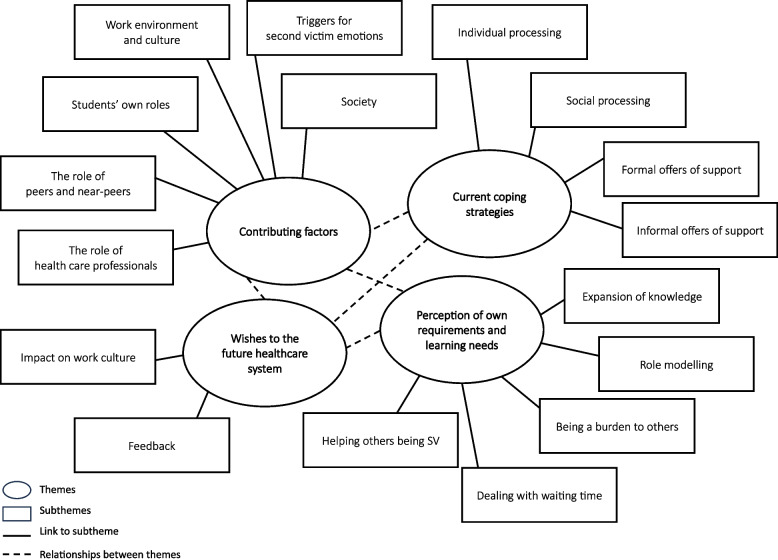
Four main themes were identified: contributing factors; current coping strategies; perception of own requirements and learning needs; wishes for the future healthcare system. Students' behavioural and emotional response to dilemmas were affected by stakeholders and practices embedded in the healthcare system. Students described patient-injury and unexpected events as triggers for second victim, but also harmful interactions with individuals and feelings of self-blame. Students' coping centred around their network, formal offers, and separation of personal- and work-life. Students sought a clear definition of second victim and a desire for role-models. Students' wished to learn how to handle feeling like a burden to others, managing waiting time after patient complaints, and learning how to help second victims recover. Students emphasized the importance of the healthcare organisation understanding students' needs and providing them relevant support.
Students experience second victim as described in the literature. Students' emotional responses were caused by classical second victim triggers, but also other triggers in the educational environment: harmful interactions and self-blame. Although some triggers differ from the second victim definition, these different triggers should be considered equally serious and acknowledged. We must aim to prepare students for future adverse events and emotional responses. The health organisation and healthcare professionals must support students' mental well-being and contribute to ideal conditions for students' professional development and management of second victim as future physicians.
“第二受害者”一词描述的是牵涉到不良事件并因此受到伤害的医疗保健专业人员。这种经历的影响各有不同。它可能表现为第二受害者综合征,描述了广泛的情绪和行为反应的程度。研究表明,医学生也可能经历第二受害者。本研究的目的是阐明医学生对第二受害者和第二受害者综合征的经历、看法和管理,并描述围绕这些问题的可能的学习需求。
13 名医学生和 2 名刚毕业的医学生参加了半结构式焦点小组访谈。访谈持续 1.5-2 小时,使用 Braun 和 Clarke 的六步主题分析方法进行录音、转录和分析。
确定了四个主要主题:促成因素;当前的应对策略;对自身需求和学习需求的看法;对未来医疗保健系统的期望。学生对困境的行为和情绪反应受到医疗保健系统中利益相关者和实践的影响。学生将患者受伤和意外事件描述为第二受害者的触发因素,但也有与个人的有害互动和自责感。学生的应对策略集中在他们的网络、正式的帮助和个人生活与工作生活的分离上。学生寻求对第二受害者的明确定义以及对榜样的渴望。学生希望学习如何处理感觉自己是别人的负担,处理完患者投诉后的等待时间,以及学习如何帮助第二受害者康复。学生强调医疗组织了解学生的需求并为他们提供相关支持的重要性。
学生经历了文献中描述的第二受害者。学生的情绪反应是由经典的第二受害者触发因素引起的,但教育环境中的其他触发因素也会引起这种反应:有害的互动和自责。尽管一些触发因素与第二受害者的定义不同,但这些不同的触发因素应被同等视为严重的,并得到承认。我们必须努力使学生为未来的不良事件和情绪反应做好准备。医疗组织和医疗保健专业人员必须支持学生的心理健康,为学生的专业发展和作为未来医生管理第二受害者创造理想的条件。