Felsch Marco, Meyer Ole, Schlickenrieder Anne, Engels Paula, Schönewolf Jule, Zöllner Felicitas, Heinrich-Weltzien Roswitha, Hesenius Marc, Hickel Reinhard, Gruhn Volker, Kühnisch Jan
Department of Conservative Dentistry and Periodontology, School of Dentistry, Ludwig-Maximilians University of Munich, Munich, Germany.
Institute for Software Engineering, University of Duisburg-Essen, Essen, Germany.
NPJ Digit Med. 2023 Oct 25;6(1):198. doi: 10.1038/s41746-023-00944-2.
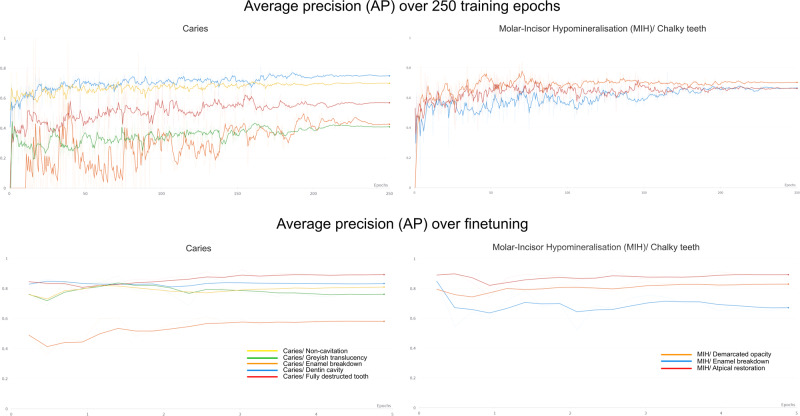
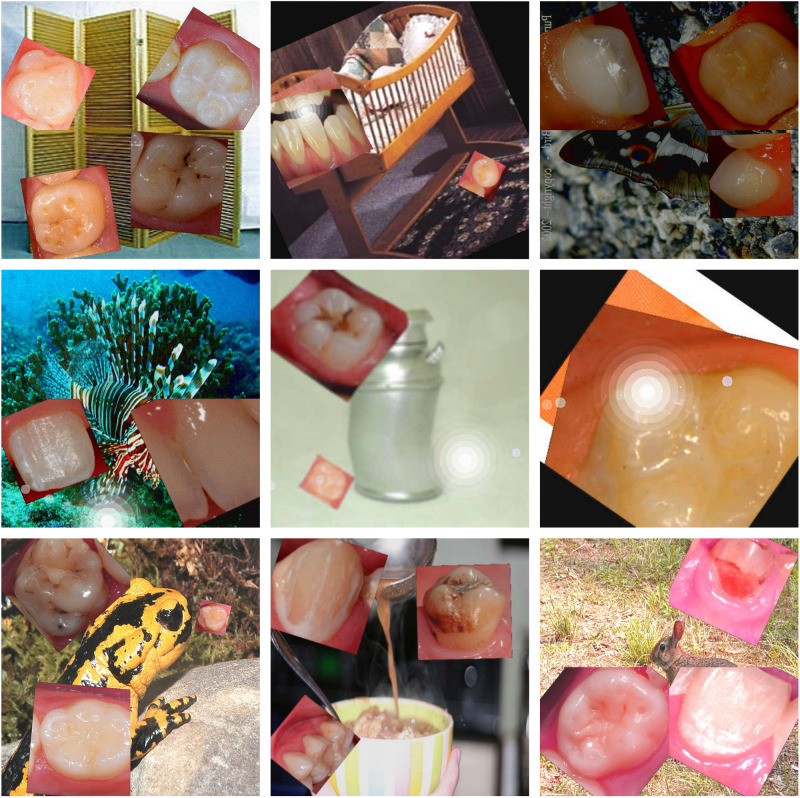
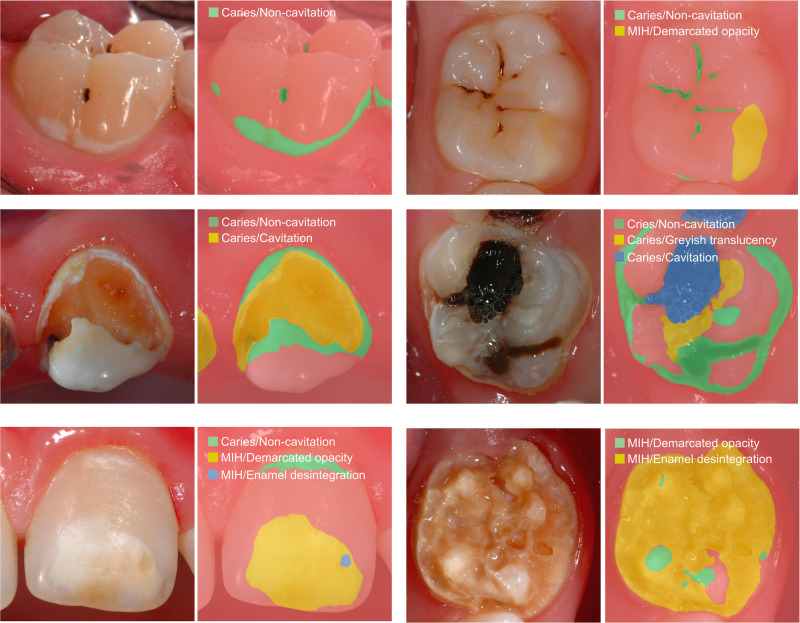
Caries and molar-incisor hypomineralization (MIH) are among the most prevalent diseases worldwide and need to be reliably diagnosed. The use of dental photographs and artificial intelligence (AI) methods may potentially contribute to realizing accurate and automated diagnostic visual examinations in the future. Therefore, the present study aimed to develop an AI-based algorithm that can detect, classify and localize caries and MIH. This study included an image set of 18,179 anonymous photographs. Pixelwise image labeling was achieved by trained and calibrated annotators using the Computer Vision Annotation Tool (CVAT). All annotations were made according to standard methods and were independently checked by an experienced dentist. The entire image set was divided into training (N = 16,679), validation (N = 500) and test sets (N = 1000). The AI-based algorithm was trained and finetuned over 250 epochs by using image augmentation and adapting a vision transformer network (SegFormer-B5). Statistics included the determination of the intersection over union (IoU), average precision (AP) and accuracy (ACC). The overall diagnostic performance in terms of IoU, AP and ACC were 0.959, 0.977 and 0.978 for the finetuned model, respectively. The corresponding data for the most relevant caries classes of non-cavitations (0.630, 0.813 and 0.990) and dentin cavities (0.692, 0.830, and 0.997) were found to be high. MIH-related demarcated opacity (0.672, 0.827, and 0.993) and atypical restoration (0.829, 0.902, and 0.999) showed similar results. Here, we report that the model achieves excellent precision for pixelwise detection and localization of caries and MIH. Nevertheless, the model needs to be further improved and externally validated.
龋齿和磨牙-切牙矿化不全(MIH)是全球最常见的疾病之一,需要进行可靠的诊断。使用牙科照片和人工智能(AI)方法可能有助于在未来实现准确和自动化的诊断视觉检查。因此,本研究旨在开发一种基于AI的算法,该算法可以检测、分类和定位龋齿和MIH。本研究包括一组18179张匿名照片的图像集。通过使用计算机视觉标注工具(CVAT),由经过训练和校准的标注人员进行逐像素图像标注。所有标注均按照标准方法进行,并由一位经验丰富的牙医独立检查。整个图像集被分为训练集(N = 16679)、验证集(N = 500)和测试集(N = 1000)。通过使用图像增强和适配视觉Transformer网络(SegFormer-B5),基于AI的算法在250个轮次上进行了训练和微调。统计数据包括交并比(IoU)、平均精度(AP)和准确率(ACC)的测定。对于微调后的模型,在IoU、AP和ACC方面的总体诊断性能分别为0.959、0.977和0.978。发现非龋洞(0.630、0.813和0.990)和牙本质龋洞(0.692、0.830和0.997)等最相关龋病类别的相应数据较高。与MIH相关的界限清晰的不透明区(0.672、0.827和0.993)和非典型修复体(0.829、0.902和0.999)显示出类似的结果。在此,我们报告该模型在龋齿和MIH的逐像素检测和定位方面达到了优异的精度。然而,该模型仍需进一步改进并进行外部验证。