Department of Transplant and Infection Immunology, Saarland University, 66421, Homburg, Germany.
Department of Neurology, Saarland University, Homburg, Germany.
J Neuroinflammation. 2023 Oct 25;20(1):246. doi: 10.1186/s12974-023-02933-4.
Peripheral facial palsy (PFP) is a common neurologic symptom which can be triggered by pathogens, autoimmunity, trauma, tumors, cholesteatoma or further local conditions disturbing the peripheral section of the nerve. In general, its cause is often difficult to identify, remaining unknown in over two thirds of cases. As we have previously shown that the quantity and quality of pathogen-specific T cells change during active infections, we hypothesized that such changes may also help to identify the causative pathogen in PFPs of unknown origin.
In this observational study, pathogen-specific T cells were quantified in blood samples of 55 patients with PFP and 23 healthy controls after stimulation with antigens from varicella-zoster virus (VZV), herpes-simplex viruses (HSV) or borrelia. T cells were further characterized by expression of the inhibitory surface molecule CTLA-4, as well as markers for differentiation (CD27) and proliferation (Ki67). Pathogen-specific antibody responses were analyzed using ELISA. Results were compared with conventional diagnostics.
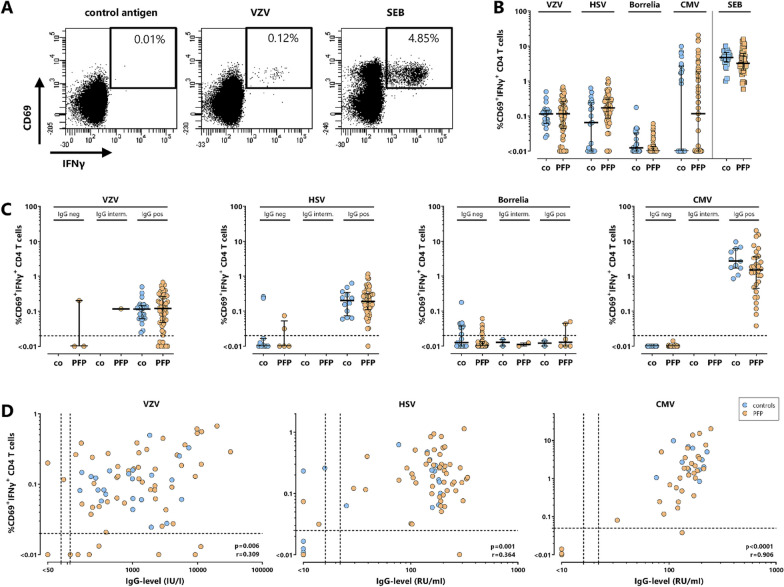
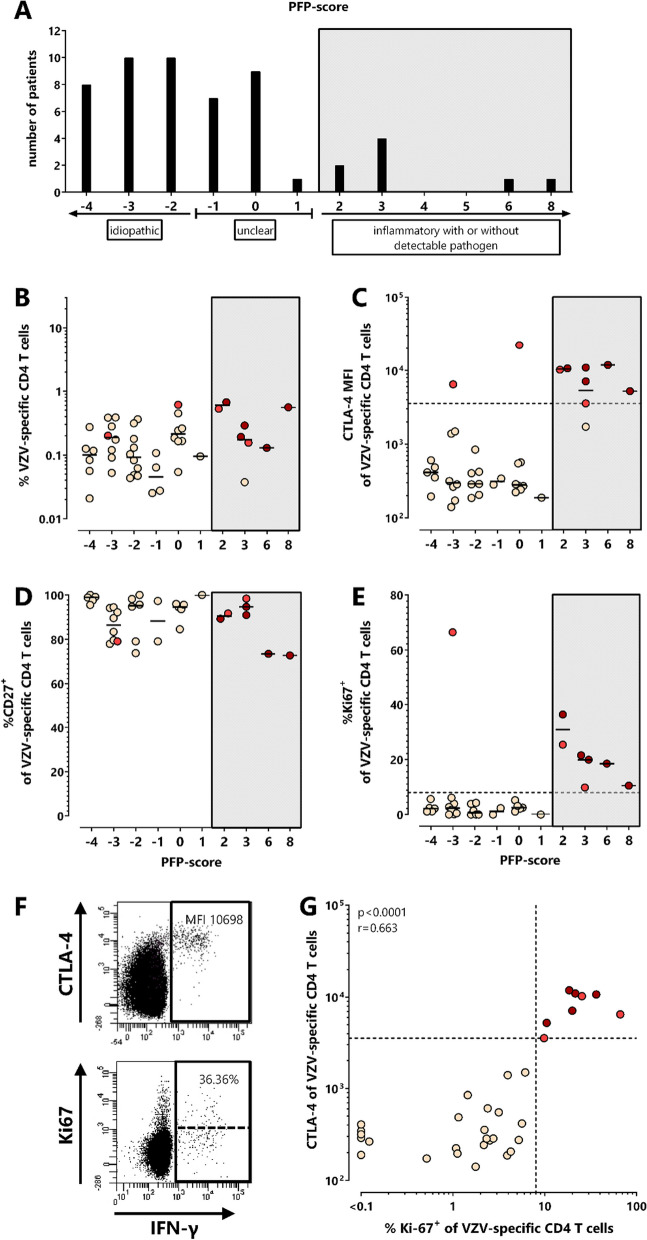
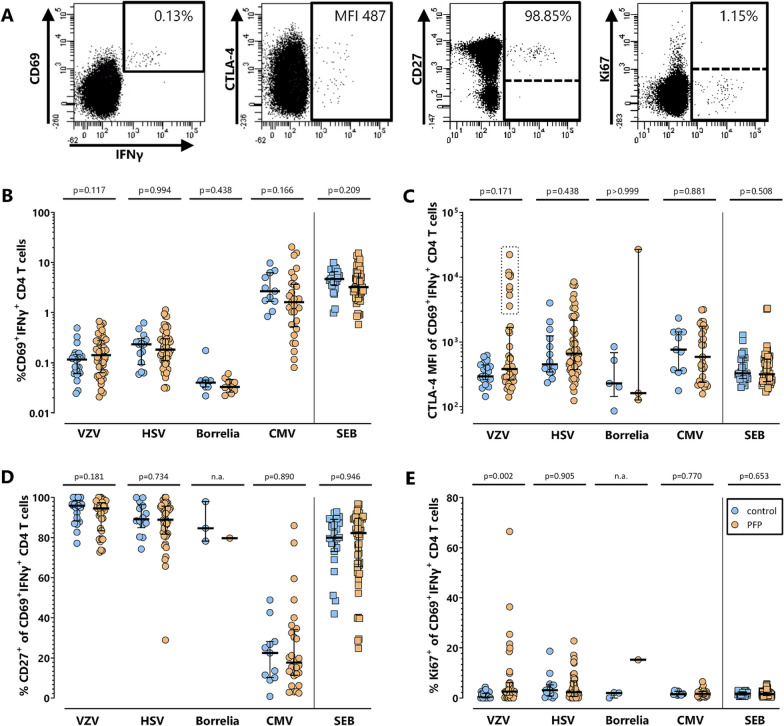
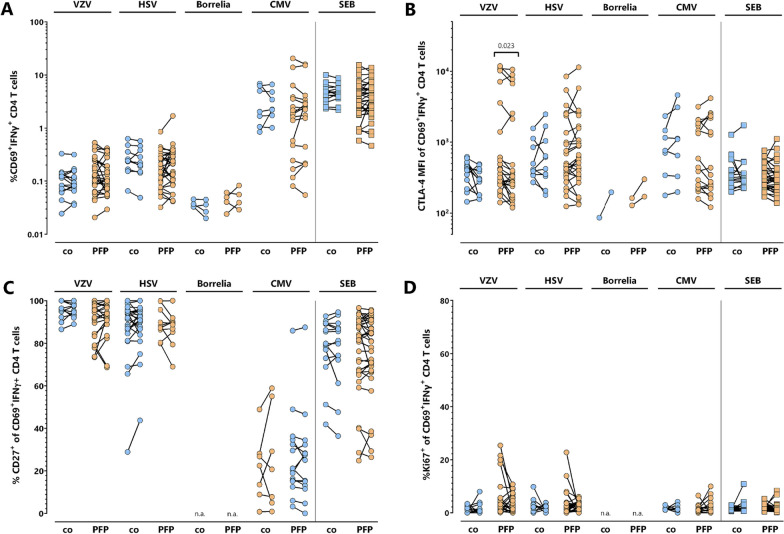
Patients with PFP were more often HSV-seropositive than controls (p = 0.0003), whereas VZV- and borrelia-specific antibodies did not differ between groups. Although the quantity and general phenotypical characteristics of antigen-specific T cells did not differ either, expression of CTLA-4 and Ki67 was highly increased in VZV-specific T cells of 9 PFP patients, of which 5 showed typical signs of cutaneous zoster. In the remaining 4 patients, a causal relationship with VZV was possible but remained unclear by clinical standard diagnostics. A similar CTLA-4- and Ki67-expression profile of borrelia-specific T cells was also found in a patient with acute neuroborreliosis.
In conclusion, the high prevalence of HSV-seropositivity among PFP-patients may indicate an underestimation of HSV-involvement in PFP, even though HSV-specific T cell characteristics seem insufficient to identify HSV as a causative agent. In contrast, striking alterations in VZV- and borrelia-specific T cell phenotype and function may allow identification of VZV- and borrelia-triggered PFPs. If confirmed in larger studies, antigen-specific immune-phenotyping may have the potential to improve specificity of the clinical diagnosis.
周围性面瘫(PFP)是一种常见的神经症状,可由病原体、自身免疫、创伤、肿瘤、胆脂瘤或进一步的局部病变引起,这些病变干扰神经的外周部分。一般来说,其病因往往难以确定,超过三分之二的病例病因不明。由于我们之前已经表明,病原体特异性 T 细胞的数量和质量在活动性感染期间会发生变化,因此我们假设这种变化也可能有助于确定来源不明的 PFP 的致病病原体。
在这项观察性研究中,我们在 55 例 PFP 患者和 23 例健康对照者的血液样本中,用水痘-带状疱疹病毒(VZV)、单纯疱疹病毒(HSV)或伯氏疏螺旋体的抗原刺激后,定量检测了病原体特异性 T 细胞。通过表达抑制性表面分子 CTLA-4,以及分化(CD27)和增殖(Ki67)标志物,进一步对 T 细胞进行了特征描述。使用 ELISA 分析了病原体特异性抗体反应。将结果与常规诊断进行了比较。
与对照组相比,PFP 患者 HSV 血清阳性率更高(p=0.0003),而 VZV 和伯氏疏螺旋体特异性抗体在两组之间没有差异。尽管抗原特异性 T 细胞的数量和一般表型特征也没有差异,但在 9 例 PFP 患者的 VZV 特异性 T 细胞中,CTLA-4 和 Ki67 的表达高度增加,其中 5 例患者出现典型的皮肤带状疱疹体征。在其余 4 例患者中,VZV 可能与 PFP 有关,但临床标准诊断仍不清楚。在 1 例急性神经伯氏疏螺旋体病患者中,也发现了伯氏疏螺旋体特异性 T 细胞类似的 CTLA-4 和 Ki67 表达谱。
总之,PFP 患者 HSV 血清阳性率较高可能表明 HSV 感染在 PFP 中的作用被低估,尽管 HSV 特异性 T 细胞特征似乎不足以确定 HSV 为致病因子。相比之下,VZV 和伯氏疏螺旋体特异性 T 细胞表型和功能的显著改变可能有助于确定 VZV 和伯氏疏螺旋体触发的 PFP。如果在更大的研究中得到证实,抗原特异性免疫表型可能有潜力提高临床诊断的特异性。