Cao Xiaojie, Liu Xinqiao
Graduate School of Education, Peking University, Beijing 100871, China.
School of Education, Tianjin University, Tianjin 300350, China.
Behav Sci (Basel). 2023 Oct 23;13(10):876. doi: 10.3390/bs13100876.
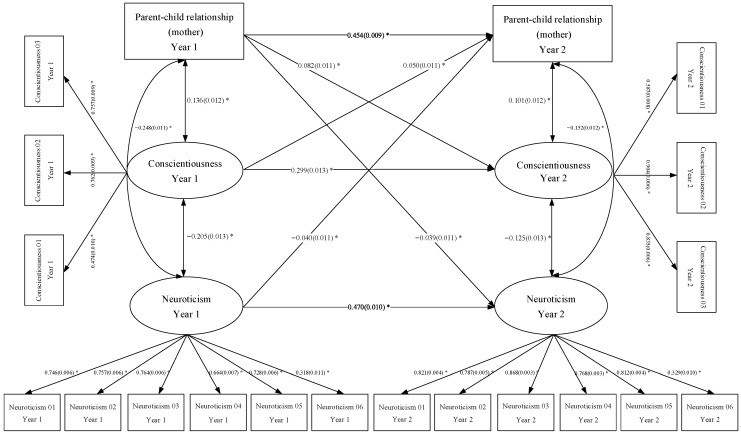
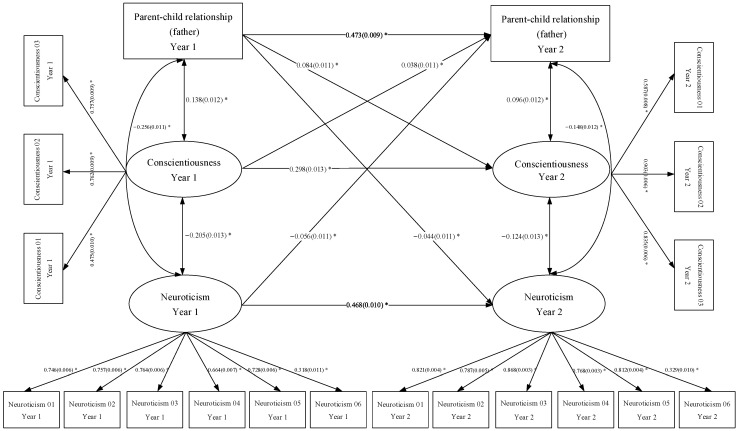
The parent‒child relationship is a crucial factor in promoting adolescent mental health. However, the current evidence on the relationship between parent‒child relationships and adolescent conscientiousness and neuroticism, as well as the directionality of these relationships, remains limited. In particular, there is a lack of analysis focusing on Chinese middle school students. Based on a sample of 8437 students from the China Education Panel Survey (CEPS) database, this study empirically examined the bidirectional relationships between parent‒child relationships, conscientiousness and neuroticism among Chinese middle school students, with specific emphasis on the significant role of parent‒child relationships in the development of conscientiousness and neuroticism. Descriptive statistical results indicated that during the seventh and eighth grades of Chinese middle school students, the closeness of their parent‒child relationships with both parents decreased, while the level of conscientiousness showed a slight decrease, and neuroticism showed an increasing trend. Correlational results demonstrated a significant positive correlation between parent‒child relationships and conscientiousness and a significant negative correlation between parent‒child relationships and neuroticism. Further analysis using cross-lagged models revealed that parent‒child relationships significantly positively predicted subsequent conscientiousness development, and conscientiousness significantly positively predicted subsequent parent‒child relationships. Parent‒child relationships significantly negatively predicted subsequent neuroticism development, and neuroticism levels also significantly negatively predicted subsequent parent‒child relationships. Based on these findings, we believe that there is a need to strengthen parent‒child relationships and to recognize the important role that both mothers and fathers play in the healthy development of their children. Both parents should actively contribute to their children's upbringing and take responsibility for their family education.
亲子关系是促进青少年心理健康的关键因素。然而,目前关于亲子关系与青少年尽责性和神经质之间的关系以及这些关系的方向性的证据仍然有限。特别是,缺乏针对中国中学生的分析。基于中国教育追踪调查(CEPS)数据库中的8437名学生样本,本研究实证检验了中国中学生亲子关系、尽责性和神经质之间的双向关系,特别强调了亲子关系在尽责性和神经质发展中的重要作用。描述性统计结果表明,在中国中学生的七年级和八年级期间,他们与父母双方的亲子关系亲密度下降,而尽责性水平略有下降,神经质则呈上升趋势。相关结果表明,亲子关系与尽责性之间存在显著正相关,亲子关系与神经质之间存在显著负相关。使用交叉滞后模型的进一步分析表明,亲子关系显著正向预测随后的尽责性发展,尽责性也显著正向预测随后的亲子关系。亲子关系显著负向预测随后的神经质发展,神经质水平也显著负向预测随后的亲子关系。基于这些发现,我们认为有必要加强亲子关系,并认识到父母双方在孩子健康成长中所起的重要作用。父母双方都应积极参与孩子的养育,并对家庭教育负责。