Institute of Clinical Chemistry, University Hospital Zurich, University of Zurich, Zurich, Switzerland.
Department of Pediatric Neurology, University Children's Hospital, Zurich, University of Zurich, Zurich, Switzerland.
J Lipid Res. 2023 Dec;64(12):100464. doi: 10.1016/j.jlr.2023.100464. Epub 2023 Oct 27.
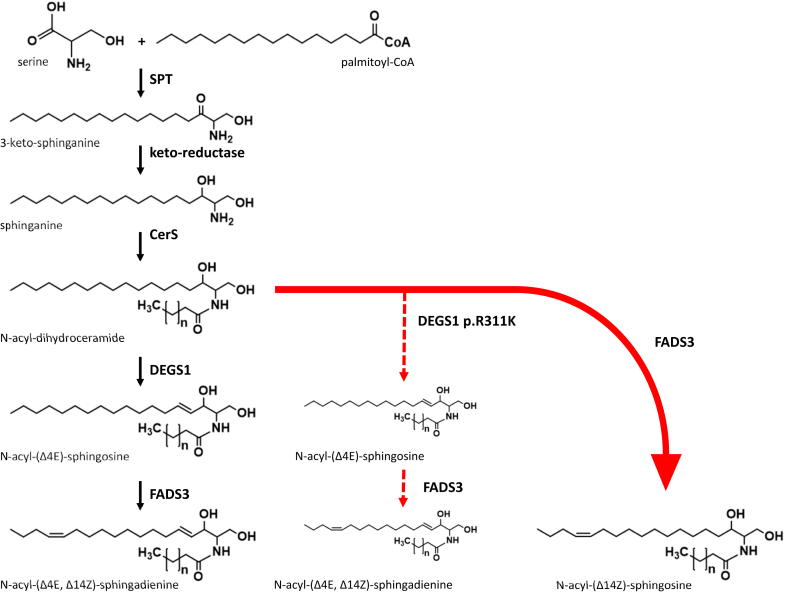
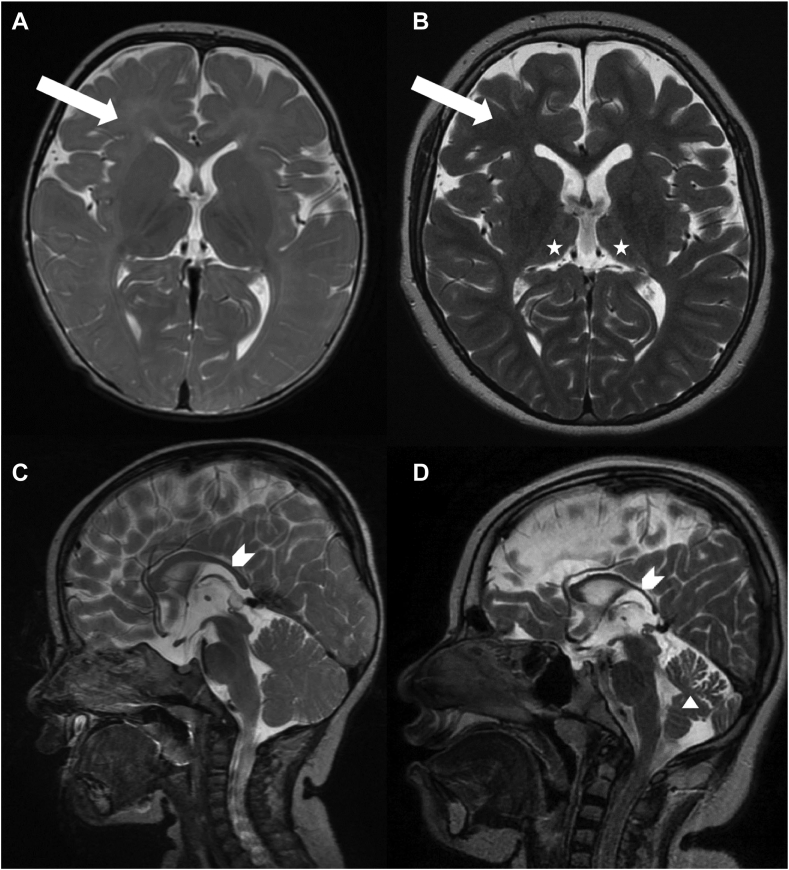
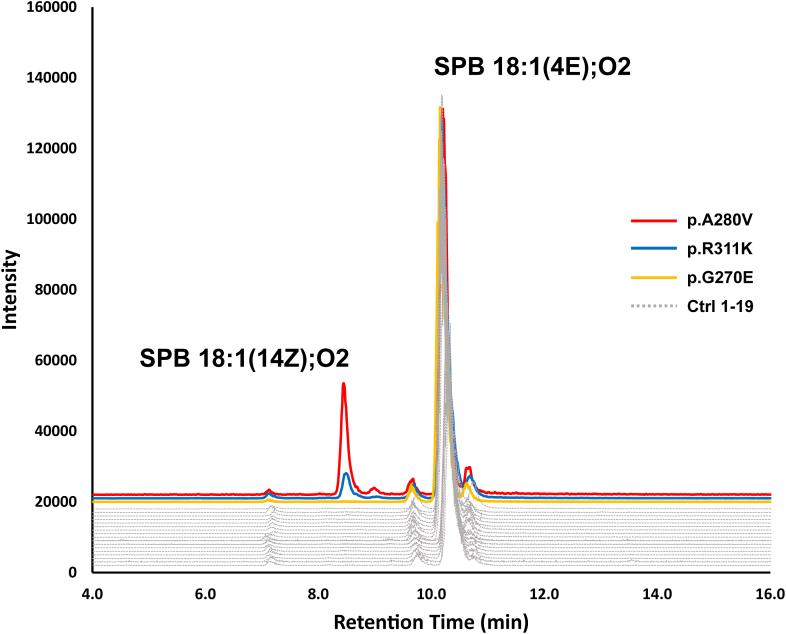
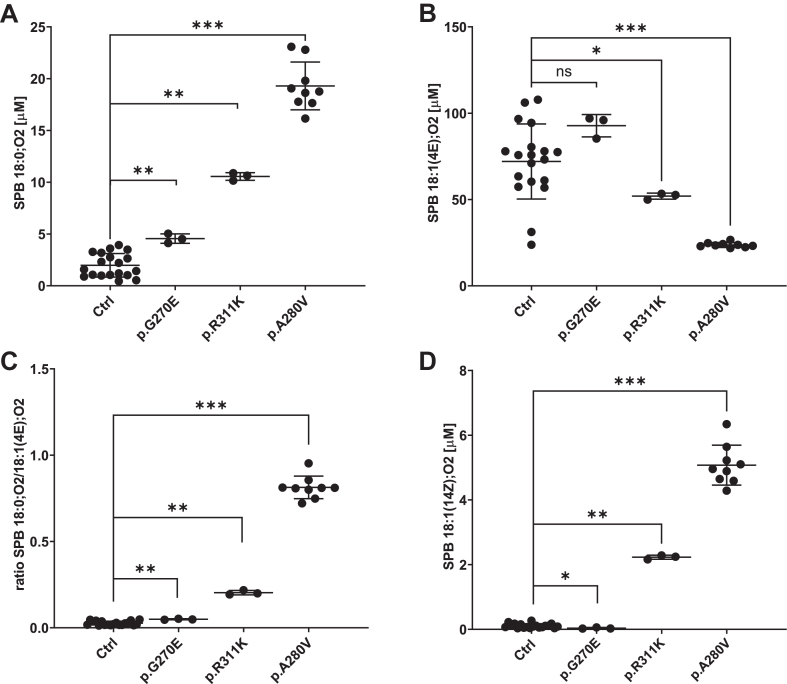
Sphingolipids (SL) represent a structurally diverse class of lipids that are central to cellular physiology and neuronal development and function. Defects in the sphingolipid metabolism are typically associated with nervous system disorders. The C4-dihydroceramide desaturase (DEGS1) catalyzes the conversion of dihydroceramide to ceramide, the final step in the SL de-novo synthesis. Loss of function mutations in DEGS1 cause a hypomyelinating leukodystrophy, which is associated with increased plasma dihydrosphingolipids (dhSL) and with the formation of an atypical SPB 18:1(14Z);O2 metabolite. Here, we characterize two novel DEGS1 variants of unknown significance (VUS), provide a structural model with a predicted substrate binding site, and propose a regulatory link between DEGS1 and fatty acid desaturase 3 (FADS3). Both VUS involve single amino acid substitutions near the C-terminus within conserved regions of the enzyme. Patient 1 (p.R311K variant) shows severe progressive tetraspasticity, intellectual disability, and epilepsy in combination with brain magnetic resonance imaging (MRI) findings, typical for DEGS1-related leukodystrophy. Patient 2 (p.G270E variant) presents with delayed psychomotor development, oculomotor apraxia, and a normal brain MRI. Plasma from the p.R311K carrier showed a significantly elevated dhSL species and the presence of SPB 18:1(14Z);O2, while the plasma SL profile for the p.G270E variant was not altered. This suggests the p.R331K variant is pathogenic, while the p.G270E appears benign. As an increase in dihydroSL species is also seen in other pathological disorders of the SL metabolism, the SPB 18:1(14Z);O2 seems to be a more specific biomarker to discriminate between pathogenic and benign DEGS1 variants.
鞘脂类(SL)是一类结构多样的脂质,它们是细胞生理学和神经元发育和功能的核心。鞘脂代谢缺陷通常与神经系统疾病有关。C4-二氢神经酰胺去饱和酶(DEGS1)催化二氢神经酰胺向神经酰胺的转化,这是 SL 从头合成的最后一步。DEGS1 功能丧失突变导致脱髓鞘性白质营养不良,与血浆中二氢神经鞘脂(dhSL)增加和形成非典型 SPB 18:1(14Z);O2 代谢物有关。在这里,我们描述了两种未知意义的新型 DEGS1 变体(VUS),提供了一个具有预测底物结合位点的结构模型,并提出了 DEGS1 和脂肪酸去饱和酶 3(FADS3)之间的调节联系。这两种 VUS 都涉及到酶保守区域内靠近 C 末端的单个氨基酸取代。患者 1(p.R311K 变体)表现出严重的进行性四肢痉挛、智力障碍和癫痫,结合大脑磁共振成像(MRI)发现,与 DEGS1 相关的白质营养不良典型。患者 2(p.G270E 变体)表现为精神运动发育迟缓、眼球运动失用和正常的大脑 MRI。p.R311K 携带者的血浆中 dhSL 显著升高,并且存在 SPB 18:1(14Z);O2,而 p.G270E 变体的血浆 SL 谱没有改变。这表明 p.R311K 变体是致病性的,而 p.G270E 似乎是良性的。由于 dhSL 物种的增加也见于其他鞘脂代谢的病理紊乱,因此 SPB 18:1(14Z);O2 似乎是区分致病性和良性 DEGS1 变体的更特异的生物标志物。