Yang Zihan, Yue Tian, Zschorlich Volker R, Li Dai, Wang Duanwei, Qi Fengxue
School of Sports Medicine and Rehabilitation, Beijing Sport University, Beijing 100084, China.
Institute of Sport Science, Carl von Ossietzky Universität Oldenburg, 26129 Oldenburg, Germany.
Brain Sci. 2023 Sep 23;13(10):1362. doi: 10.3390/brainsci13101362.
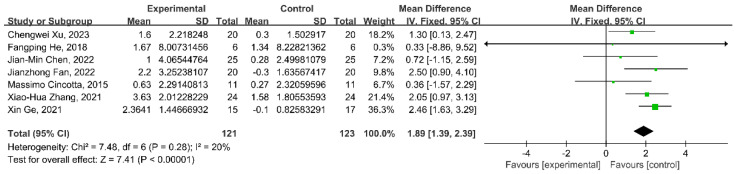
Traumatic brain injury, cardiac arrest, intracerebral hemorrhage, and ischemic stroke may cause disorders of consciousness (DoC). Repetitive transcranial magnetic stimulation (rTMS) has been used to promote the recovery of disorders of consciousness (DoC) patients. In this meta-analysis, we examined whether rTMS can relieve DoC patient symptoms. We searched through journal articles indexed in PubMed, the Web of Science, Embase, Scopus, and the Cochrane Library until 20 April 2023. We assessed whether studies used rTMS as an intervention and reported the pre- and post-rTMS coma recovery scale-revised (CRS-R) scores. A total of 207 patients from seven trials were included. rTMS significantly improved the recovery degree of patients; the weighted mean difference (WMD) of the change in the CRS-R score was 1.89 (95% confidence interval (CI): 1.39-2.39; < 0.00001) in comparison with controls. The subgroup analysis showed a significant improvement in CRS-R scores in rTMS over the dorsolateral prefrontal cortex (WMD = 2.24; 95% CI: 1.55-2.92; < 0.00001; = 31%) and the primary motor cortex (WMD = 1.63; 95% CI: 0.69-2.57; = 0.0007; = 14%). Twenty-hertz rTMS significantly improved CRS-R scores in patients with DoC (WMD = 1.61; 95% CI: 0.39-2.83; = 0.010; = 31%). Furthermore, CRS-R scores in rTMS over 20 sessions significantly improved (WMD = 1.75; 95% CI: 0.95-2.55; < 0.0001; = 12%). rTMS improved the symptoms of DoC patients; however, the available evidence remains limited and inadequate.
创伤性脑损伤、心脏骤停、脑出血和缺血性中风可能导致意识障碍(DoC)。重复经颅磁刺激(rTMS)已被用于促进意识障碍(DoC)患者的恢复。在这项荟萃分析中,我们研究了rTMS是否能缓解DoC患者的症状。我们检索了截至2023年4月20日在PubMed、科学网、Embase、Scopus和Cochrane图书馆中索引的期刊文章。我们评估了研究是否使用rTMS作为干预措施,并报告了rTMS前后昏迷恢复量表修订版(CRS-R)的评分。总共纳入了来自7项试验的207名患者。与对照组相比,rTMS显著提高了患者的恢复程度;CRS-R评分变化的加权平均差(WMD)为1.89(95%置信区间(CI):1.39-2.39;P<0.00001)。亚组分析显示,在背外侧前额叶皮层进行rTMS治疗后,CRS-R评分有显著改善(WMD = 2.24;95%CI:1.55-2.92;P<0.00001;I² = 31%),在初级运动皮层进行rTMS治疗后,CRS-R评分也有显著改善(WMD = 1.63;95%CI:0.69-2.57;P = 0.0007;I² = 14%)。20赫兹的rTMS显著提高了DoC患者的CRS-R评分(WMD = 1.61;95%CI:0.39-2.83;P = 0.010;I² = 31%)。此外,超过20次治疗的rTMS治疗后,CRS-R评分有显著改善(WMD = 1.75;95%CI:0.95-2.55;P<0.0001;I² = 12%)。rTMS改善了DoC患者的症状;然而,现有证据仍然有限且不充分。