Xu Chengwei, Wu Wanchun, Zheng Xiaochun, Liang Qimei, Huang Xiyan, Zhong Haili, Xiao Qiuyi, Lan Yue, Bai Yang, Xie Qiuyou
Department of Rehabilitation Medicine, Joint Research Centre for Disorders of Consciousness, Zhujiang Hospital of Southern Medical University, Guangzhou, China.
Department of Rehabilitation Medicine, The First Affiliated Hospital of Nanchang University, Nanchang, China.
Front Neurol. 2023 Feb 16;14:1059789. doi: 10.3389/fneur.2023.1059789. eCollection 2023.
Recent studies have shown that patients with disorders of consciousness (DoC) can benefit from repetitive transcranial magnetic stimulation (rTMS) therapy. The posterior parietal cortex (PPC) is becoming increasingly important in neuroscience research and clinical treatment for DoC as it plays a crucial role in the formation of human consciousness. However, the effect of rTMS on the PPC in improving consciousness recovery remains to be studied.
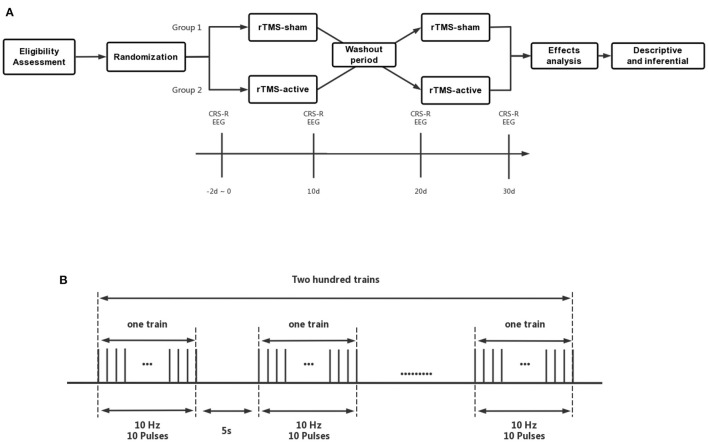
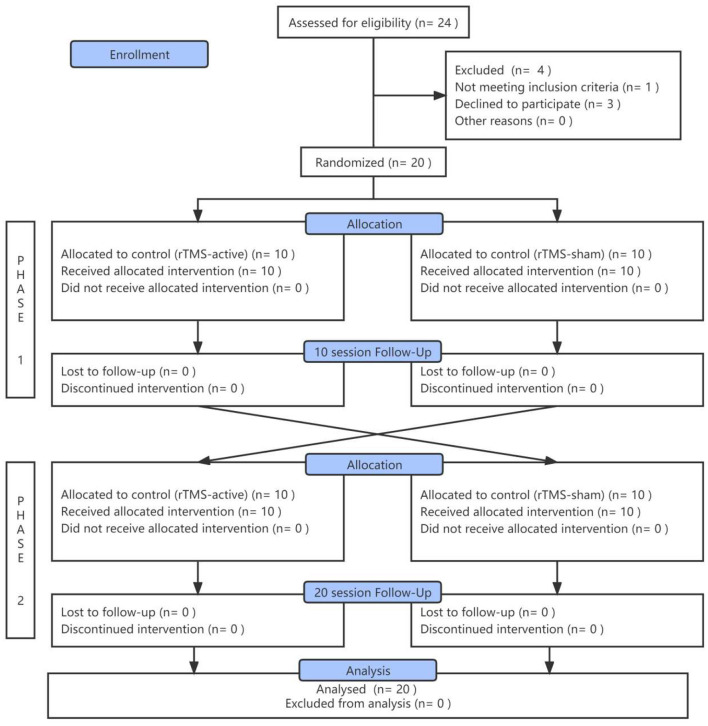
We conducted a crossover, randomized, double-blind, sham-controlled clinical study to assess the efficacy and safety of 10 Hz rTMS over the left PPC in unresponsive patients. Twenty patients with unresponsive wakefulness syndrome were recruited. The participants were randomly divided into two groups: one group received active rTMS treatment for 10 consecutive days ( = 10) and the other group received sham treatment for the same period ( = 10). After a 10-day washout period, the groups crossed over and received the opposite treatment. The rTMS protocol involved the delivery of 2000 pulses/day at a frequency of 10 Hz, targeting the left PPC (P3 electrode sites) at 90% of the resting motor threshold. The primary outcome measure was the JFK Coma Recovery Scele-Revised (CRS-R), and evaluations were conducted blindly. EEG power spectrum assessments were also conducted simultaneously before and after each stage of the intervention.
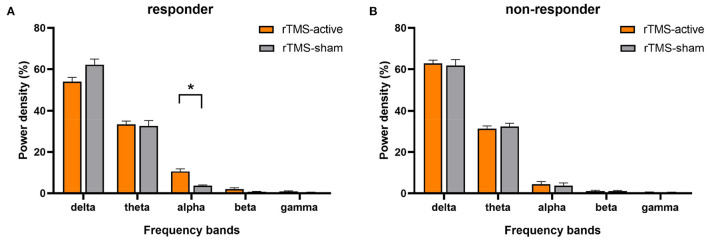
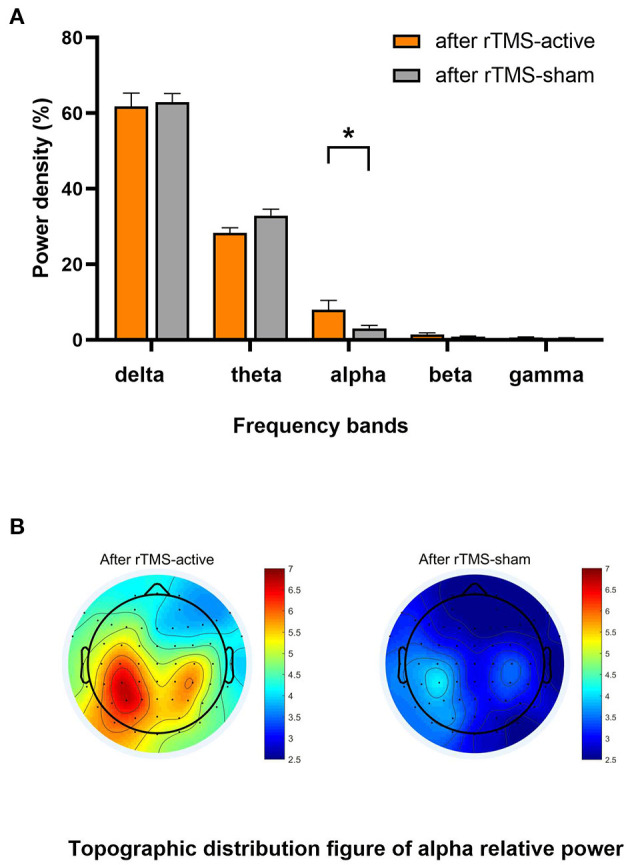
rTMS-active treatment resulted in a significant improvement in the CRS-R total score ( = 8.443, = 0.009) and the relative alpha power ( = 11.166, = 0.004) compared to sham treatment. Furthermore, 8 out of 20 patients classified as rTMS responders showed improvement and evolved to a minimally conscious state (MCS) as a result of active rTMS. The relative alpha power also significantly improved in responders ( = 26.372, = 0.002) but not in non-responders ( = 0.704, = 0.421). No adverse effects related to rTMS were reported in the study.
This study suggests that 10 Hz rTMS over the left PPC can significantly improve functional recovery in unresponsive patients with DoC, with no reported side effects.
www.ClinicalTrials.gov, identifier: NCT05187000.
最近的研究表明,意识障碍(DoC)患者可从重复经颅磁刺激(rTMS)治疗中获益。顶叶后皮质(PPC)在DoC的神经科学研究和临床治疗中变得越来越重要,因为它在人类意识形成中起着关键作用。然而,rTMS对PPC改善意识恢复的作用仍有待研究。
我们进行了一项交叉、随机、双盲、假刺激对照的临床研究,以评估10 Hz rTMS对无反应患者左侧PPC的疗效和安全性。招募了20例无反应觉醒综合征患者。参与者被随机分为两组:一组连续10天接受rTMS主动治疗(n = 10),另一组在同一时期接受假刺激治疗(n = 10)。经过10天的洗脱期后,两组交叉并接受相反的治疗。rTMS方案包括以10 Hz的频率每天发放2000个脉冲,以静息运动阈值的90%为靶点刺激左侧PPC(P3电极部位)。主要结局指标是肯尼迪昏迷恢复量表修订版(CRS-R),评估由盲法进行。在干预的每个阶段前后还同时进行脑电图功率谱评估。
与假刺激治疗相比,rTMS主动治疗使CRS-R总分(t = 8.443,P = 0.009)和相对α功率(t = 11.166,P = 0.004)有显著改善。此外,在20例被归类为rTMS反应者的患者中,有8例因接受rTMS主动治疗而有所改善并演变为最低意识状态(MCS)。反应者的相对α功率也显著改善(t = 26.372,P = 0.002),而非反应者则无改善(t = 0.704,P = 0.421)。该研究未报告与rTMS相关的不良反应。
本研究表明,对左侧PPC进行10 Hz rTMS可显著改善DoC无反应患者的功能恢复,且未报告有副作用。