CSL, Bio21 Institute, Melbourne, VIC 3052, Australia.
CSL, CSL Biologics Research Centre, 1066 Bern, Switzerland.
Biomolecules. 2023 Oct 13;13(10):1522. doi: 10.3390/biom13101522.
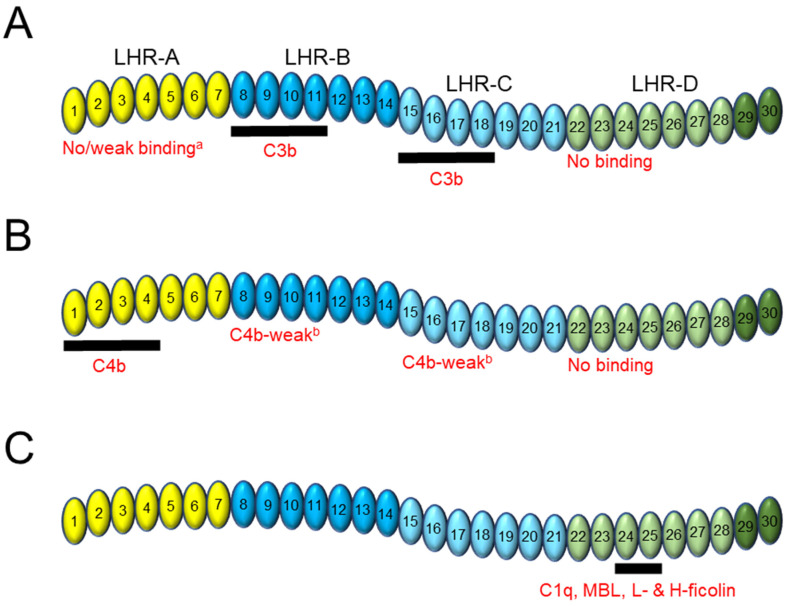
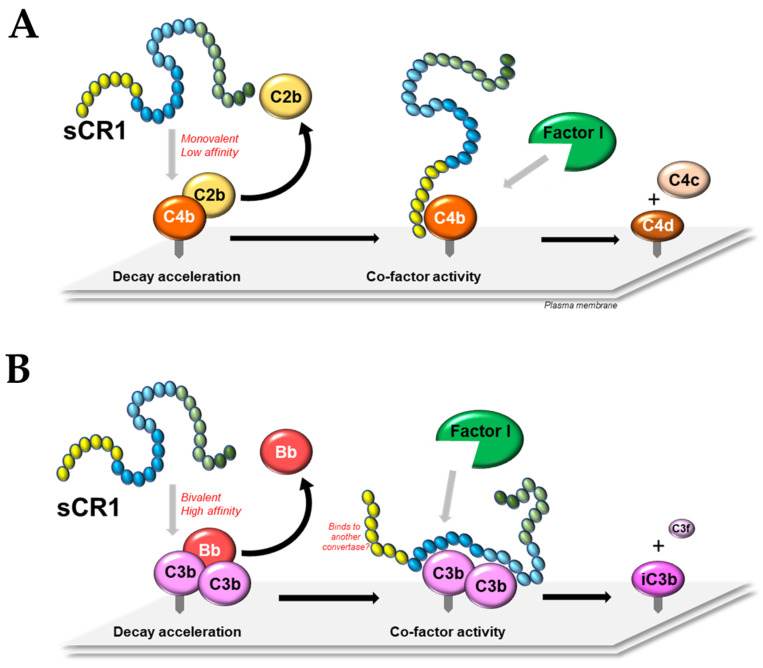
Human complement receptor 1 (CR1) is a membrane-bound regulator of complement that has been the subject of recent attempts to generate soluble therapeutic compounds comprising different fragments of its extracellular domain. This review will focus on the extracellular domain of CR1 and detail how its highly duplicated domains work both separately and together to mediate binding to its main ligands C3b and C4b, and to inhibit the classical, lectin, and alternative pathways of the complement cascade via the mechanisms of decay acceleration activity (DAA) and co-factor activity (CFA). Understanding the molecular basis of CR1 activity is made more complicated by the presence not only of multiple ligand binding domains within CR1 but also the fact that C3b and C4b can interact with CR1 as both monomers, dimers, and heterodimers. Evidence for the interaction of CR1 with additional ligands such as C1q will also be reviewed. Finally, we will bring the mechanistic understanding of CR1 activity together to provide an explanation for the differential complement pathway inhibition recently observed with CSL040, a soluble CR1-based therapeutic candidate in pre-clinical development.
人类补体受体 1(CR1)是一种膜结合的补体调节剂,最近有人试图生成包含其细胞外结构域不同片段的可溶性治疗化合物,该受体就是其中的研究对象。这篇综述将聚焦于 CR1 的细胞外结构域,并详细介绍其高度重复的结构域如何分别和共同发挥作用,以介导与主要配体 C3b 和 C4b 的结合,并通过衰变加速因子(DAA)和辅助因子(CFA)机制抑制补体级联的经典、凝集素和替代途径。由于 CR1 不仅存在多个配体结合结构域,而且 C3b 和 C4b 可以作为单体、二聚体和异二聚体与 CR1 相互作用,因此 CR1 活性的分子基础变得更加复杂。还将对 CR1 与其他配体(如 C1q)相互作用的证据进行综述。最后,我们将把对 CR1 活性的机制理解结合起来,为最近在临床前研究中观察到的基于可溶性 CR1 的治疗候选药物 CSL040 对不同补体途径的抑制作用提供解释。