Molecular Oncology and Therapeutics, Osaka Metropolitan University Graduate School of Medicine, Osaka 5458585, Japan.
Biomolecules. 2023 Oct 19;13(10):1551. doi: 10.3390/biom13101551.
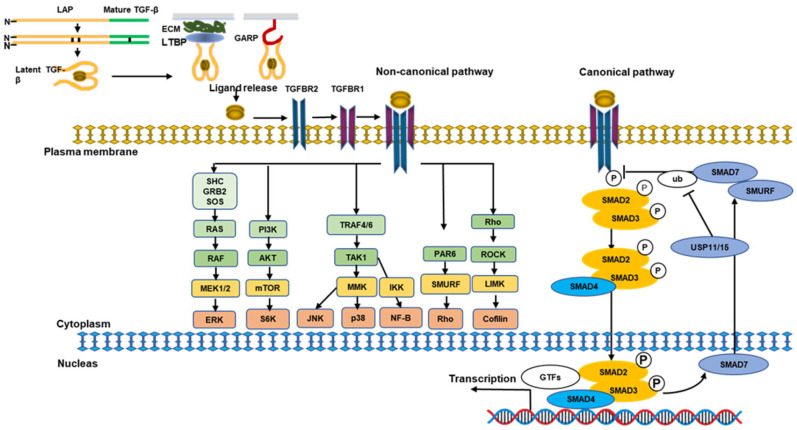
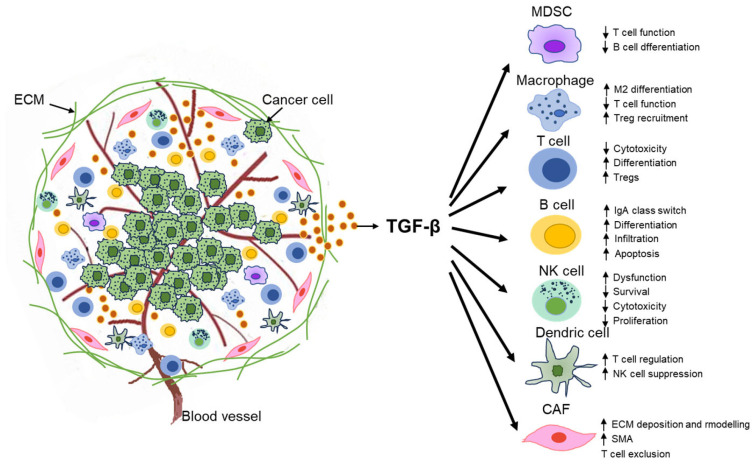
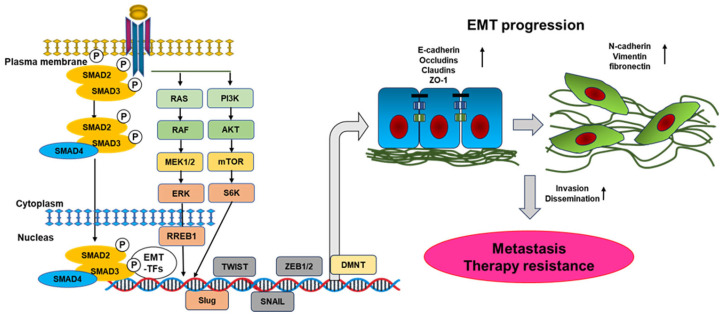
Transforming growth factor-β (TGF-β) has attracted attention as a tumor suppressor because of its potent growth-suppressive effect on epithelial cells. Dysregulation of the TGF-β signaling pathway is considered to be one of the key factors in carcinogenesis, and genetic alterations affecting TGF-β signaling are extraordinarily common in cancers of the gastrointestinal system, such as hereditary nonpolyposis colon cancer and pancreatic cancer. Accumulating evidence suggests that TGF-β is produced from various types of cells in the tumor microenvironment and mediates extracellular matrix deposition, tumor angiogenesis, the formation of CAFs, and suppression of the anti-tumor immune reaction. It is also being considered as a factor that promotes the malignant transformation of cancer, particularly the invasion and metastasis of cancer cells, including epithelial-mesenchymal transition. Therefore, elucidating the role of TGF-β signaling in carcinogenesis, cancer invasion, and metastasis will provide novel basic insight for diagnosis and prognosis and the development of new molecularly targeted therapies for gastrointestinal cancers. In this review, we outline an overview of the complex mechanisms and functions of TGF-β signaling. Furthermore, we discuss the therapeutic potentials of targeting the TGF-β signaling pathway for gastrointestinal cancer treatment and discuss the remaining challenges and future perspectives on targeting this pathway.
转化生长因子-β(TGF-β)因其对上皮细胞具有强烈的生长抑制作用而被视为肿瘤抑制因子。TGF-β 信号通路的失调被认为是致癌的关键因素之一,影响 TGF-β 信号的遗传改变在胃肠道癌症中非常常见,如遗传性非息肉病性结肠癌和胰腺癌。越来越多的证据表明,TGF-β 由肿瘤微环境中的各种细胞产生,并介导细胞外基质沉积、肿瘤血管生成、CAFs 的形成以及抑制抗肿瘤免疫反应。它也被认为是促进癌症恶性转化的因素,特别是癌细胞的侵袭和转移,包括上皮-间充质转化。因此,阐明 TGF-β 信号在致癌作用、癌症侵袭和转移中的作用将为胃肠道癌症的诊断和预后提供新的基础见解,并为开发新的分子靶向治疗方法提供基础。在这篇综述中,我们概述了 TGF-β 信号的复杂机制和功能。此外,我们讨论了靶向 TGF-β 信号通路治疗胃肠道癌症的治疗潜力,并讨论了针对该通路的剩余挑战和未来展望。