Siskey Ryan L, Yarbrough Ronald V, Spece Hannah, Hodges Scott D, Humphreys Steven C, Kurtz Steven M
Exponent Inc., Philadelphia, PA 19104, USA.
3Spine, Chattanooga, TN 37402, USA.
Bioengineering (Basel). 2023 Oct 15;10(10):1198. doi: 10.3390/bioengineering10101198.
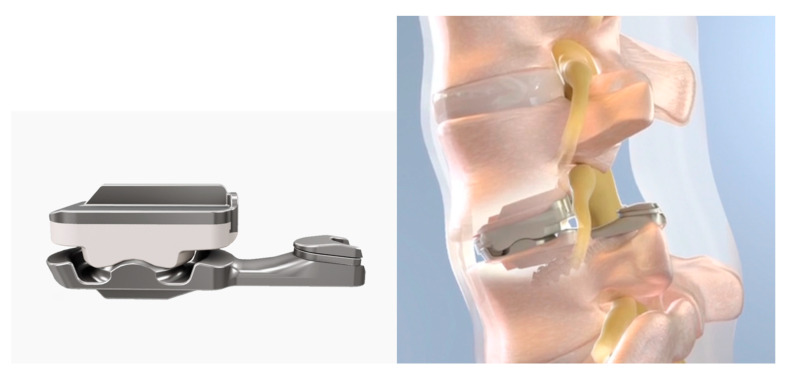
A novel, lumbar total joint replacement (TJR) design has been developed to treat degeneration across all three columns of the lumbar spine (anterior, middle, and posterior columns). Thus far, there has been no in vitro studies that establish the preclinical safety profile of the vitamin E-stabilized highly crosslinked polyethylene (VE-HXLPE) lumbar TJR relative to historical lumbar anterior disc replacement for the known risks of wear and impingement faced by all motion preserving designs for the lumbar spine.
QUESTIONS/PURPOSE: In this study we asked, (1) what is the wear performance of the VE-HXLPE lumbar TJR under ideal, clean conditions? (2) Is the wear performance of VE-HXLPE in lumbar TJR sensitive to more aggressive, abrasive conditions? (3) How does the VE-HXLPE lumbar TJR perform under impingement conditions?
A lumbar TJR with bilateral VE-HXLPE superior bearings and CoCr inferior bearings was evaluated under clean, impingement, and abrasive conditions. Clean and abrasive testing were guided by ISO 18192-1 and impingement was assessed as per ASTM F3295. For abrasive testing, CoCr components were scratched to simulate in vivo abrasion. The devices were tested for 10 million cycles (MC) under clean conditions, 5 MC under abrasion, and 1 MC under impingement.
Wear rates under clean and abrasive conditions were 1.2 ± 0.5 and 1.1 ± 0.6 mg/MC, respectively. The VE-HXLPE components demonstrated evidence of burnishing and multidirectional microscratching consistent with microabrasive conditions with the cobalt chromium spherical counterfaces. Under impingement, the wear rates ranged between 1.7 ± 1.1 (smallest size) and 3.9 ± 1.1 mg/MC (largest size). No functional or mechanical failure was observed across any of the wear modes.
Overall, we found that that a VE-HXLPE-on-CoCr lumbar total joint replacement design met or exceeded the benchmarks established by traditional anterior disc replacements, with wear rates previously reported in the literature ranging between 1 and 15 mg/MC.
The potential clinical benefits of this novel TJR design, which avoids long-term facet complications through facet removal with a posterior approach, were found to be balanced by the in vitro tribological performance of the VE-HXLPE bearings. Our encouraging in vitro findings have supported initiating an FDA-regulated clinical trial for the design which is currently under way.
已开发出一种新型腰椎全关节置换(TJR)设计,用于治疗腰椎所有三柱(前柱、中柱和后柱)的退变。到目前为止,尚无体外研究确定相对于历史上的腰椎前路椎间盘置换,维生素E稳定的高度交联聚乙烯(VE-HXLPE)腰椎TJR的临床前安全性概况,因为所有腰椎运动保留设计都面临已知的磨损和撞击风险。
问题/目的:在本研究中,我们提出以下问题:(1)VE-HXLPE腰椎TJR在理想、清洁条件下的磨损性能如何?(2)VE-HXLPE在腰椎TJR中的磨损性能对更具侵蚀性、磨蚀性的条件是否敏感?(3)VE-HXLPE腰椎TJR在撞击条件下的表现如何?
对一种双侧带有VE-HXLPE上关节面和钴铬合金下关节面的腰椎TJR在清洁、撞击和磨蚀条件下进行评估。清洁和磨蚀测试遵循ISO 18192-1标准,撞击测试按照ASTM F3295进行评估。对于磨蚀测试,对钴铬合金部件进行刮擦以模拟体内磨损。这些装置在清洁条件下测试1000万次循环(MC),在磨蚀条件下测试5 MC,在撞击条件下测试1 MC。
清洁和磨蚀条件下的磨损率分别为1.2±0.5和1.1±0.6 mg/MC。VE-HXLPE部件显示出与钴铬合金球形配对面的微磨蚀条件一致的研磨和多方向微划痕迹象。在撞击条件下,磨损率在1.7±1.1(最小尺寸)至3.9±1.1 mg/MC(最大尺寸)之间。在任何磨损模式下均未观察到功能或机械故障。
总体而言,我们发现VE-HXLPE-on-CoCr腰椎全关节置换设计达到或超过了传统前路椎间盘置换所确立的基准,文献中先前报道的磨损率在1至15 mg/MC之间。
这种新型TJR设计通过后路切除小关节避免了长期小关节并发症,其潜在的临床益处被VE-HXLPE关节面的体外摩擦学性能所平衡。我们令人鼓舞的体外研究结果支持启动一项目前正在进行的由美国食品药品监督管理局(FDA)监管的该设计的临床试验。