Department of Pathology, School of Medicine, Autonomous University of Nuevo Leon, Monterrey 64460, Mexico.
Medicina (Kaunas). 2023 Sep 23;59(10):1702. doi: 10.3390/medicina59101702.
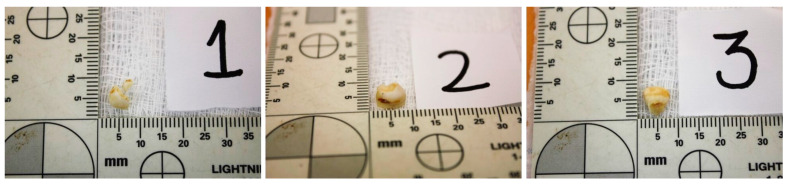
In many forensic cases, the identification of human remains is performed by comparing their genetic profile with profiles from reference samples of relatives, usually the parents. Here, we report, for the first time, the identification of the remains of an adult using DNA from the person's deciduous teeth as a reference sample. Fragments of a skeletonized and burned body were found, and a short tandem repeat (STR) profile was obtained. A woman looking for her missing son went to the authorities. When the DNA profile of the woman was compared to a database, a positive match suggested a first-degree kinship with the person to whom the remains belonged. The woman had kept three deciduous molars from her son for more than thirty years. DNA typing of dental pulp was performed. The genetic profiles obtained from the molars and those from the remains coincided in all alleles. The random match probability was 1 in 2.70 × 10. Thus, the remains were fully identified. In the routine identification of human remains, ambiguous STR results may occur due to the presence of null alleles or other mutational events. In addition, erroneous results can be produced by false matches with close family members or even with people who are completely unrelated to the victim, such that, in some cases, a probability of paternity greater than 99.99% does not necessarily indicate biological paternity. Whenever possible, it is preferable to use reference samples from the putative victim as a source of DNA for identification.
在许多法医学案例中,通过将其遗传特征与亲属(通常是父母)的参考样本进行比较来鉴定遗骸。在这里,我们首次报告了使用个体乳牙作为参考样本鉴定成人遗骸的情况。发现了一具骨骼化和烧焦的尸体的碎片,并获得了短串联重复序列(STR)图谱。一位寻找失踪儿子的妇女向当局报案。当将该妇女的 DNA 图谱与数据库进行比较时,阳性匹配表明与遗骸所属者存在一级亲属关系。该妇女将其儿子的三颗乳牙保存了三十多年。对牙髓进行了 DNA 分型。从臼齿和遗骸中获得的遗传图谱在所有等位基因上都一致。随机匹配概率为 1 比 2.70×10。因此,遗骸得到了完全确认。在常规的遗骸鉴定中,由于存在无效等位基因或其他突变事件,可能会出现模糊的 STR 结果。此外,与近亲甚至与受害者完全无关的人进行错误匹配也可能导致错误的结果,因此,在某些情况下,亲子关系概率大于 99.99%并不一定表明生物学上的亲子关系。只要有可能,最好使用假定受害者的参考样本作为鉴定的 DNA 来源。