Chang Liao, Yu Huiyun, Miao Xinyao, Wen Siqi, Zhang Bao, Li Shengbin
Bio-evidence Sciences Academy, Western China Science and Technology Innovation Harbour, Xi'an Jiaotong University, Xi'an, China.
College of Medicine and Forensics, Xi'an Jiaotong University, Xi'an, China.
Front Genet. 2021 Feb 22;12:602429. doi: 10.3389/fgene.2021.602429. eCollection 2021.
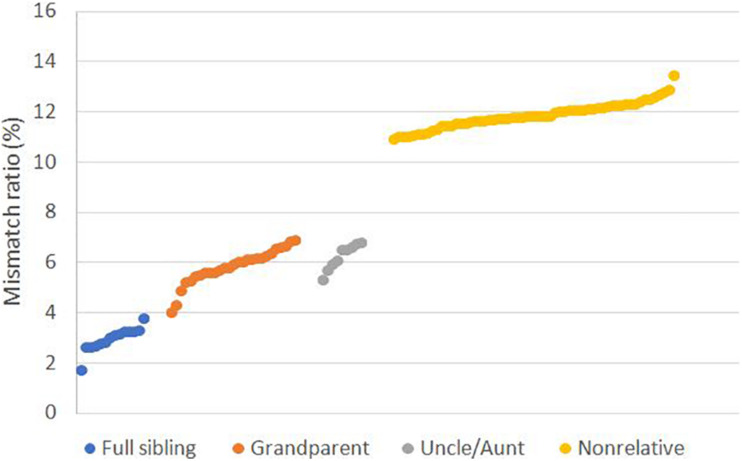
Parentage testing is routinely performed by genotyping short tandem repeat (STR) through capillary electrophoresis in the present. However, ambiguous or even misjudged paternity based on STRs happens from time to time in cases where only one putative parent is available. We analyzed STR data of 7,818,969 unrelated pairs and 75 close-relative pairs and found that although the probability of a random false match between non-relatives was 4.22 × 10, the incidence of false or ambiguous paternity results between children and first-degree relatives of their true parent was as high as 18.67%. These results highlight the risk of false inclusion of a relative or even non-relatives in parentage testing with STRs. We then validated all ambiguous STR results by targeted sequencing with a custom panel containing 4,830 individual identification single nucleotide polymorphisms (IISNP), found that the ratio of mismatch loci to total SNPs was 1.78-6.95% in close relatives compared with 10.93-13.49% in unrelated pairs. Last, we reported three real cases with undetermined paternity by STRs and rectified them by dissecting with our IISNP panel. These results suggested that high-density IISNP panel can be used to identify and rectify misjudged cases effectively.
目前,亲子鉴定通常通过毛细管电泳对短串联重复序列(STR)进行基因分型来完成。然而,在只有一位推定父母可供检测的情况下,基于STR的亲子鉴定结果出现模糊甚至错误判断的情况时有发生。我们分析了7818969对无血缘关系的个体以及75对近亲个体的STR数据,发现虽然非亲属之间随机错误匹配的概率为4.22×10,但孩子与其亲生父母的一级亲属之间出现错误或模糊亲子鉴定结果的发生率高达18.67%。这些结果凸显了在使用STR进行亲子鉴定时,将亲属甚至非亲属错误纳入的风险。然后,我们使用包含4830个个体识别单核苷酸多态性(IISNP)的定制面板进行靶向测序,对所有模糊的STR结果进行了验证,发现近亲中错配位点与总SNP的比例为1.78 - 6.95%,而非亲属对中这一比例为10.93 - 13.49%。最后,我们报告了三例通过STR无法确定亲子关系的真实案例,并通过我们的IISNP面板进行分析纠正了这些案例。这些结果表明,高密度IISNP面板可有效用于识别和纠正误判案例。