Key Laboratory of Medicinal and Edible Plants Resources Development of Sichuan Education Department, School of Pharmacy, Chengdu University, Chengdu 610106, China.
Laboratory of Integrative Medicine, Clinical Research Center for Breast, State Key Laboratory of Biotherapy, West China Hospital, Sichuan University and Collaborative Innovation Center, Chengdu 610041, China.
Molecules. 2023 Oct 17;28(20):7139. doi: 10.3390/molecules28207139.
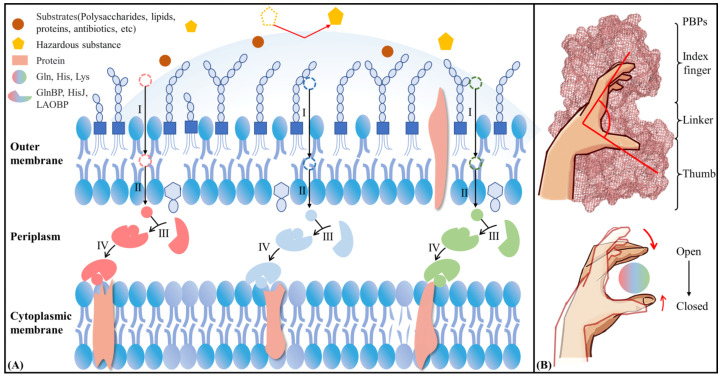
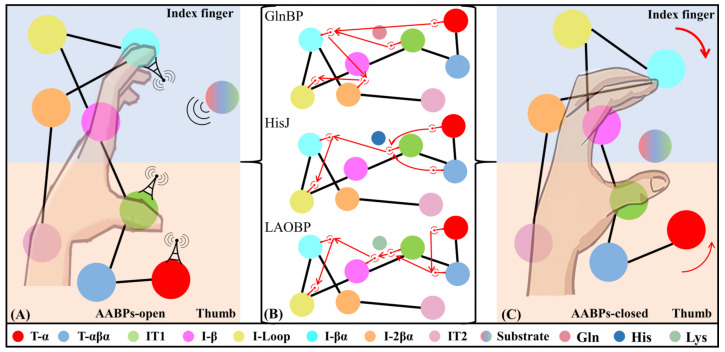
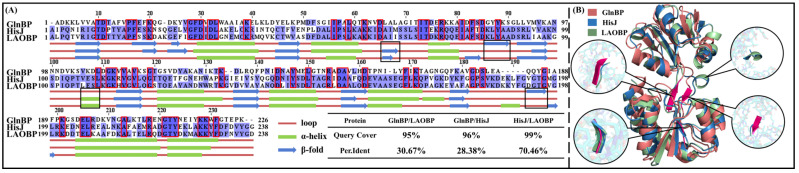
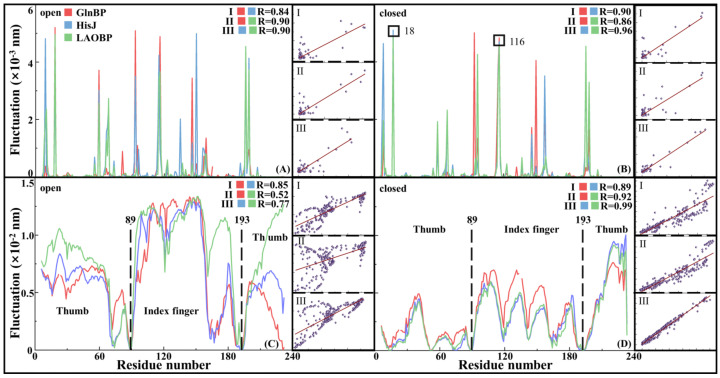
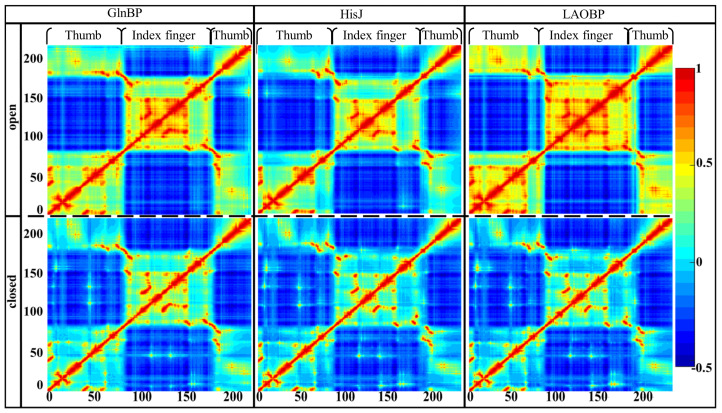
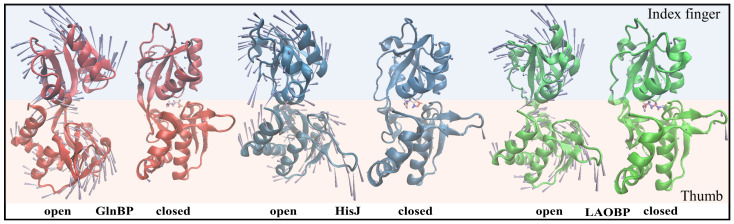
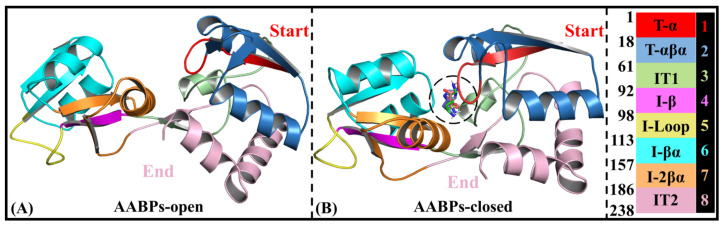
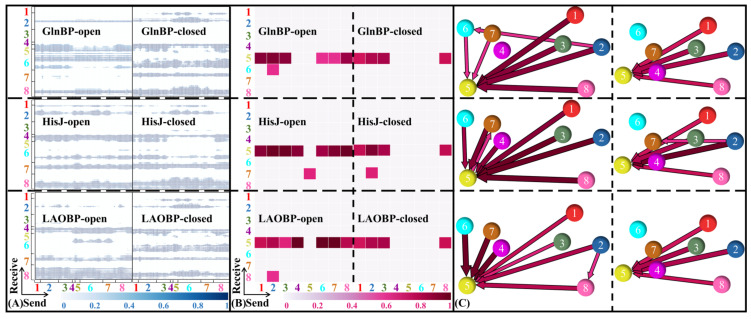
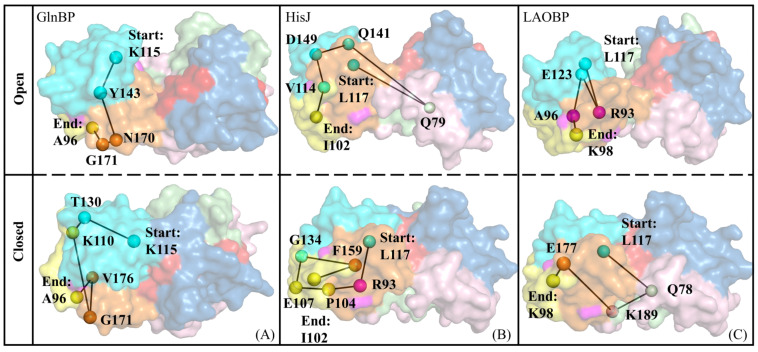
Amino acid binding proteins (AABPs) undergo significant conformational closure in the periplasmic space of Gram-negative bacteria, tightly binding specific amino acid substrates and then initiating transmembrane transport of nutrients. Nevertheless, the possible closure mechanisms after substrate binding, especially long-range signaling, remain unknown. Taking three typical AABPs-glutamine binding protein (GlnBP), histidine binding protein (HisJ) and lysine/arginine/ornithine binding protein (LAOBP) in ()-as research subjects, a series of theoretical studies including sequence alignment, Gaussian network model (GNM), anisotropic network model (ANM), conventional molecular dynamics (cMD) and neural relational inference molecular dynamics (NRI-MD) simulations were carried out. Sequence alignment showed that GlnBP, HisJ and LAOBP have high structural similarity. According to the results of the GNM and ANM, AABPs' Index Finger and Thumb domains exhibit closed motion tendencies that contribute to substrate capture and stable binding. Based on cMD trajectories, the Index Finger domain, especially the I-Loop region, exhibits high molecular flexibility, with residues 11 and 117 both being potentially key residues for receptor-ligand recognition and initiation of receptor allostery. Finally, the signaling pathway of AABPs' conformational closure was revealed by NRI-MD training and trajectory reconstruction. This work not only provides a complete picture of AABPs' recognition mechanism and possible conformational closure, but also aids subsequent structure-based design of small-molecule oncology drugs.
氨基酸结合蛋白(AABP)在革兰氏阴性菌的周质空间中经历显著的构象封闭,紧密结合特定的氨基酸底物,然后启动营养物质的跨膜运输。然而,底物结合后可能的封闭机制,特别是远程信号转导,仍然未知。以()-中的三种典型的 AABP-谷氨酰胺结合蛋白(GlnBP)、组氨酸结合蛋白(HisJ)和赖氨酸/精氨酸/鸟氨酸结合蛋白(LAOBP)作为研究对象,进行了一系列理论研究,包括序列比对、高斯网络模型(GNM)、各向异性网络模型(ANM)、传统分子动力学(cMD)和神经关系推理分子动力学(NRI-MD)模拟。序列比对表明,GlnBP、HisJ 和 LAOBP 具有高度的结构相似性。根据 GNM 和 ANM 的结果,AABP 的 Index Finger 和 Thumb 结构域表现出封闭的运动趋势,有助于捕获和稳定结合底物。基于 cMD 轨迹,Index Finger 结构域,特别是 I-Loop 区域,表现出高度的分子灵活性,残基 11 和 117 都是受体-配体识别和受体变构启动的潜在关键残基。最后,通过 NRI-MD 训练和轨迹重建揭示了 AABP 构象封闭的信号通路。这项工作不仅提供了 AABP 识别机制和可能的构象封闭的完整图景,还有助于随后基于结构的小分子肿瘤药物设计。