Unidad de Investigación en Reproducción Humana, Instituto Nacional de Perinatología-Facultad de Química, Universidad Nacional Autónoma de México, Mexico City 11000, Mexico.
Departamento de Fisiología y Desarrollo Celular, Instituto Nacional de Perinatología, Mexico City 11000, Mexico.
Int J Mol Sci. 2023 Oct 11;24(20):15085. doi: 10.3390/ijms242015085.
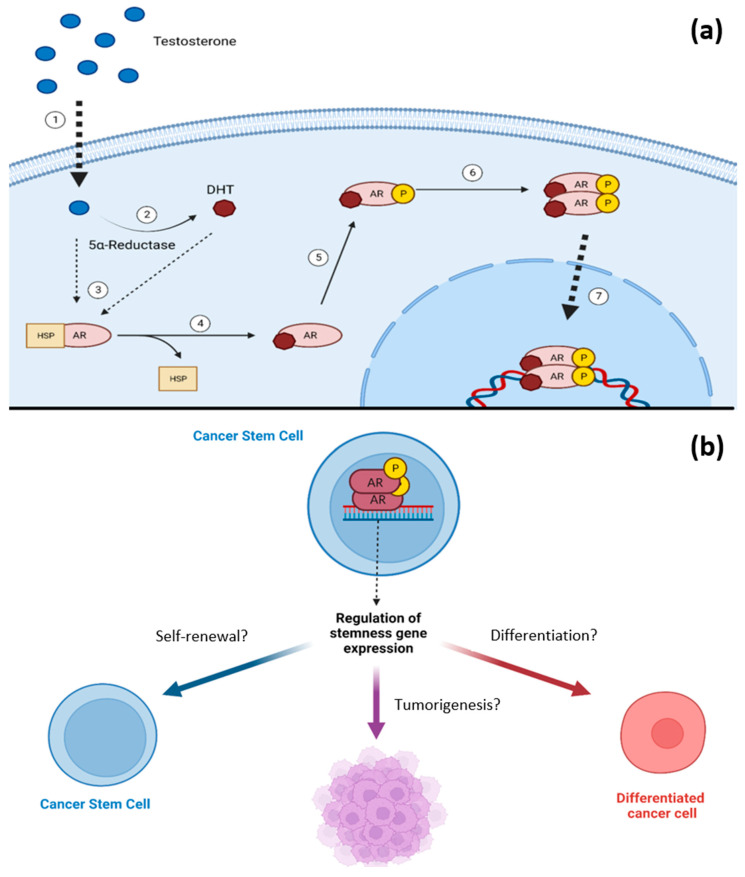
Cancer stem cells exhibit self-renewal, tumorigenesis, and a high differentiation potential. These cells have been detected in every type of cancer, and different signaling pathways can regulate their maintenance and proliferation. Androgen receptor signaling plays a relevant role in the pathophysiology of prostate cancer, promoting cell growth and differentiation processes. However, in the case of prostate cancer stem cells, the androgen receptor negatively regulates their maintenance and self-renewal. On the other hand, there is evidence that androgen receptor activity positively regulates the generation of cancer stem cells in other types of neoplasia, such as breast cancer or glioblastoma. Thus, the androgen receptor role in cancer stem cells depends on the cellular context. We aimed to analyze androgen receptor signaling in the maintenance and self-renewal of different types of cancer stem cells and its action on the expression of transcription factors and surface markers associated with stemness.
肿瘤干细胞具有自我更新、致瘤性和高分化潜能。这些细胞已在每一种癌症中被检测到,不同的信号通路可以调节它们的维持和增殖。雄激素受体信号在前列腺癌的病理生理学中发挥着重要作用,促进细胞生长和分化过程。然而,在前列腺癌干细胞的情况下,雄激素受体负调控它们的维持和自我更新。另一方面,有证据表明雄激素受体活性正向调节其他类型肿瘤(如乳腺癌或神经胶质瘤)中癌症干细胞的产生。因此,雄激素受体在癌症干细胞中的作用取决于细胞环境。我们旨在分析雄激素受体信号在不同类型癌症干细胞的维持和自我更新中的作用,以及它对与干细胞特性相关的转录因子和表面标志物表达的影响。